On August 31, 2026, the Defense Department added versions of OpenAI's ChatGPT and xAI's Grok to GenAI.mil, its central portal for generative AI. Both join Google's Gemini, which launched the portal in December 2025. The practical result is that a service member or civilian employee logging in now chooses among three frontier models inside one secured environment. The number of people who can do this is large: the department has said roughly three million personnel are eligible, and reporting around the launch put current usage at about 1.7 million people already onboarded. The news is not that the military is using AI. It is the shape of how it chose to buy it.
 OpenAI
 xAI
xAI Google
What GenAI.mil Actually Is
GenAI.mil is a walled version of commercial AI. Access requires a Common Access Card, the smartcard that authenticates Defense Department personnel, so it is not open to the public. Anything run through it is handled as Controlled Unclassified Information and cleared to Impact Level 5, the security tier that sits one step below what is required for classified material. Crucially, the government versions are carved out of the data collection that comes with ordinary consumer apps, which is the entire point. The department wanted the capability of frontier chat assistants without routing sensitive but unclassified work through consumer channels that log and train on inputs.

The models are pitched at different jobs. The ChatGPT deployment emphasizes chat, file handling, projects, and custom assistants for unclassified administrative, logistics, planning, and policy work. The Grok deployment leans toward operational support such as supply-chain management for logisticians and market research for acquisition staff. Gemini, already in place, anchors the portal. That division is worth noting because it frames the models as interchangeable tools matched to tasks rather than a single standardized system the whole department must adopt.
Why Multi-Model, and Why It Matters
The most instructive design choice is that the department did not pick one winner. It put three competing frontier models behind the same front door. For a buyer at this scale, that is a defensible strategy for reasons that apply well beyond the military. Model quality leapfrogs constantly, with different labs leading on different tasks in different months. Standardizing on one vendor locks the buyer to that vendor's roadmap, pricing, and outages. Offering several keeps competitive pressure on all of them and lets the work flow to whichever model handles a given task best.
Three models, one portal, different emphases
All three are general chat assistants. The emphases below reflect the workloads described around the launch, not an exclusive division of labor.
- •Launched the portal in December 2025
- •General assistant and document work
- •The established baseline on GenAI.mil
- •Chat, files, and projects
- •Custom assistants for repeat tasks
- •Administrative, planning, and policy drafting
- •Supply-chain support for logisticians
- •Market research for acquisition staff
- •Broader operational assistance
There is a procurement logic underneath the security story. A single portal with a shared access model and a shared data boundary means the department owns the environment while the models remain swappable inside it. If one vendor's terms change or its model falls behind, the portal does not have to be rebuilt, only re-pointed. That is the same reason many enterprises have moved away from committing an entire AI stack to one provider. The Pentagon is simply doing it under stricter security constraints and with a far larger user base.
Standardizing on one model locks you to one lab's roadmap. Offering several keeps the work flowing to whichever model is best that quarter.
Analysis of GenAI.mil's multi-model design
The Adoption Curve Is the Real Signal
The usage figures deserve scrutiny because they are unusually high for a government software rollout. An eligible base of three million with roughly 1.7 million already onboarded implies a majority of the workforce has at least an account, which is faster uptake than most enterprise AI deployments report. Two caveats keep that honest. Having an account is not the same as daily use, and onboarding figures reported around a launch tend to capture provisioning rather than sustained engagement. Still, even discounted, the direction is clear: the department is treating frontier chat as general-purpose office infrastructure, not a specialist tool for a small unit.
GenAI.mil reach, in millions of people
A majority of the eligible workforce has been onboarded. Account provisioning and sustained daily use are different measures; the figure below is the former.
Roughly 1.7 million onboarded out of about 3 million eligible implies a majority of the workforce has an account.
The workloads named around the launch reinforce that. Logistics, acquisition research, planning, and policy drafting are the connective tissue of a large organization, the same knowledge work that fills any office. That is the significance for the broader market. When the largest employer in the United States decides that a majority of its staff should have a frontier assistant for routine work, it is a data point about how normalized this software has become, not a niche defense story.
The Notable Absence
One frontier lab is missing. Anthropic's Claude is not on GenAI.mil, following a supply-chain risk designation that excluded it, a decision Anthropic has been contesting in court after declining to grant the kind of unrestricted access it said conflicted with its safety guardrails. The dispute is its own story, but the relevant point for GenAI.mil is that a multi-model portal still reflects policy and procurement decisions about which vendors are allowed in. Multi-model does not mean every model. It means several approved ones, chosen and governed by the buyer. Other providers, including Amazon Web Services, Microsoft, Nvidia, and Reflection AI, have signed separate defense agreements, so the wider government AI market is broader than any single portal.
What It Means Beyond the Beltway
Strip away the security clearances and GenAI.mil describes a pattern any organization can recognize. A single governed environment, a shared identity and data boundary, and several frontier models available inside it, selected per task and swappable over time. That is the architecture a lot of enterprises are converging on for the same reasons: model quality moves too fast to bet everything on one provider, and the durable asset is the governed environment around the models rather than any one model.
It is the same principle behind model-agnostic tooling in the commercial world. A platform such as Metir AI that routes across models from OpenAI, Anthropic, Google, and xAI is making the enterprise-scale version of the choice the Pentagon just made at national scale: keep the environment and the controls constant, and let the model underneath be the thing that changes. When the buyer with three million users and the strictest security requirements in the country lands on a multi-model design, it is a strong signal about which layer of the stack is worth owning.
What to Watch Next
The open questions are about durability, not adoption. Watch whether onboarding converts into sustained daily use, since account provisioning and habitual reliance are different things. Watch how the department handles model updates inside a Controlled Unclassified Information boundary, because the value of a swappable portal depends on being able to move to newer models without a security re-review each time. And watch whether the Claude exclusion is resolved or hardens into a precedent for how safety commitments and government access requirements are reconciled. GenAI.mil has answered the question of whether frontier AI belongs in routine government work. The next chapter is about governing it well at scale.
Sources:
- The Pentagon now has its own version of ChatGPT and Grok | TechCrunch
- Grok and ChatGPT join Gemini in Pentagon's enterprise genAI portal | DefenseScoop
- The US military gets its own ChatGPT | Defense One
- GenAI.mil, Explained: What It Is and What It Means | Military.com
- ChatGPT will be available to 3 million military users on GenAI.mil | Breaking Defense
Image credits
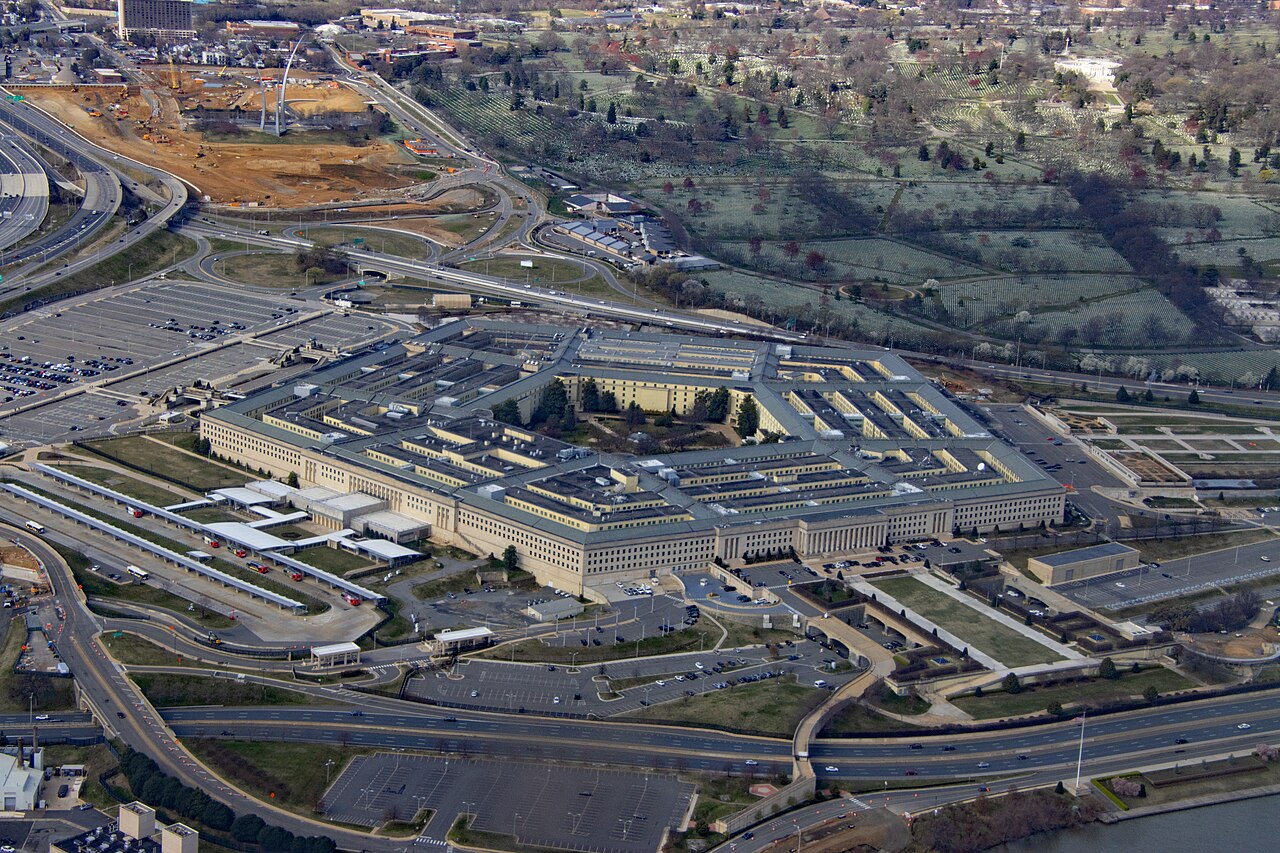
Header image: aerial photograph of the Pentagon in Arlington, Virginia, via Wikimedia Commons, licensed under CC BY 2.0. In-body photograph of the Pentagon (January 2008) by David B. Gleason via Wikimedia Commons, licensed under CC BY-SA 2.0.