Oracle reported fiscal first-quarter 2027 results on September 10, 2026, for the three months ended August 31, 2026. Revenue reached $19.3 billion, up 30% year over year, and cloud infrastructure revenue jumped 121% to $7.4 billion. The number that dominated the reaction, though, was Oracle's remaining performance obligations, or RPO: contracted backlog that reached $664 billion, up from $455 billion a year earlier. Oracle also guided to $90 billion to $95 billion in gross capital spending for fiscal 2027, a figure that puts the company's own building plans at the center of the story alongside its bookings. Shares rose roughly 7% in after-hours trading following the print, a smaller move than the swings Oracle has produced after some of its past several earnings reports.
 OpenAI
 NVIDIA
 Microsoft
 AWS
AWSWhat RPO is, and why this jump is unusual
Remaining performance obligations are contracts a customer has signed but Oracle has not yet delivered and billed for. It is a real, disclosed commitment, not a forecast, but it is also not revenue and not cash. A services company's RPO typically grows in step with its revenue, at a similar percentage rate, because contract terms and delivery timelines do not change much quarter to quarter.
Oracle's RPO has not behaved like that. It stood at $138 billion at the end of fiscal 2025 in June 2025, then reached $455 billion by the end of the very next quarter, before hitting $638 billion in June 2026 and now $664 billion. That trajectory, roughly 4.8 times over five quarters, reflects a small number of very large AI infrastructure contracts rather than the accumulation of many ordinary enterprise software deals. Oracle itself has said the increase is concentrated in "large scale AI contracts," including some in which the customer prepays Oracle or supplies its own hardware.
Oracle's backlog went from $138B to $664B in five quarters
Remaining performance obligations (RPO) at each fiscal quarter-end, in billions of dollars. The steepest jump followed Oracle's large AI infrastructure contracts signed in mid-to-late 2025.
RPO is contracted, not-yet-recognized revenue, not cash collected. The $26B quarter-over-quarter gain in Q1 FY2027 is far smaller than the $85B gain the prior quarter, even though Oracle booked over $30B in new AI cloud contracts in the quarter.
The quarter-over-quarter pattern is worth reading carefully. RPO grew by $85 billion between Q3 and Q4 of fiscal 2026, but by only $26 billion between Q4 FY2026 and Q1 FY2027, even though Oracle says it booked more than $30 billion in new AI cloud contracts during the quarter. New bookings and net RPO growth are not the same thing: RPO also falls as contracted revenue gets recognized and delivered, so a $30 billion quarter of new business can still show up as a much smaller net increase in the backlog balance. That is a normal mechanic of the metric, not necessarily a sign of slowing demand, but it is the kind of detail that gets lost when only the topline $664 billion figure is repeated.
The gap between a signed contract and a data center
A backlog number tells you what customers have agreed to buy. It does not, by itself, tell you Oracle has the data centers, power and chips in place to deliver it, or the cash to build them. That gap is the more interesting story in this earnings report than the backlog headline itself.
Oracle spent $28.5 billion on capital expenditure in the quarter, up from $8.5 billion in the same quarter a year earlier, and free cash flow ran negative by roughly $5.4 billion. For the full fiscal year, Oracle is now guiding to $90 billion to $95 billion in gross capital expenditure, while telling investors that net cash capex, after financing arrangements and customer-supplied hardware are netted out, should stay below $70 billion. That distinction between gross and net capex matters: it signals that a meaningful share of the physical buildout is being financed off Oracle's own balance sheet, through debt, equity issuance, and the same customer prepayment arrangements that show up inside the RPO figure. Fiscal 2026's actual capital spending came in at $55.7 billion, itself above the roughly $50 billion Oracle had guided to earlier that year, so the pattern of guidance rising as the year proceeds is not new.
A backlog dollar is not a revenue dollar until it is built
Oracle's RPO records demand it has already contracted. Turning that demand into recognized revenue requires spending, and raising, far more capital than Oracle's operating cash flow currently generates.
A customer commits to buy AI training or inference capacity over a multi-year term. This is booked as backlog, not revenue.
Land, power, chips and construction have to be paid for up front. FY2027 gross capex is guided to $90-95B, against $19.3B of quarterly revenue.
Debt, equity issuance, customer prepayments and customer-supplied hardware all substitute for cash Oracle does not yet have. Net cash capex is guided below $70B after these offsets.
Q1 FY2027 alone added 850MW of data center capacity and delivered more than 300,000 GPUs to AI cloud customers.
Only once capacity is delivered and used does backlog convert into reported revenue, spread across the life of each contract.
A cancelled or renegotiated contract, a financing shortfall, or a slower-than-planned build can each break this chain before the last step.
On the delivery side, Oracle said it brought 850 megawatts of additional data center capacity online in the quarter and delivered more than 300,000 GPUs to AI cloud customers, which the company described as nearly tripling the prior quarter's delivered capacity. That is real, physical progress against the backlog, and it is the piece of this report that turns a contractual promise into something customers can actually run workloads on.
The OpenAI concentration question
Oracle does not publish a customer-level breakdown of its RPO. Several financial outlets have nonetheless reported, based on the scale of Oracle's publicly disclosed multi-year compute agreement with OpenAI as part of the Stargate initiative, that roughly half of Oracle's backlog traces back to that single customer. That estimate has circulated widely since Oracle's RPO first jumped in mid-2025 and has continued to be cited through this earnings cycle. It is worth being precise about what this is: an analyst and press estimate built from the size of publicly known contracts, not a figure Oracle has confirmed in its filings.
A backlog dollar is not a revenue dollar until it is built, financed, and delivered.
On reading Oracle's Q1 FY2027 remaining performance obligations
If that concentration estimate is roughly right, it is the central risk sitting underneath an otherwise strong quarter. A services backlog spread across thousands of customers fails gracefully: a handful of cancellations barely move the total. A backlog concentrated in one or two AI labs is far more sensitive to those specific customers' funding, revenue growth, and continued need for the exact capacity contracted. Oracle is, in effect, underwriting a long-duration bet that a small number of AI labs will keep growing into the capacity it is building for them, financed substantially by debt and equity that Oracle itself has to service regardless of how that bet plays out.
How this compares to the hyperscalers
Oracle is not alone in reporting a large AI-driven cloud backlog this earnings season. Amazon's AWS segment reported RPO of $496 billion at the end of its second quarter of 2026, on quarterly AWS revenue of $42.2 billion, up 36.7% year over year. Alphabet's Google Cloud reported a backlog of $514 billion against quarterly cloud revenue of $24.8 billion, up 82% year over year. Both are large, both are growing fast, and both sit inside companies with other profitable, diversified businesses funding much of the buildout.
Measured against each company's own most recent quarterly revenue, Oracle's backlog is roughly 34 times its quarterly revenue, compared with about 12 times for AWS and 21 times for Google Cloud. That ratio is a rough, self-calculated comparison rather than a figure any of the three companies publishes, and Oracle's total revenue base includes its legacy database and applications business alongside cloud, which understates the comparison somewhat. Even accounting for that, the gap is large enough to make a structural point: Oracle is running a much bigger bet, relative to its existing scale, than Amazon or Alphabet are running relative to theirs. Where AWS and Google Cloud are large, profitable businesses adding an AI layer on top of an already-diversified cloud franchise, Oracle's growth is disproportionately a single, concentrated wager on being the infrastructure layer for a small number of frontier AI labs, funded with debt and equity raised specifically for that purpose. That is closer to the economics of a dedicated "neocloud" AI infrastructure provider than to a traditional diversified hyperscaler, even though Oracle is a much larger and older company than most neoclouds.
What the guidance implies
Oracle raised its full fiscal 2027 revenue outlook to at least $90 billion, which would represent roughly 34% growth over fiscal 2026's revenue, and guided non-GAAP earnings per share to $8.10 for the year. For the second quarter of fiscal 2027, Oracle guided to total revenue growth of 30% to 34% and cloud revenue growth of 64% to 71%. Those numbers assume the delivery pace seen in Q1, roughly 850 megawatts of capacity and 300,000-plus GPUs per quarter, continues or accelerates, funded by the capital plan Oracle has now laid out.
The takeaway
Oracle's Q1 FY2027 results are a genuine confirmation of AI infrastructure demand: revenue growth accelerated, cloud infrastructure revenue more than doubled year over year, and the backlog beat analyst expectations even after a year of already-extraordinary growth. They are also a reminder that a backlog is a promise, not a delivered product. Converting $664 billion of contracted demand into recognized revenue requires Oracle to keep raising and spending tens of billions of dollars a year, on schedule, largely on behalf of a customer base that press reporting suggests is unusually concentrated in one AI lab. Whichever cloud ultimately wins the largest share of that AI infrastructure buildout, the more durable value for most enterprises sits one layer up, in tools that are not locked to a single AI provider's roadmap or a single cloud's capacity constraints. That portability, being able to run a workload against whichever model and infrastructure fits it best rather than being contractually tied to one vendor's backlog, is the same principle Metir AI applies at the application layer.
Sources:
- Oracle Announces Q1 Results Driven by Triple Digit Growth in Cloud Infrastructure Revenues | Oracle Investor Relations
- Oracle Announces Record Q4 and FY 2026 Results Driven by Cloud Infrastructure & Cloud Applications | Oracle Investor Relations
- Oracle Announces Fiscal 2025 Fourth Quarter and Fiscal Full Year Financial Results | Oracle Investor Relations
- Oracle has $455bn in remaining performance obligations at end of Q1 2026 | Data Center Dynamics
- Oracle Q1 FY2027 earnings beat as cloud infrastructure revenue doubles | Yahoo Finance
- Oracle Q1 2027 Earnings: Cloud Infrastructure Revenue Doubles, $90B Guidance Set | 24/7 Wall St.
- Oracle earnings preview: AI spending, cloud growth and a $638 billion backlog in focus | investinglive
- Oracle Delivers Q4 FY 2025 Results With 27% Cloud Growth, RPO Hits $138 Billion | Futurum Group
- Oracle Q3 FY 2026 Earnings Driven by OCI AI Infrastructure Demand | Futurum Group
- Oracle spent $55.7B on data centres, plans to raise $40B more | TNW
- Alphabet Q2 2026 earnings takeaways: Google Cloud revenue jumps 82%, stock sinks on capex hike | CNBC
- AWS Backlog Surpasses $496B, Signals Potential $1 Trillion Revenue Milestone | KuCoin
- Amazon (AMZN) Q2 2026 Earnings: Revenue Beats, AWS Surges 37% | Webull
- Oracle Corporation Announces Promotion of Clay Magouyrk and Mike Sicilia to CEOs; Safra Catz Appointed Executive Vice Chair | Oracle Investor Relations
Image credits
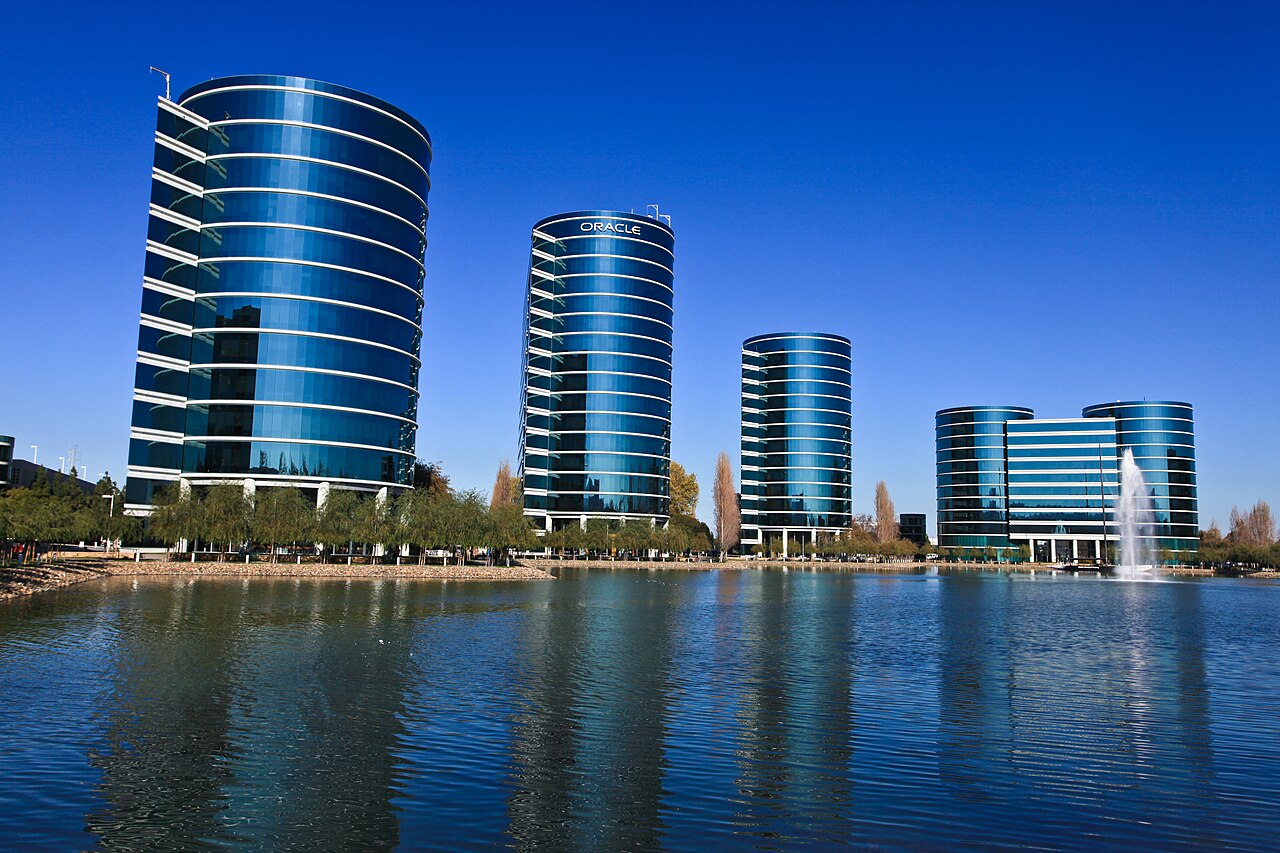
Header image: Oracle's headquarters campus at Redwood Shores, California, showing the company's cylindrical glass towers, photographed by Håkan Dahlström via Wikimedia Commons, licensed under CC BY 2.0. In-body photograph: a single Oracle Redwood Shores headquarters tower, photographed by King of Hearts via Wikimedia Commons, licensed under CC BY-SA 3.0. No photograph exists of Oracle's Q1 FY2027 earnings call or of the specific data centers this quarter's capex funds, so both images depict the company's headquarters campus rather than the event or the infrastructure itself.