OpenAI is reportedly weighing two decisions that would reshape how a frontier AI lab relates to both the public markets and the federal government. According to reporting first surfaced by The New York Times and since covered by multiple outlets, OpenAI has discussed offering the US government a roughly 5% equity stake, valued in various reports at somewhere between $43 billion and $50 billion, as part of a broader idea to share AI-generated wealth with the public. Separately, the company's advisers are said to be leaning toward delaying its initial public offering until 2027 rather than accept a lower valuation than the roughly $1 trillion target chief executive Sam Altman reportedly wants. Neither decision is final. Both are worth taking seriously, and worth being precise about what is confirmed versus what is still reported and exploratory.
 OpenAI
What is actually confirmed
Three things here are on firmer ground than the rest of the story. First, OpenAI confidentially filed draft IPO paperwork with the US Securities and Exchange Commission in June 2026, a step the company itself has acknowledged. A confidential filing lets a company begin the formal process while keeping financials private until closer to launch, and it does not commit the company to any particular listing date. Second, OpenAI's 2025 financials, reported via leaked and subsequently audited documents covered by the Financial Times and others, show revenue of $13.07 billion against a net loss of $38.53 billion attributable to the company. Third, OpenAI closed a $122 billion funding round in March 2026 at an $852 billion valuation, its most recent priced private mark.
Revenue tripled. The loss grew faster.
OpenAI's reported 2025 revenue versus its net loss attributable to the company, in billions of dollars.
Revenue rose from $3.7B in 2024 to $13.07B in 2025. The $38.53B net loss includes a $41.55B non-cash charge tied to OpenAI's October 2025 conversion to a for-profit public benefit corporation; the underlying operating loss was a smaller, though still large, $20.92B.
The net loss figure deserves a footnote most headlines skip. Of that $38.53 billion, a large share, about $41.55 billion, is a non-cash charge tied to OpenAI's October 2025 conversion from a nonprofit structure into a for-profit public benefit corporation. Strip that one-time accounting event out and the underlying operating loss was $20.92 billion on $34 billion in total costs and expenses, still a very large number, but a different one than the headline net loss suggests. Both figures matter for different reasons: the operating loss shows how the actual business is running, while the net loss is what shows up on the audited income statement an IPO prospectus would eventually have to disclose.
The reported 5% stake and the "Public Wealth Fund" idea
The equity-stake proposal is, by every account so far, exploratory. Reporting describes it as raised by Altman in early discussions with US officials, still at a conceptual stage, with no final agreement reached. The idea reportedly draws on the model of Alaska's Permanent Fund, which distributes returns from state oil investments to residents, applied here to AI-driven economic gains instead.
The proposal draws inspiration from Alaska's Permanent Fund: distributing the returns of a resource, in this case AI, broadly to the public rather than concentrating them in private hands.
Reported framing of OpenAI's 'Public Wealth Fund' idea
The dollar figure attached to the stake moves depending on which valuation it is measured against. Five percent of OpenAI's confirmed $852 billion March 2026 valuation is about $42.6 billion; five percent of the $1 trillion figure floated for a future IPO is $50 billion. That is the likely source of the $43-50 billion range appearing across coverage. It is worth being explicit that this would very likely require Congressional approval to structure and fund, and multiple reports note it remains unclear whether other AI companies with a stake in the outcome, including Anthropic, Google, and Meta, would support or match such an arrangement. A single company volunteering equity to the government is a materially different governance precedent than an industry-wide standard, and right now this is the former, proposed, not the latter, established.
Why the IPO might wait until 2027
On the listing timeline, reporting attributed to The New York Times describes OpenAI's advisers presenting two paths: wait until 2027 and pursue the roughly $1 trillion valuation, or list sooner at a lower number. Altman reportedly called any reduction to the trillion-dollar target a "non-starter." OpenAI's chief financial officer has reportedly told associates that a 2027 listing is under consideration. The market reaction to this reporting was itself notable: shares in SoftBank, a major OpenAI investor, fell sharply on the news, a sign of how closely tied SoftBank's own valuation has become to OpenAI's eventual public price.
The trillion-dollar gap Altman won't close
Current private valuations versus OpenAI's reported IPO target, in billions of dollars. The target bar is a reported goal, not a priced round.
OpenAI closed a $122B round at an $852B valuation in March 2026; Anthropic closed a Series H at $965B in June 2026. The $1 trillion figure is what OpenAI's advisers have reportedly floated for a 2027 listing, a target Sam Altman has reportedly refused to lower.

The valuation math is the part worth sitting with. A $1 trillion target against $13.07 billion in 2025 revenue is roughly a 76x revenue multiple, a level that would sit well outside any sustained public technology valuation on record. That gap is exactly why holding the line matters to Altman and exactly why it is a live risk to the timeline: public investors, unlike private round participants, get to set the price through an open order book, and a large first-day discount would be a costly and visible outcome for a company this closely watched. Waiting a year gives OpenAI more revenue growth to point to and more room to argue the multiple down without cutting the headline number.
How OpenAI's path compares to Anthropic's
Anthropic is moving on a similar but distinct track. It confidentially filed its own draft S-1 in June 2026 after closing a $965 billion Series H, and by mid-July had bankers scheduling investor meetings, a step further along the standard IPO playbook than OpenAI has publicly confirmed reaching. Neither company's valuation is a public-market price yet, and the same caution applies to both: a private financing round is negotiated with a small set of investors, while an IPO hands the pricing pen to the open market. Which of the two frontier labs lists first, and at what multiple, will be a genuine data point for how public capital prices AI companies once the story moves from private narrative to audited disclosure.
 Anthropic
What it means for anyone building on these models
None of this changes today's API pricing or product terms. But a company simultaneously discussing a government equity stake, weighing a delayed IPO, and carrying a $38.5 billion net loss is a useful reminder that even the largest AI labs are working through real structural and financial uncertainty, not operating from settled ground. That is exactly the kind of moment where betting a product entirely on one vendor's roadmap, pricing, or corporate status carries real risk. A model-agnostic approach, routing tasks to whichever provider fits best rather than locking into a single lab, is one straightforward way for builders to stay insulated from a single company's cap-table events. Platforms like Metir AI exist to make that kind of provider flexibility the default rather than a migration project.
The takeaway
Two threads are worth separating cleanly. The IPO delay to 2027 is reported and plausible, backed by named sourcing and a coherent financial logic: hold the valuation line, let revenue catch up. The 5% government equity stake is earlier and thinner, a conceptual proposal raised in conversations, not a term sheet, not yet requiring the Congressional approval it would likely need, and not yet endorsed or matched by any other AI company. Both are worth watching precisely because of what they would establish if they happen: a real government stake in a frontier AI lab, and a public listing priced against one of the largest disclosed net losses any private technology company has carried into a debut.
Sources:
- OpenAI Reported To Discuss Offering U.S. Government a 5% Stake | CoinDesk
- OpenAI Offers 5% Equity to US Government Ahead of Potential 2027 IPO | Crypto Briefing
- OpenAI Discusses 5% Government Stake Ahead of Planned IPO | American Bazaar
- OpenAI May Delay IPO to 2027 as Sam Altman Holds Firm on $1 Trillion Valuation | Business Today
- OpenAI IPO Delay Sends SoftBank Down $38 Billion: Altman Refuses Any Cut to $1 Trillion Target | TechTimes
- OpenAI Weighs Delaying Its IPO to 2027 as Altman Holds Out for a $1 Trillion Valuation | HNGN
- OpenAI Lost $38.5 Billion in 2025: Audited Financials Expose $17B Azure Dependency | TechTimes
- OpenAI's $1 Trillion Ambition Could Delay Its IPO | TheStreet
- Anthropic Moves Closer to Mega-IPO as Bankers Line Up Investor Meetings | CNBC
- Anthropic Confidentially Files for IPO After Raising $65 Billion at a $965 Billion Valuation | Fortune
Image credits
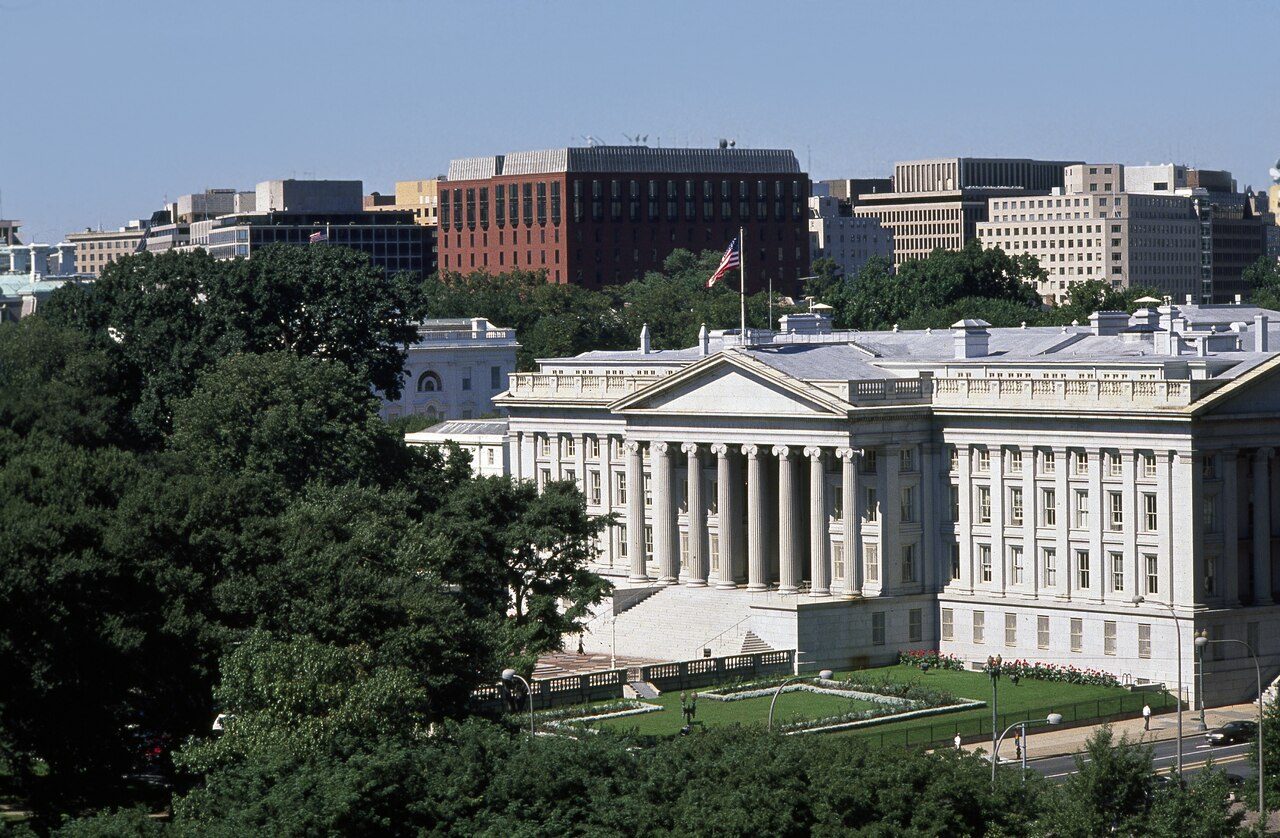
Header image: an aerial view of the U.S. Treasury Department building in Washington, D.C., photographed by Carol M. Highsmith, from the Carol M. Highsmith Archive at the Library of Congress, via Wikimedia Commons, in the public domain. In-body photograph of Sam Altman speaking at TED in 2025, by Steve Jurvetson via Wikimedia Commons, licensed under CC BY 2.0.