On October 21, 2026, Google Cloud announced that OpenAI models are coming to Model Garden, its catalogue of more than 200 first-party, third-party and open models. Three models are included, GPT-6 Astra, GPT-6.1 Sol and GPT-6 Luna, and they are in private preview for select enterprise customers, with general availability expected within weeks according to Techzine and Tech Times. The announcement matters less as a product launch than as a change in how the three largest closed-model families are bought. This article lays out what was announced, what is still missing, and how the move fits a year of loosening cloud exclusivity.
 OpenAI
 Google Cloud
 Microsoft
 AWS
 Anthropic
What was announced
According to Techzine Global, the three models are positioned by OpenAI as follows: GPT-6 Astra for heavy work such as coding, computer use and scientific research; GPT-6.1 Sol as a model close to Astra in intelligence at lower cost; and GPT-6 Luna as a fast, low-cost model for everyday work at scale. Sales run through the Google Cloud Marketplace, and usage appears on a single invoice that counts toward existing cloud commitments and Flexible Savings Plans.
On the developer side, Techzine reports that Codex CLI and Desktop workflows can already connect for inference, while support for Gemini for Business and Google Antigravity will arrive later. Tech Times adds that Codex itself is slated to come to Google Cloud.
Google Cloud VP of Product Management Michael Gerstenhaber framed the move around workload fit, saying "Modern enterprise AI requires that each workload be matched to the right model," as quoted by Techzine. OpenAI president Greg Brockman, quoted by Tech Times, called it "an important step in making our most capable models and Codex available where customers are already building."
Modern enterprise AI requires that each workload be matched to the right model.
Michael Gerstenhaber, Google Cloud, as quoted by Techzine
Why billing is the real story
Most enterprises do not buy AI models one contract at a time. They draw down a cloud commitment negotiated with finance and procurement, and any spend outside it needs a new approval path. By routing OpenAI usage through Marketplace and letting it count toward committed spend, Google Cloud removes the procurement step that usually slows adoption of a new vendor. Tech Times reports that GPT-6 usage counts toward Committed Use Credits and draws down Flexible Savings Plans.
This is an analytical inference rather than a reported fact, but the logic is consistent: when a buyer already holds a large commitment, the cheapest model to adopt is often the one that fits inside it. Model price per token then competes with the price of opening a second vendor relationship.
Reference API rates for the three models
US dollars per million tokens, OpenAI direct API rates as cited by Tech Times. Google Cloud has not published its own Model Garden rates.
One caution on pricing. Tech Times lists reference rates from OpenAI's direct API, shown above, and states that Google Cloud has not published its own Model Garden rates for these models. The chart therefore shows what the models cost elsewhere, not what a Google Cloud customer will pay. The spread between the three tiers, a factor of 100 between Astra and Luna on output tokens, is the practical reason tiered routing matters.
Data governance: what is and is not live
Per Techzine and Tech Times, prompts, context and outputs stay within the customer's data perimeter and are not used to train models, and the models run on Google Cloud infrastructure behind isolated gateways. Tech Times also lists Dedicated Serving Instances for reserved compute and VPC Service Controls to keep inference traffic inside a customer's project boundary. Zero Data Retention and Confidential Compute are described as coming soon, so regulated buyers with strict retention requirements should treat the preview as incomplete until those arrive.
The path to this announcement
OpenAI's distribution widened in steps. Techzine notes that GPT models were initially exclusive to Microsoft Azure, that AWS followed in summer 2025, and that Google previously supplied compute capacity to OpenAI under a 2025 deal without OpenAI models appearing in Google's general model selection.
How OpenAI distribution widened across clouds
Timeline assembled from the reports cited in this article.
- 1
Through 2025: Azure-centred
GPT models initially exclusive to Microsoft Azure
- 2
Summer 2025: AWS access
OpenAI models reach AWS (Techzine)
- 3
Feb 2026: AWS Frontier deal
AWS named exclusive third-party distributor of the Frontier agent platform
- 4
Apr 27, 2026: Exclusivity removed
Microsoft licence becomes non-exclusive, runs through 2032
- 5
Oct 21, 2026: Google Cloud
GPT-6 Astra, GPT-6.1 Sol, GPT-6 Luna in Model Garden, private preview
The most consequential step came on April 27, 2026. VentureBeat reported that Microsoft and OpenAI amended their partnership so that Microsoft's licence to OpenAI intellectual property is now non-exclusive and runs through 2032 on a fixed calendar date, replacing the earlier trigger tied to an AGI declaration. Microsoft no longer pays OpenAI a revenue share on Azure-accessed models, while OpenAI continues to pay Microsoft a 20% revenue share through 2030, subject to a total cap that has not been disclosed. Microsoft keeps about 27% ownership of OpenAI's for-profit entity. OpenAI's statement says Microsoft remains its primary cloud partner, and VentureBeat noted that the meaning of "first on Azure" is deliberately ambiguous.
That followed Amazon's February investment of up to $50 billion ($15 billion upfront, $35 billion conditional), alongside an expanded AWS agreement of $100 billion over eight years and AWS becoming the exclusive third-party distributor for OpenAI's Frontier platform, as reported by VentureBeat.

Competing readings
Reasonable analysts read the deal in different ways, and the evidence supports more than one:
- Customer-choice reading. Gerstenhaber's quote and the single-invoice design point to a catalogue strategy in which Google Cloud sells the best model per workload, including rivals'. Google says it is the only hyperscaler offering all three leading closed-model families (Gemini, Claude and GPT-6), a claim reported by Techzine and Tech Times that we have not independently verified.
- Revenue-reach reading. OpenAI's revenue chief Denise Dresser reportedly wrote that the earlier Microsoft arrangement "limited our ability to meet enterprises where they are," per VentureBeat. Selling inside every major cloud's commitments is a direct answer to that limit.
- Concentration-risk reading. Tech Times argues that consolidating several model families on one cloud concentrates infrastructure risk, which runs against typical multi-cloud guidance. A single invoice is convenient, but an outage or policy change at one provider would affect every model behind it.
Techzine also reports that Google has kept its own Gemini models deliberately exclusive to its cloud, which makes the contrast with its handling of OpenAI notable. Whether that asymmetry holds is an open question.
Implications for teams choosing models
- Model choice and cloud choice are separating. A buyer committed to one cloud can now reach several labs' models without a second contract, which lowers the switching cost between models while raising the dependency on the cloud.
- Evaluate on your own workload. Three tiers with a hundredfold price spread reward routing easy tasks to the cheap tier. Teams that keep prompts, evaluations and history portable can test those splits without rewriting integrations. Metir is built around that model-agnostic idea, letting teams compare models from different labs in one workspace.
- Read the preview terms. Private preview, missing Zero Data Retention and unpublished Model Garden pricing are all reasons to hold production commitments until general availability.
What to watch next
- General availability timing and published Google Cloud rates for the three models.
- Arrival of Zero Data Retention and Confidential Compute.
- Whether AWS Bedrock availability, flagged by Amazon in April as coming in weeks, matches the Google Cloud feature set.
- Whether Anthropic's and Google's own models keep pace as buyers compare them side by side on one invoice.
Sources:
- OpenAI's models are finally fully supported on Google Cloud (Techzine Global, Oct 21, 2026)
- Google Cloud unifies GPT-6, Claude and Gemini on a single invoice for enterprise (Tech Times, Oct 22, 2026)
- Microsoft and OpenAI gut their exclusive deal, freeing OpenAI to sell on AWS and Google Cloud (VentureBeat, Apr 27, 2026)
- Everything That Happened in AI Today, Thursday, October 22 (The Neuron)
Image credits
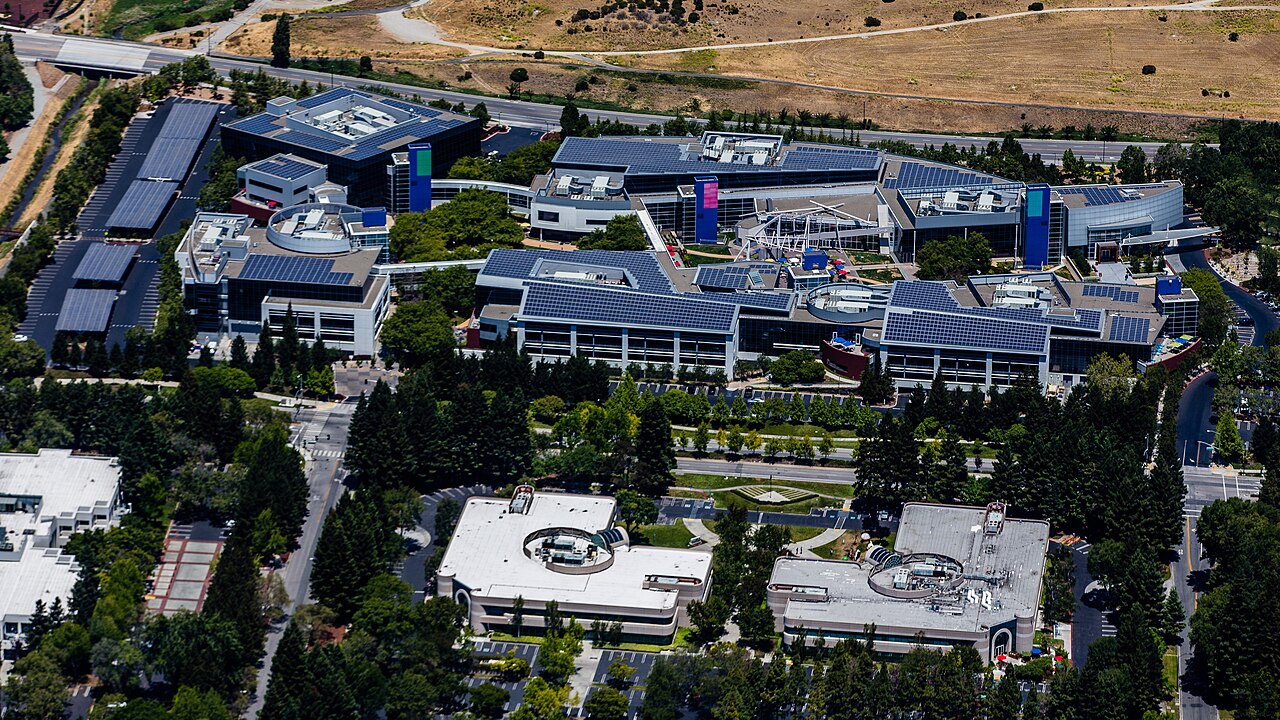
- Hero: aerial view of the Google campus, Mountain View, California, by Austin McKinley, CC BY 3.0, via Wikimedia Commons.
- In-body: Sam Altman speaking at TED (cropped), by Steve Jurvetson, CC BY 2.0, via Wikimedia Commons. Both files were reviewed visually before use.