In less than a decade, OpenAI has gone from a nonprofit research lab with idealistic ambitions to the most influential artificial intelligence company in the world. Its journey—marked by groundbreaking technology, bitter feuds, boardroom coups, and a meteoric rise to an $830 billion valuation—reads like a Silicon Valley thriller. This is the complete story of how OpenAI became the face of the AI revolution.
The Founding Vision: A Billion-Dollar Bet on Safe AI (2015)
On December 11, 2015, OpenAI was officially founded with a mission that would seem almost quaint by today's standards: to develop artificial general intelligence (AGI) that benefits all of humanity. The founding team was a who's who of tech luminaries: Sam Altman, Elon Musk, Ilya Sutskever, Greg Brockman, Trevor Blackwell, Vicki Cheung, Andrej Karpathy, Durk Kingma, John Schulman, Pamela Vagata, and Wojciech Zaremba.
Sam Altman, then president of startup accelerator Y Combinator, and Elon Musk, already famous for Tesla and SpaceX, served as co-chairs. The initial pledge was staggering: $1 billion in funding from private investors including Musk, Altman, PayPal co-founder Peter Thiel, Reid Hoffman, Jessica Livingston, and Amazon Web Services. However, only a small fraction of that billion dollars materialized in the early years.
The motivation was partly existential. Musk and Altman stated they were concerned about AI safety and the potential for catastrophe from careless development of general-purpose AI. There was also a competitive element: they worried that Google, through its 2014 acquisition of DeepMind, was racing ahead without sufficient focus on safety.
Greg Brockman, who had run technology for payments company Stripe, became chief technology officer. Ilya Sutskever, who had studied under AI pioneer Geoffrey Hinton and worked at Google Brain, became research director. The structure was deliberately nonprofit, ensuring the mission took precedence over profit.
The Early Research Years: Building the Foundation (2015-2019)
OpenAI's early years were marked by steady, if unglamorous, research progress. The lab operated in relative obscurity, publishing papers and building the technological foundations that would later shake the world.
GPT-1: The First Step (2018)
On June 11, 2018, OpenAI researchers published "Improving Language Understanding by Generative Pre-Training", introducing GPT-1—the first Generative Pre-trained Transformer. With 117 million parameters, it was a significant improvement over previous language models, proving that the Transformer architecture could be scaled for impressive results.
The breakthrough was conceptual as much as technical: instead of training models for specific tasks, GPT-1 demonstrated that a model could be pre-trained on vast amounts of text and then fine-tuned for specific applications. It was a proof of concept that would change everything.
GPT-2: Too Dangerous to Release? (2019)
On February 14, 2019, OpenAI introduced GPT-2—a direct scale-up with both parameter count and dataset size increased tenfold to 1.5 billion parameters. The model could generate remarkably coherent text, but OpenAI made a controversial decision: they would initially withhold the full model due to concerns over misinformation and malicious use.
GPT-2 became the first AI model to spark global debate on responsible release strategies. Critics accused OpenAI of fearmongering and restricting research; defenders praised their caution. The full model was eventually released on November 5, 2019, once the team determined the risks were manageable.
The decision foreshadowed tensions that would later split the company: how do you balance open research with safety concerns in an era of increasingly powerful AI?
Elon Musk: The Co-Founder Who Became an Adversary
Elon Musk's relationship with OpenAI is one of the most fascinating subplots in the company's history. As a co-founder who donated $44 million to get OpenAI off the ground, Musk was instrumental in the organization's creation.
But in 2018, Musk departed from OpenAI's board. While he initially cited a potential conflict of interest with Tesla (which was developing its own AI for autonomous driving), reports later surfaced alleging internal conflicts. According to some accounts, Musk had proposed a merger with Tesla or taking direct control of OpenAI; when the board declined, the relationship soured.
The split turned acrimonious as OpenAI shifted toward commercialization. In March 2024, Musk sued OpenAI and Sam Altman, alleging they had abandoned the company's founding mission. The lawsuit claimed that "OpenAI, Inc. has been transformed into a closed-source de facto subsidiary of the largest technology company in the world: Microsoft."
Musk alleged he had been "manipulated" into co-founding OpenAI on the basis it would be nonprofit, but that Altman and others, along with Microsoft, "established an opaque web of for-profit OpenAI affiliates, engaged in rampant self-dealing." The new lawsuit described the situation as "perfidy and deceit of Shakespearean proportions."
OpenAI fired back by releasing emails showing Musk agreeing with plans to raise more money and move away from open-source releases. Musk ultimately withdrew the lawsuit in June 2024, only to revive it in federal court in August.
The feud continues to this day, with Musk launching his own AI company, xAI, and regularly criticizing OpenAI on social media. It's a bitter divorce between a co-founder and the company he helped create.
The Pivot: From Nonprofit to "Capped-Profit" (2019)
By 2019, OpenAI faced a fundamental problem: building cutting-edge AI required vast computational resources, which required vast sums of money. Operating as a nonprofit made fundraising extremely difficult.
The solution was radical. In March 2019, OpenAI created a "capped-profit" subsidiary called OpenAI LP, a hybrid structure that would allow investment while theoretically limiting returns. Under the model, profits in excess of a 100x return would go to the nonprofit. For example, a $10 million investment would only trigger the cap after generating $1 billion in returns.
OpenAI essentially admitted it was unlikely to raise the money necessary to achieve its goals while operating as a nonprofit. But the move was controversial, particularly among early supporters who believed in the nonprofit mission.
Elon Musk was particularly incensed, tweeting: "I'm still confused as to how a nonprofit to which I donated ~$100M somehow became a $30B market cap for-profit. If this is legal, why doesn't everyone do it?"
The change commenced an ongoing internal struggle between commercialization and the founding mission to ensure AI benefits humanity—a tension that would later erupt into full-blown crisis.
The Microsoft Partnership: A Marriage of Necessity (2019-2023)
The capped-profit structure enabled OpenAI's most consequential partnership. In July 2019, Microsoft invested $1 billion in OpenAI to support building AGI with widely distributed benefits. Microsoft became OpenAI's exclusive cloud provider, with the companies jointly developing Azure AI supercomputing technologies.
But that was just the beginning. Between 2019 and early 2023, Microsoft invested an additional $2 billion, including a funding round in 2021.
Then came the big one. In January 2023, following ChatGPT's viral success, Microsoft announced a "multiyear, multibillion dollar investment" widely reported as $10 billion. Microsoft's cumulative investment in OpenAI has reportedly swelled to $13 billion.
Under the terms, Microsoft would receive three-quarters of OpenAI's profits until it recovers its investment, with additional investors taking 49% and OpenAI retaining 2% in equity. Following a recent recapitalization, Microsoft holds approximately 27% of OpenAI Group on an as-converted diluted basis.
The partnership gave OpenAI access to Microsoft's vast Azure computing infrastructure—essential for training increasingly large models. It gave Microsoft exclusive access to OpenAI's technology, which it has integrated into products from Bing to Office to GitHub Copilot.
It was a marriage of necessity that would be tested during OpenAI's darkest hour.
GPT-3 and the API Business (2020)
In June 2020, OpenAI announced GPT-3—a 175-billion-parameter behemoth that set a new benchmark for generative AI. Its human-like responses fueled applications across writing, coding, and creative industries. On June 11, 2020, OpenAI announced users could request access to the GPT-3 API, describing it as a "text in, text out" interface that could complete almost any English language task.
GPT-3 was a sensation in AI circles, spawning countless startups and demos. But crucially, OpenAI took a different approach from GPT-2: instead of open-sourcing the model, they offered it through a paid API. The business model was born.
On September 22, 2020, Microsoft announced it had licensed GPT-3 exclusively—others could still receive output from the public API, but only Microsoft had access to the underlying model.
OpenAI was no longer just a research lab. It was becoming a business.
The ChatGPT Explosion: The Fastest-Growing App in History (2022)
On November 30, 2022, OpenAI released ChatGPT to the public—and nothing would ever be the same.

Built on GPT-3.5 (a fine-tuned version of GPT-3), ChatGPT was a simple conversational interface that made powerful AI accessible to anyone. The response was immediate and unprecedented.
ChatGPT gained one million users in five days. It hit 100 million monthly active users in just two months—setting the record for the fastest-growing consumer app in history. For comparison, Instagram took 2.5 years, TikTok took 9 months, and Netflix took over 3 years to reach 100 million users.
What made this growth even more impressive: it happened with essentially zero marketing spend. No Super Bowl ads, no influencer campaigns—just an insanely useful product that spread through word-of-mouth.
OpenAI engineers said they hadn't expected ChatGPT to be very successful and were surprised by the coverage it received. It was released almost as an afterthought, a demo of GPT-3.5's capabilities.
Instead, it became a cultural phenomenon. By early November 2025, as ChatGPT approached its third anniversary, the company reported some 800 million people used the chatbot every week. ChatGPT had become synonymous with AI itself.
GPT-4 and the AI Arms Race (2023)
Riding the wave of ChatGPT's success, OpenAI released GPT-4 in March 2023—a multimodal model that could process both text and images. It was a significant leap forward in capabilities, particularly in reasoning, coding, and handling complex tasks.
GPT-4 triggered an AI arms race. Google rushed to release Bard (later Gemini), Anthropic launched Claude, and countless startups pivoted to incorporate large language models. The entire tech industry scrambled to respond.
Microsoft, armed with exclusive access to OpenAI's technology, integrated GPT-4 into Bing, Office 365, and other products. The "new Bing" with ChatGPT integration became Microsoft's biggest consumer product launch in years.
OpenAI was now at the center of the tech universe.
The Boardroom Coup: Five Days in November (2023)
Then came the most dramatic chapter in OpenAI's history—a weekend that nearly destroyed the company.
On November 17, 2023, OpenAI's board of directors ousted CEO Sam Altman. The official statement said "the board no longer has confidence in his ability to continue leading OpenAI," citing that Altman had not been "consistently candid in his communications with the board."
The details were murky, but gradually emerged. Former board member Helen Toner later explained that Altman had withheld information—for example, about the ChatGPT release and his ownership of OpenAI's startup fund. Two executives reportedly told the board about "psychological abuse" from Altman. Board members worried whether Altman was taking AI safety risks seriously enough.
Microsoft learned about the firing just one minute before it went public. Greg Brockman, OpenAI's president and co-founder, found out moments before it happened—and resigned immediately.
What happened next was unprecedented. OpenAI employees revolted. 745 of the approximately 770 employees signed a letter demanding Altman's return or threatening to leave for Microsoft. Even Ilya Sutskever, the chief scientist who had participated in the firing, signed the letter in an apparent reversal.
Microsoft CEO Satya Nadella announced he would hire Altman, Brockman, and their team to lead a new AI research division at Microsoft. OpenAI was on the verge of total collapse.
The board blinked. On November 22, Altman was reinstated. A new board was established featuring Bret Taylor (former Twitter board chair), Larry Summers (former U.S. Treasury Secretary), and Adam D'Angelo (Quora CEO, the only holdover from the board that fired Altman).
It was a stunning five-day saga that revealed the power dynamics at OpenAI: the employees and investors held more sway than the board. The attempted coup had backfired spectacularly.
The Aftermath: Leadership Exodus (2024)
The boardroom drama had lasting consequences. In May 2024, Ilya Sutskever, OpenAI's co-founder and chief scientist, left the company after almost a decade. His role in the November coup had made his position untenable.
Immediately after, Jan Leike, who led the "Superalignment" team with Sutskever, also resigned. Leike's departure was particularly pointed: he wrote on X that he had been "disagreeing with OpenAI leadership about the company's core priorities for quite some time" and that "safety culture and processes have taken a backseat to shiny products."
OpenAI disbanded the Superalignment team—which had been tasked with ensuring control over superintelligent AI and promised 20% of OpenAI's compute—just one year after announcing it.
Later in 2024, more departures followed: CTO Mira Murati (who had briefly served as interim CEO during the Altman drama), Chief Research Officer Bob McGrew, and VP of Research Barret Zoph all left in September.
The exodus of safety-focused researchers to competitors like Anthropic raised questions about OpenAI's commitment to its original mission.
The Latest Models: GPT-4o, o1, and Beyond (2024-2025)
Despite the turmoil, OpenAI continued shipping new models at a blistering pace.
In May 2024, OpenAI launched GPT-4o (the "o" standing for "omni")—a multimodal flagship integrating voice, text, and vision in one model. GPT-4o was faster, cheaper, and more capable than GPT-4.
In December 2024, OpenAI released the o1 series—models trained to "think before answering" with a private chain-of-thought where intermediate reasoning steps are computed internally before generating responses. The o1 model excelled at complex reasoning, particularly in mathematics and coding.
In December 2024, OpenAI introduced o3 and o4-mini—the smartest models the company has released to date. In evaluations, o3 makes 20% fewer major errors than o1 on difficult, real-world tasks, excelling in programming, business consulting, and creative ideation.
By February 2025, OpenAI launched GPT-4.1, which outperformed GPT-4o across the board with major gains in coding and instruction following. GPT-4.5 debuted later in February as OpenAI's largest and most capable GPT model to date.
OpenAI also released Sora, a video generation model that can create high-quality videos from text prompts—though its release was limited compared to earlier products.
The pace of releases was staggering, cementing OpenAI's position at the frontier of AI capabilities.
The For-Profit Conversion and Valuation Explosion (2024-2025)
As OpenAI's products gained traction, the company's valuation skyrocketed—and its corporate structure evolved once again.
In October 2024, OpenAI raised funding at a $157 billion valuation. But that was just the beginning.
In March 2025, OpenAI completed the largest private technology funding round in history—$40 billion at a $300 billion valuation, nearly double the previous valuation. SoftBank, Thrive Capital, Microsoft, Nvidia, and other top-tier investors participated.
But OpenAI wasn't done. By December 2025, reports emerged that OpenAI was raising another $100 billion targeting completion by Q1 2026. This round would value the company at a staggering $750-830 billion—approaching the valuation of the world's largest companies.
To enable these fundraising rounds, OpenAI completed its long-anticipated restructuring, converting from a nonprofit into a traditional for-profit public benefit corporation (PBC). The nonprofit OpenAI Foundation now owns approximately 26% of the for-profit entity, with Microsoft holding 27%.
The conversion was controversial. Elon Musk sued to block it, arguing it violated OpenAI's founding principles. After months of negotiations and regulatory approval in California and Delaware, the restructuring was completed.
The IPO on the Horizon: A $1 Trillion Company?
The for-profit conversion clears the runway for what could be one of the largest IPOs in history.
OpenAI is reportedly preparing for a U.S. IPO that could value the company at up to $1 trillion, with internal targets for a filing in H2 2026 and a 2027 listing. CEO Sam Altman has downplayed excitement about going public, but the company is clearly laying the groundwork.
The financials support the astronomical valuation. In July 2025, OpenAI reported annualized revenue of $12 billion, up from $3.7 billion in 2024—driven by ChatGPT subscriptions that reached 20 million paid users by April 2025.
But the costs are equally staggering. The company projects an $8 billion operating loss in 2025, with long-term spending of approximately $115 billion through 2029. Annual expenditures are projected to reach $17 billion in 2026, $35 billion in 2027, and $45 billion in 2028—primarily for compute and talent.
OpenAI has projected revenue will reach $200 billion by 2030, with profitability achieved as the models mature and costs stabilize. It's an audacious bet that the AI market will expand to support such massive scale.
OpenAI Today: Dominance and Challenges
As of late 2025, OpenAI occupies a unique position in the AI landscape.
Market Position: ChatGPT is the dominant consumer AI product, with 800 million weekly users. OpenAI's API powers countless applications, and its models set the benchmark others aim to beat.
Enterprise Traction: Major companies have adopted OpenAI's technology, with the API business and ChatGPT Enterprise driving revenue growth. Microsoft's integration of OpenAI tech across its product suite provides massive distribution.
Competition: But the landscape is increasingly crowded. Anthropic's Claude is competitive, particularly with developers. Google's Gemini leverages Google's distribution. Meta is pursuing open-source models. Chinese companies like DeepSeek are closing the gap. And countless startups are targeting specific niches.
Controversies: OpenAI faces criticism on multiple fronts: concerns about safety culture following the leadership exodus, copyright lawsuits from publishers and artists, questions about the sustainability of the business model, and ongoing disputes with Elon Musk.
Technical Challenges: There are whispers that the scaling laws that powered GPT's rapid improvement may be hitting diminishing returns. OpenAI's pivot to reasoning models like o1 and o3 suggests the company is exploring new architectures beyond pure scale.
The Road Ahead: What's Next for OpenAI?
OpenAI stands at a fascinating crossroads. The company that began as a nonprofit research lab has become a for-profit juggernaut pursuing a potential $1 trillion IPO. The organization founded on ideals of openness now develops closed-source models. The team that emphasized safety has seen its most prominent safety researchers depart.
Yet OpenAI has undeniably achieved its stated goal of advancing AI capabilities. ChatGPT has brought AI to the masses. GPT-4 and its successors have pushed the boundaries of what's possible. The company has created genuine economic value and enabled countless applications.
Whether OpenAI can maintain its lead remains an open question. The AI race is intensifying, with competitors investing hundreds of billions. The technical challenges are mounting. And the original mission—ensuring AGI benefits all of humanity—feels more distant as commercial pressures intensify.
But if OpenAI's history teaches us anything, it's that the company is nothing if not resilient. From Elon Musk's departure to the capped-profit pivot to the ChatGPT explosion to the November boardroom coup, OpenAI has navigated existential challenges and emerged stronger.
As Sam Altman steers the company toward an IPO and what could be the final push toward AGI, the next chapter promises to be just as dramatic as the first.
Conclusion: The AI Company That Changed Everything
In less than ten years, OpenAI has gone from ambitious nonprofit to the company that sparked the AI revolution. ChatGPT's release will be remembered as the moment AI went mainstream. The company's models have set the pace for the entire industry. And its trajectory from $1 billion in pledges to an $830 billion valuation represents one of the fastest value creation stories in tech history.
The journey has been anything but smooth—marked by leadership battles, strategic pivots, bitter feuds, and an exodus of key researchers. The company's evolution from nonprofit to capped-profit to for-profit PBC raises questions about whether OpenAI has strayed from its founding mission or simply adapted to the realities of building AGI.
But one thing is undeniable: OpenAI has fundamentally changed the world's relationship with artificial intelligence. Whether that change ultimately benefits humanity—the original goal articulated on that December day in 2015—remains the defining question of our time.
Stay informed about the latest developments in AI and the companies shaping our future. Follow the Metir AI blog for in-depth analysis of OpenAI, Anthropic, Google DeepMind, and the technologies transforming how we work, create, and think.
Image credits
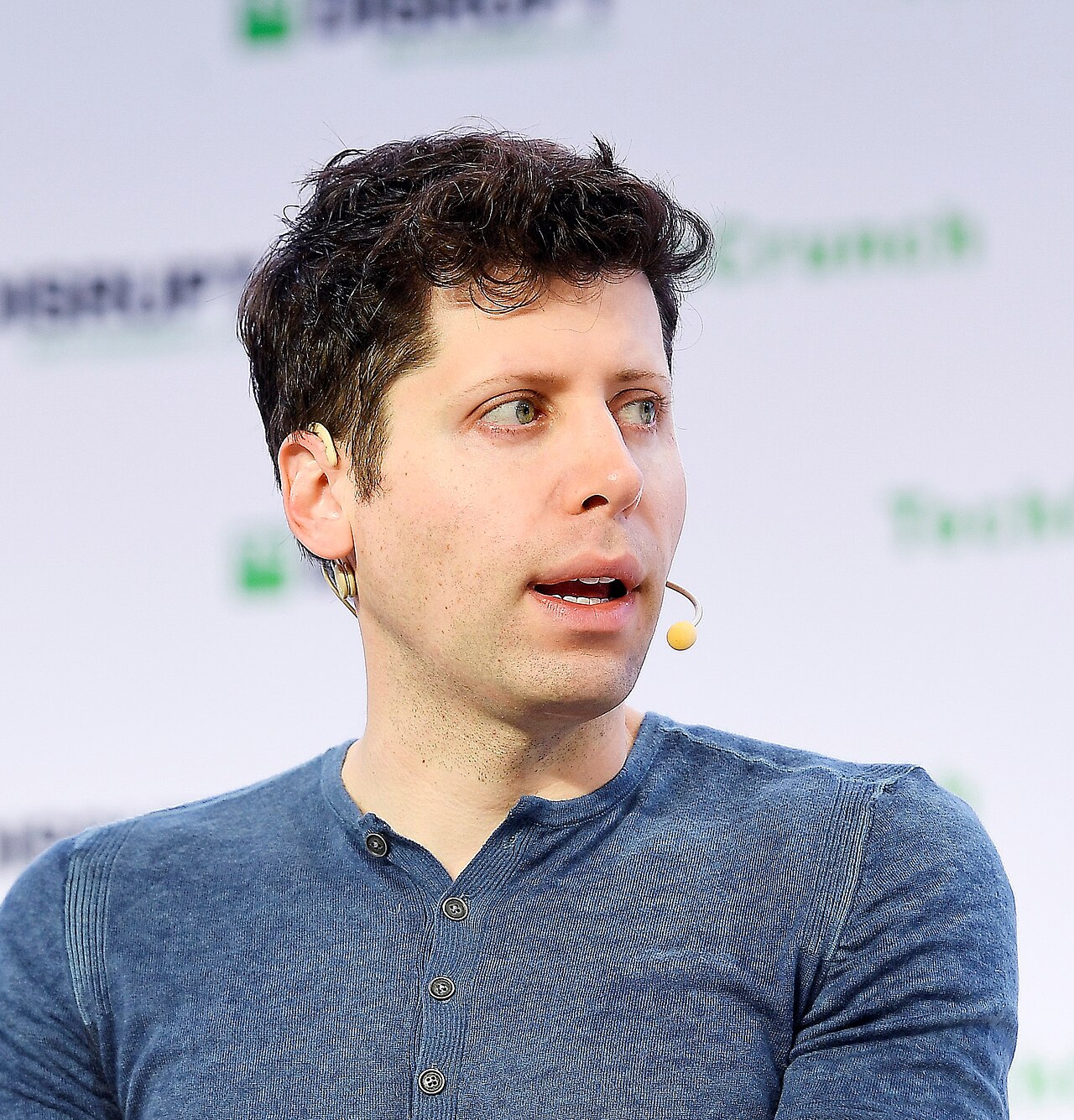
Header image: Sam Altman speaking at TechCrunch Disrupt San Francisco 2019, by TechCrunch via Wikimedia Commons, licensed under CC BY 2.0. In-body photograph of the Pioneer Building by HaeB via Wikimedia Commons, licensed under CC BY-SA 4.0.