OpenAI has disbanded its stand-alone robotics team and moved the researchers into other groups, according to a Fortune report published on November 13, 2026. The company confirmed the change to Fortune and said it is meant to speed up robotics progress rather than signal a retreat. The more interesting part is the stated reason: that general frontier models can now be applied to robots directly, so a separate robotics model effort is no longer the best structure.
What is confirmed
All of the following comes from Fortune's reporting, which is the only detailed source we found. Treat it as a single-source account until OpenAI publishes its own statement.
- The team was disbanded and staff reassigned. The robotics research team joined the main research organization, reporting to Chief Research Officer Mark Chen. The applied robotics and hardware teams joined the larger Applied organization, which reports to President Greg Brockman.
- OpenAI says this is not a retreat. A spokesperson said the company remains committed to general-purpose robots and is developing its own humanoid robot. Fortune reports Sam Altman is targeting a first public demonstration in 2027.
- The timing was visible at a conference. OpenAI had registered booth #208 at the CoRL robotics conference in Austin that week, and Fortune found it empty.
- Team size and leadership were not disclosed. The article does not say how many people were on the team or who led it, so claims about the scale of the change should be treated with caution.
 OpenAI
 NVIDIA
The technical argument: general model versus specialist
OpenAI's stated rationale is that its researchers first believed the best route was building on models such as Sora, its video generator, and that this has since changed. Fortune reports the company now says its general frontier models, including GPT-6 Astra, can be applied directly to robots.
As evidence, Fortune cites an Nvidia study in which an Astra-powered agent scored 74.8% on a simulated manipulation benchmark, versus 51.0% for the best specialized robotics models. By our arithmetic that is a gap of 23.8 percentage points.
General model vs specialist on a simulated manipulation benchmark
Success score, percent. The gap is 23.8 percentage points.
Source: Nvidia study as cited by Fortune. Simulated tasks only; real-world performance is not measured here.
Three caveats matter when reading that number:
- It is simulated. Simulation measures a policy's ability to plan and sequence manipulation under controlled conditions. It does not capture sensor noise, hardware wear, or contact dynamics in a real warehouse or home.
- It is one benchmark from one study. The article does not describe the task suite, and a single comparison cannot establish a general trend.
- The comparison set is "the best specialized robotics models". The result says a general model beat that set on this benchmark, not that specialization has no future.
The counter-arguments researchers raise
Fortune quotes academics who read the move differently, which is a useful guide to where the disagreement actually sits.
Robotics is no longer a special problem.
Guanya Shi, Carnegie Mellon, as cited by Fortune
- For the general-model view. Shi reads the reorganization as a sign that robotics is increasingly an application of general intelligence rather than its own field.
- For the data-advantage view. Russ Tedrake of MIT and Walden Robotics argues that robots gathering data in real workplaces remain an advantage, which favors companies that operate fleets rather than only those that train large models.
- On deployment constraints. Shi also notes that smaller models running onboard will still be needed, because cloud-hosted models depend on a constant network connection.
These are not mutually exclusive. A plausible reading is a split architecture, with a large general model handling planning and a small local model handling low-latency control, though neither researcher is quoted as predicting that exact design.
A pattern in OpenAI's own history
The reorganization is the third phase of a recurring story, all from Fortune's account.
| Period | What happened | Stated reason |
|---|---|---|
| 2020 | Robotics team wound down | Co-founder Wojciech Zaremba cited limited robot data and a faster path to AGI through language models |
| 2024 | Team rebuilt, with a partnership with Figure | Renewed interest in embodied models |
| February 2025 | Figure partnership ended | Figure said it would develop its own robot AI |
| November 2026 | Stand-alone team disbanded; staff moved to Research and Applied | General frontier models can be applied directly |
The earlier wind-down and this one share a logic: language and general models were judged the faster path. The difference now is that the company says the general model itself is the robot brain, and it is still building hardware.
The financial context
Fortune reports OpenAI is under pressure to cut costs and focus on core products, that Altman told the company to drop "side quests", and that it has cut efforts including Sora. The article says the company reportedly had $10.9 billion in operating losses last quarter and is seeking a new funding round while preparing for a possible IPO in early 2027. Our own coverage of the round is in OpenAI's reduced funding target at a $1.25 trillion valuation. Reading the robotics change as partly a cost-discipline decision is reasonable, but Fortune does not attribute it to finances, and OpenAI describes it as an acceleration.
What this means for robotics startups
Robotics startups that raised large rounds on the premise that robots need their own foundation model now face a sharper question: does a general model from a frontier lab close the gap? The Nvidia result is one data point for yes. The fleet-data argument is the main reason for no. Both depend on real-world, not simulated, results, which have not yet been published.
What to watch
- A real-world benchmark. Evidence from physical robots, not only simulation, would test the central claim.
- The 2027 humanoid demonstration. The one concrete milestone Fortune reports.
- Hiring and publication patterns. Whether OpenAI keeps publishing robotics research after the team merge.
- Competitor responses. Whether other labs fold embodied work into general model teams or keep dedicated groups.
Takeaways for builders
- Model choice and embodiment are converging. If general models handle manipulation, the same models used for text and code become relevant to physical tasks.
- Benchmarks need context. A simulated score is a starting point, not a deployment forecast.
- Avoid single-vendor dependence. Teams building agents that may later touch hardware benefit from being able to swap models as results change. Multi-model platforms such as Metir are one way to keep that flexibility without re-engineering a workflow.
Sources:
- Fortune: OpenAI disbands robotics team as its general models start running robots
- Daily AI digest, November 14, 2026 (headline index that surfaced the story)
Image credits
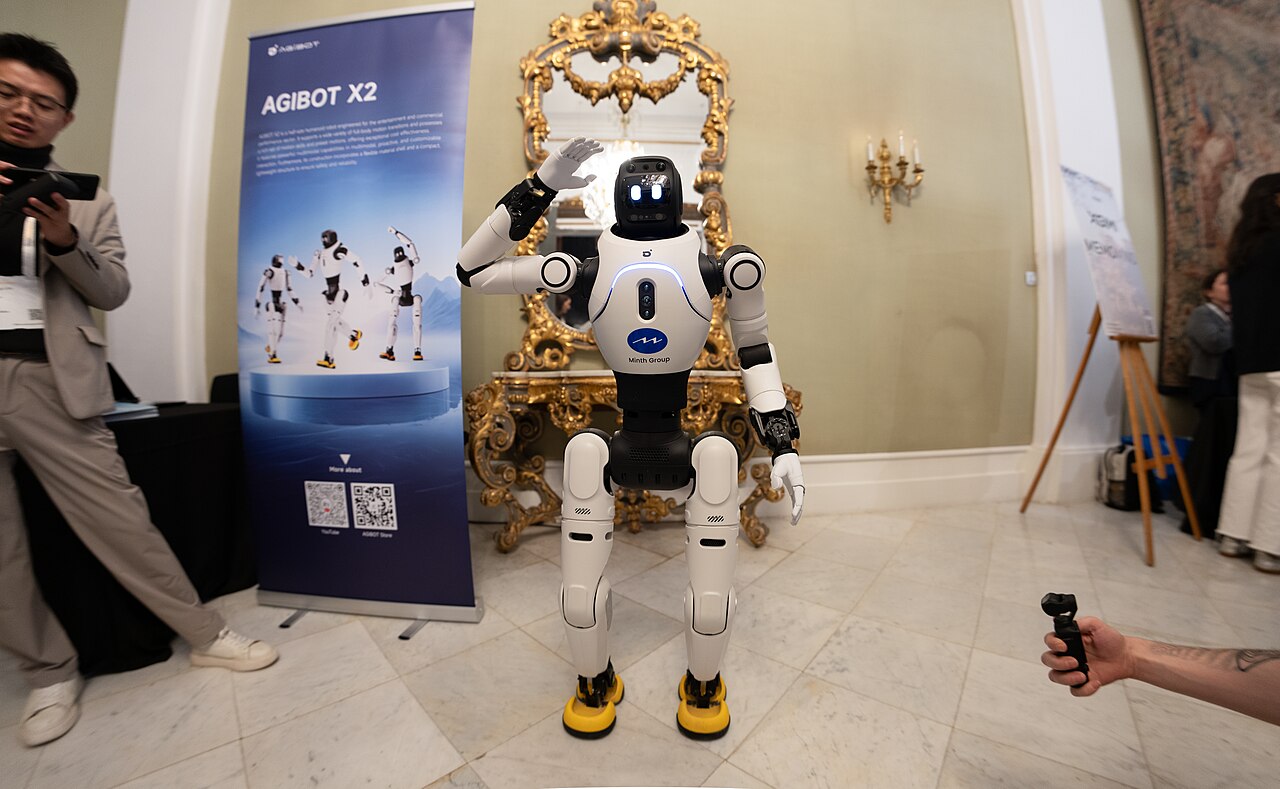
- AgiBot X2 humanoid robot, Mobile World Congress 2026: JJxFile, CC BY 4.0, via Wikimedia Commons.