On September 1, 2026, OpenAI announced that healthcare organizations can now connect their Epic electronic health record environments directly to ChatGPT for Healthcare. Epic is the system running clinical operations at roughly 40% of US hospitals, holding data for more than 325 million patients, so wiring ChatGPT into it is a distribution move as much as a product one: OpenAI is reaching clinicians inside the record system they already live in, rather than asking them to open a separate app.
 OpenAI
This is a different product from the consumer Health in ChatGPT feature OpenAI relaunched in July 2026, which let individual US users connect their own Apple Health data and personal medical records to the main chat window. The Epic integration covers ChatGPT for Healthcare, an enterprise product for hospitals and clinicians operating under a Business Associate Agreement (BAA), with its own access model, its own safety validation, and its own read-only design. The two features share a company and a chat interface. They do not share a regulatory footing, an audience, or a risk profile.
What actually shipped
The integration works in two modes. In the first, a clinician brings authorized patient context from Epic into an ordinary ChatGPT conversation, then asks questions across appointment notes, lab results, medications, and specialist documentation rather than clicking through tabs or relying on memory before a visit. In the second, ChatGPT is embedded directly inside Epic's own interface, so a clinician using supported EHR workflows never has to leave the patient chart to get an AI-assisted summary, a pre-visit review, or a clinical timeline.
Two ways in, one boundary
Both integration modes read from the same slice of the Epic chart and stop at the same line: nothing is written back.
Requires an applicable Business Associate Agreement (BAA); not available on individual accounts.
Both modes are read-only. ChatGPT can retrieve and reason over the record, identify what changed since a previous visit, and surface medication changes or unresolved follow-ups, but it cannot write anything back: no new notes, no orders, no messages to patients, and no changes to existing chart permissions. UCSF Health, one of the launch partners, has reported the integration as a time-saver for providers; UCSF's president and CEO, Suresh Gunasekaran, said that by bringing relevant information together more quickly and comprehensively, the technology has the potential to reduce time spent synthesizing data and give clinicians more time with patients.
Why read-only is the point, not a limitation
It's worth sitting with why OpenAI built the connection this way rather than treating it as an obvious minimum. A read-only integration is a deliberate risk posture, not the easiest thing to ship. Making ChatGPT capable of writing into a live medical record, placing an order, or messaging a patient would require a much higher bar of reliability guarantee than reading and summarizing does, and it would move the product from an assistant a clinician double-checks into a system whose outputs alter care directly. By stopping at retrieval and reasoning, OpenAI keeps a human in the loop for every action that actually changes a patient's record, while still letting the model do the part it is comparably good at: synthesizing a lot of scattered documentation quickly.
A model that can only read the chart still needs a clinician to act on what it finds. That is the boundary the design is built around, not an accident of scope.
Metir AI analysis
That boundary is also legible to regulators and hospital compliance teams in a way a read-write system would not be. Access requires an applicable BAA, appropriate Epic authorization, and an approved workspace configuration, which puts the integration inside the same HIPAA compliance apparatus hospitals already use to govern every other system that touches protected health information. Nothing here promises the model is free of the error modes any large language model can have. It limits the blast radius of an error to a wrong summary a clinician can catch, rather than a wrong order that reaches a patient.
The Healthcare Public Data plugin
Alongside the Epic connection, OpenAI introduced a Healthcare Public Data plugin that gives ChatGPT structured access to nine official sources, including PubMed, DailyMed, ClinicalTrials.gov, RxNorm, and the CMS Coverage database. That widens the tool beyond a single patient's chart into the reference material clinicians already consult separately: checking a drug's current warnings on DailyMed, confirming a coverage policy through CMS, or looking up trial eligibility on ClinicalTrials.gov, all from inside the same chat.
The accuracy numbers OpenAI published
Physician safety rating for EHR-context answers, and the two named accuracy scores from the Healthcare Public Data plugin.
OpenAI said all five public data sources it tested scored above 93% on accuracy; DailyMed and CMS Coverage are the two it named exact figures for.
OpenAI reported physicians rated 99.1% of ChatGPT's EHR-context responses safe across 4,363 ratings spanning 27 clinical use cases, and said accuracy on the public data plugin came in above 93% across each of the five sources it tested, naming DailyMed at 98.6% and CMS Coverage at 93.2%. Those are OpenAI's own published figures rather than independent third-party audits, which is worth noting plainly: a vendor grading its own safety validation is a lower evidentiary bar than a peer-reviewed clinical trial, even when the numbers themselves are specific and sourced.
Distribution and the competitive field
The more structural story here is where OpenAI chose to put the product. Reaching clinicians embedded inside the dominant EHR, rather than as a standalone app they have to remember to open, is a distribution strategy that mirrors how ambient clinical documentation has already scaled: Microsoft's Nuance DAX, Abridge, and Nabla have all built their traction by living inside or alongside the EHR workflow clinicians already use for every patient, not by competing for a separate slot in a clinician's day. Those products largely focus on capturing and structuring the visit conversation itself; OpenAI's Epic integration instead focuses on retrieving and reasoning over what is already documented. The two categories are adjacent rather than identical, and a hospital adopting one does not necessarily displace the other.
 Microsoft
Availability
Access is deliberately narrow and tiered. ChatGPT Enterprise customers who want the Epic integration go through their OpenAI account team rather than a self-serve signup. Eligible US ChatGPT for Clinicians users can install the Healthcare Public Data plugin directly. Individual ChatGPT accounts, of any plan, cannot access the Epic integration at all; it is built for approved organizational workspaces operating under a BAA, not for a person connecting their own account to a hospital's system.
The takeaway
The Epic integration is a narrower, more conservative product than a first glance at "ChatGPT reads your medical chart" might suggest, and that narrowness looks deliberate rather than incidental. Read-only access, BAA gating, and organization-level approval are all constraints that trade capability for auditability, in a domain where an unaccountable write action is a much more expensive mistake than an unaccountable summary. The bigger signal is distributional: OpenAI reaching clinicians through the record system 40% of US hospitals already run on is a different kind of bet than shipping another consumer health chatbot, and it says something about where OpenAI expects the durable enterprise value in health AI to sit. For any organization evaluating tools like this, the same governance question keeps surfacing regardless of vendor: how a system is scoped, gated, and audited against the systems of record it touches typically matters more than which model sits behind it, which is also why data portability and avoiding lock-in to any single provider's integration terms, an approach platforms like Metir AI are built around, is a governance property worth weighing on its own.
Sources:
- Healthcare organizations can now connect EHR and additional industry data sources to ChatGPT | OpenAI
- ChatGPT Health adds Epic integration for clinicians to import patient data | TechCrunch
- OpenAI launches Epic integration with ChatGPT for Healthcare | TechTarget
- OpenAI Brings Epic Health Records to ChatGPT for Clinicians | PYMNTS
- ChatGPT for Healthcare adds Epic integration | Becker's Hospital Review
- ChatGPT for Healthcare unveils new integrations with Epic, public health data | Fierce Healthcare
- OpenAI Connects Epic Health Records and Public Data to ChatGPT | Unite.AI
- OpenAI integrates Epic Systems to give clinicians read-only patient data access | Crypto Briefing
- Using the Epic plugin with ChatGPT and Codex | OpenAI Help Center
- ChatGPT for Healthcare | OpenAI Help Center
Image credits
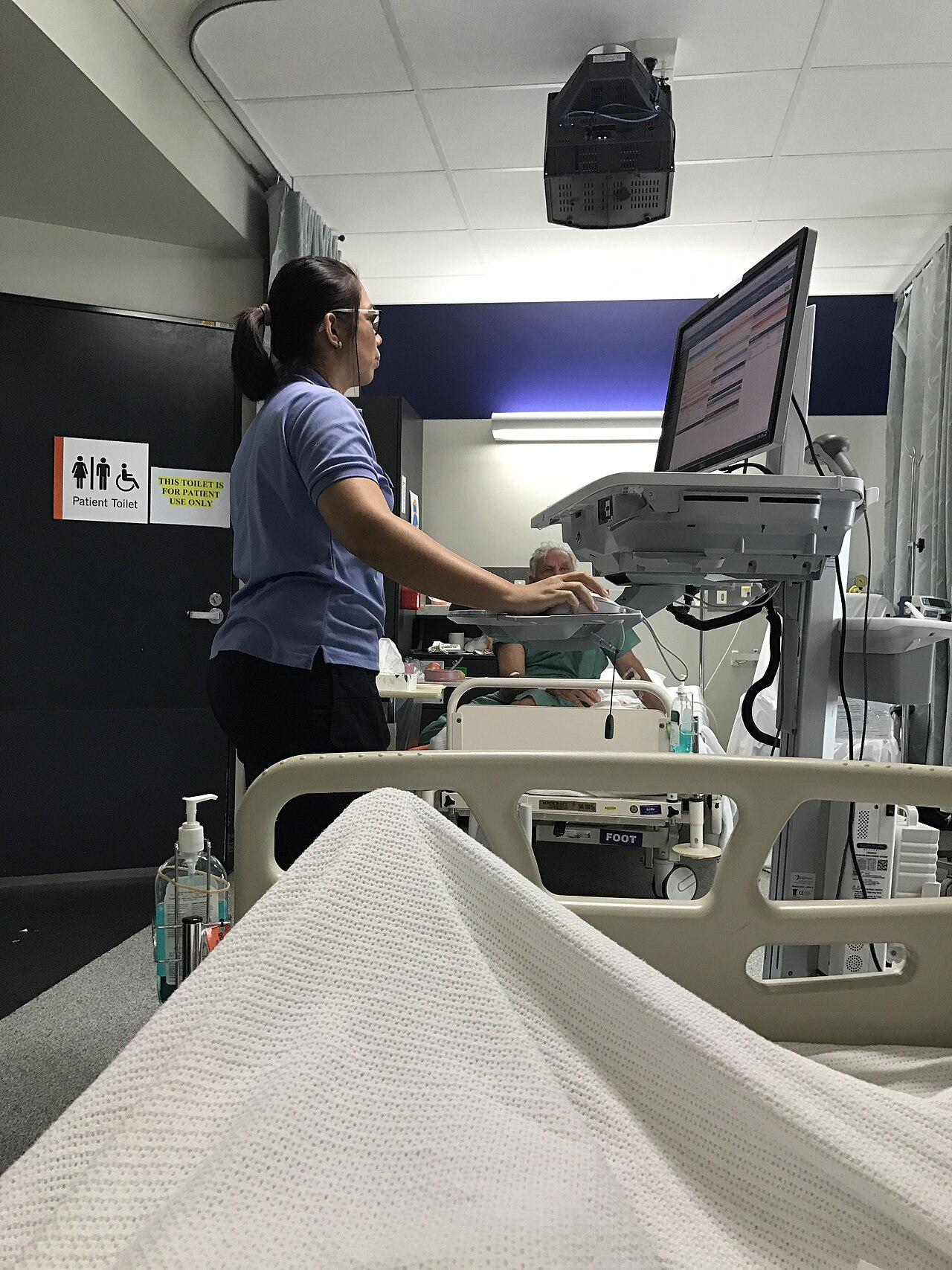
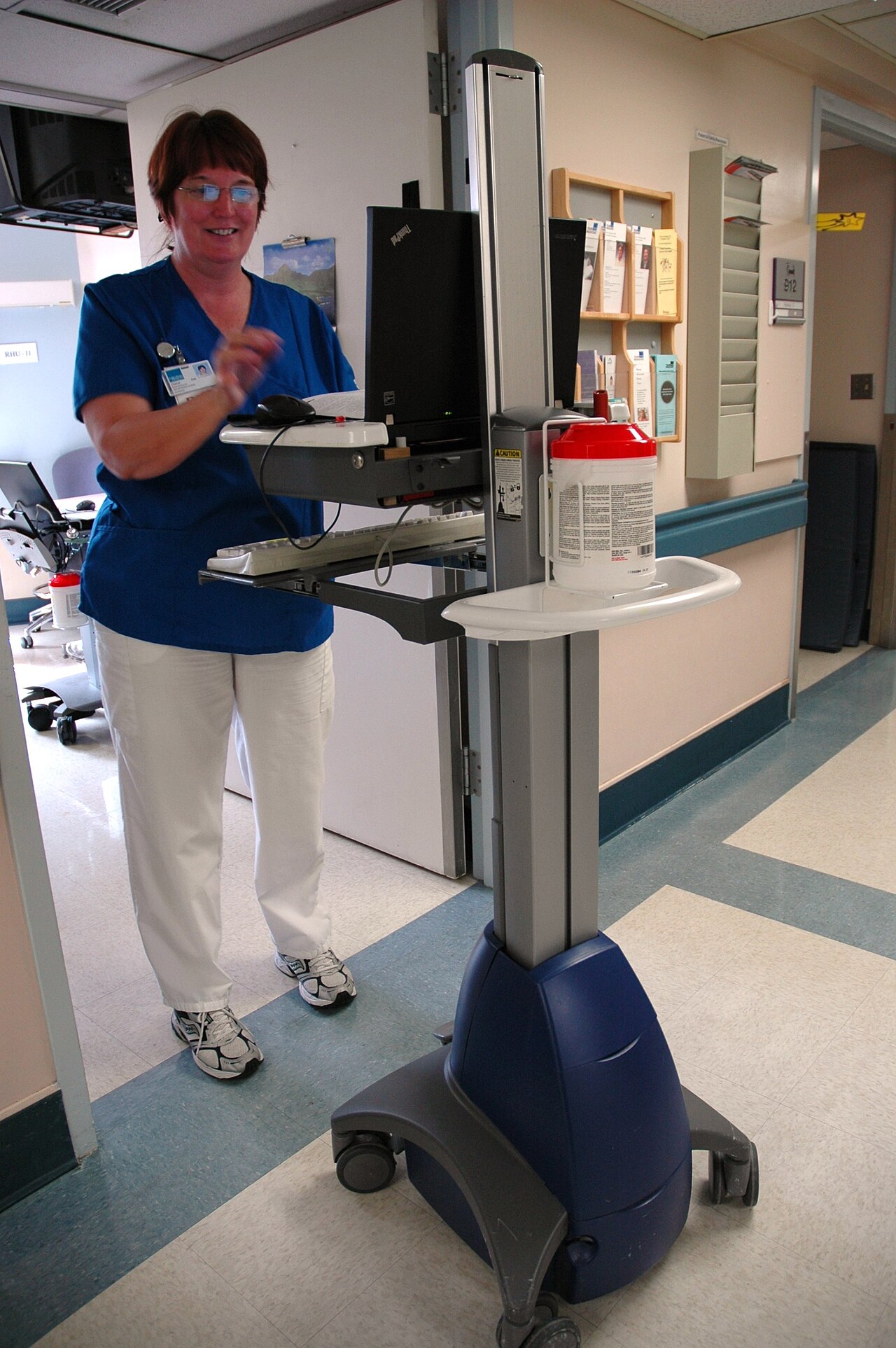
Header image: a nurse at Princess Alexandra Hospital, Brisbane, operating a mobile computer workstation at a patient's bedside, photographed by Kgbo, licensed under CC BY-SA 4.0, via Wikimedia Commons. In-body photograph: a nurse with a mobile computer workstation at Virginia Mason Hospital, Seattle, photographed by Wonderlane, licensed under CC BY 2.0, via Wikimedia Commons. Neither photo depicts the OpenAI-Epic integration itself; both show real clinicians using hospital computer systems at the point of care.