
Court filings made public on September 23 and 24, 2026, show OpenAI telling a federal court that its own ChatGPT integration into Apple Intelligence and Siri "dramatically underperformed," a rare admission from a company that rarely discusses its own product's shortfalls in public, let alone under oath. The filings surfaced in an antitrust lawsuit brought by Elon Musk's X Corp. and SpaceXAI (xAI) against Apple and OpenAI, and they describe a partnership that, by OpenAI's own account, never came close to delivering the results either side expected when it was announced in 2024.
 Apple
Apple OpenAIOpenAI
 xAI
xAIWhat the filings say
The OpenAI-Apple integration launched in December 2024, bringing ChatGPT into Siri and other Apple Intelligence features as an optional extension. According to the court filings, OpenAI's internal assessment soured almost immediately. A month after launch, the integration appeared, in OpenAI's own words, to be "off to a slow start," and the company cut its forecasts for the additional weekly active users it expected the deal to generate. By summer 2025, OpenAI's filings state, "it was clear that Apple's integration of ChatGPT was dramatically underperforming."
By summer 2025, it was clear that Apple's integration of ChatGPT was dramatically underperforming.
OpenAI, in court filings made public September 2026
The filings also describe what OpenAI expected going in: a "halo effect" from Apple's brand and its placement across hundreds of millions of iPhones, one that OpenAI hoped would translate into new ChatGPT users and paid subscription conversions. That halo effect, per OpenAI's own account, did not materialize. Reporting on the filings also notes that Apple's privacy architecture meant OpenAI could not see or train on Siri-routed ChatGPT queries, so even the usage that did occur generated no data OpenAI could use to improve its own models or measure engagement directly, a constraint any distribution partner relying on downstream product signal would need to negotiate around.
The reason OpenAI's filings point to: off by default
One detail in the filings does more explanatory work than any other: ChatGPT inside Apple Intelligence was off by default. To use it, an iPhone owner had to open Settings, navigate to Apple Intelligence & Siri, tap into the ChatGPT extension, tap "Set Up," and then choose either to enable it without an account or sign in with an OpenAI account and follow further on-screen steps. Apple also ships a "Confirm ChatGPT Requests" toggle that is itself on by default, meaning that even after opting in, a user is prompted for confirmation every time Siri or another Apple Intelligence feature wants to hand a request to ChatGPT. Each of those is a small, sensible privacy decision in isolation. Stacked together, they add up to a multi-step activation flow that most iPhone owners, who never open the Settings app looking for a new AI assistant to configure, simply never completed.
This is not a niche observation about one product. It is one of the most repeated, most quietly ignored findings in consumer software: the default is the feature. Whatever fraction of users would rationally benefit from a setting, the fraction who actually experience it is overwhelmingly determined by whether it is on when they first encounter the product, not by whether they would choose it if asked. A feature that requires four or five deliberate taps through a settings menu is not competing with a feature that is one tap away. It is competing with never being seen at all, because the vast majority of users never open the menu.
From a 2024 handshake to a 2026 court filing
Publicly reported milestones in the Apple-OpenAI ChatGPT integration and the xAI antitrust suit that surfaced OpenAI's own account of it. A date-ordered sequence, not an inferred causal chain.
Distribution is not the same thing as engagement
The Apple-OpenAI deal is worth examining precisely because it is a case study in a distinction that gets collapsed constantly in AI industry coverage: distribution and engagement are not the same axis. OpenAI secured genuinely enormous distribution through the Apple deal, presence on thousands of iPhone models, promoted at Apple's own keynotes, built into the operating system layer of the best-selling smartphone line on earth. By the metric of "how many devices could theoretically reach this feature," the deal delivered completely. By the metric that actually matters to a subscription business, active usage that converts into paid accounts, OpenAI's own filings say it fell dramatically short.
The gap between those two metrics is friction, and friction compounds. A default-off setting is friction at the point of activation. A confirmation prompt on every single use is friction at the point of continued use. Privacy segmentation that prevents OpenAI from learning who is engaging or why is friction at the point of even diagnosing the problem in real time. None of these frictions individually looks like a deal-breaker when a partnership is being negotiated, and Apple's reasons for each of them, user privacy and control chief among them, are defensible on their own terms. But a distribution deal is only as valuable as what survives the friction the distributing platform chooses to keep in place, and here, by OpenAI's own account, not much did.
What this says about Apple's broader AI position
The underperformance sits inside a larger pattern for Apple's AI strategy in 2026: a company that has been visibly cautious, and at times visibly behind, in how aggressively it pushes generative AI features on its own customers. Apple famously refused OpenAI's request for a two-year exclusivity period when the original deal was struck, keeping the arrangement non-exclusive from the outset, and has since added Google's Gemini as an additional Siri backend option. Apple did not go all-in on any single AI partner, and it did not go all-in on making any partner's assistant hard to avoid inside its own operating system either. A defaults-off, confirmation-gated, privacy-partitioned integration is consistent with a company protecting its own control over the assistant layer of iOS rather than one optimizing a partner's growth metrics.
 Google
Whether that caution is prudent platform stewardship or a missed opportunity depends on priorities Apple has not stated for the record, and the court filings do not resolve that question either way. What the filings do resolve, in OpenAI's own words, is that whatever Apple's Siri integration was optimized for, it was not optimized for ChatGPT's own weekly-active-user or subscription growth, and OpenAI's internal forecasts reflect that they expected otherwise.
The litigation context
The filings emerged inside X Corp. and SpaceXAI's antitrust suit against Apple and OpenAI, filed in August 2025 in the US District Court for the Northern District of Texas, before Judge Mark Pittman. xAI's complaint alleged that the Apple-OpenAI arrangement functioned as an exclusive deal in practice, foreclosing rivals such as xAI's Grok from the kind of built-in iPhone distribution ChatGPT received, and that Apple's Writing Tools, camera features, and Siri itself gave OpenAI privileged access to a vast pool of potential user prompts that competitors could not reach.
On September 14, 2026, X Corp. and SpaceXAI moved to dismiss their claims against Apple with prejudice, stating the claims had been resolved without disclosing terms, while continuing to pursue their case against OpenAI. Apple did not oppose the motion. OpenAI, still a defendant, has separately sought summary judgment, arguing in part that its own reported usage data undercuts xAI's foreclosure theory: if the ChatGPT-Siri integration was used as little as OpenAI's internal numbers suggest, OpenAI argues, any competitive harm to a rival like Grok from being excluded from that same channel is "indisputably de minimis." That argument is precisely why OpenAI's underperformance admission appears in the record at all. It was submitted as evidence for OpenAI's own defense, not as a voluntary disclosure. Trial against OpenAI remains scheduled for January 2027.
The broader lesson for embedded AI features
For any company building AI into an existing product, whether that is an operating system, a browser, or a business application, the ChatGPT-Siri episode is a clean, well-documented example of a mechanism that shows up constantly and gets underweighted just as constantly: default state beats theoretical capability every time distribution meets a real, distracted user base. A powerful model wired into an app that requires several deliberate steps to reach will lose, in raw usage, to a weaker one that is simply already switched on.
It is also a reminder that being the default assistant inside somebody else's platform is a fundamentally different position than being the assistant a person actively chose. A user who opts into a specific model, or who can freely switch between models based on which one actually serves a given task, is a different kind of user than one who stumbled into a pre-set default they never configured. Metir AI is built around that second kind of choice: rather than funneling every request to one default provider, it lets people pick and switch between models directly, so the model serving a task is the one a person actually wants for it, not whichever one happened to ship turned on.
Sources:
- OpenAI says Apple's ChatGPT integration 'dramatically underperformed' | MacDailyNews
- ChatGPT in Siri 'Persistently Underperforming,' Says OpenAI | MacRumors
- OpenAI says Apple Intelligence users showed little interest in ChatGPT integration | 9to5Mac
- ChatGPT as an extension in Siri dramatically underperformed, says OpenAI | AppleInsider
- OpenAI: Apple's ChatGPT tools 'dramatically underperformed' | Business Post
- ChatGPT Integration With Apple Intelligence Fell Short of OpenAI's Forecasts | AppleMagazine
- X Corp. Moves to Dismiss Apple From Antitrust Suit, Keeping OpenAI Claims | Unite.AI
- OpenAI Seeks Summary Judgment in xAI Case | Lawyer Monthly
- Musk's xAI Drops Antitrust Lawsuit Against Apple Over AI Competition | Bloomberg
- X and SpaceXAI move to drop Apple from antitrust lawsuit | 9to5Mac
- Musk Firms Drop Apple Antitrust Suit but Continue Case Against OpenAI | PYMNTS.com
- Turn on ChatGPT on iPhone | Apple Support
- Setting up ChatGPT with Apple Intelligence | OpenAI Help Center
Image credits
Hero image: "Apple Park aerial view, June 2024" by Nils Huenerfuerst, licensed CC0 (public domain). Source: Wikimedia Commons. Reviewed before publication; shows Apple's Cupertino headquarters, not a depiction of the ChatGPT-Siri integration or the litigation.
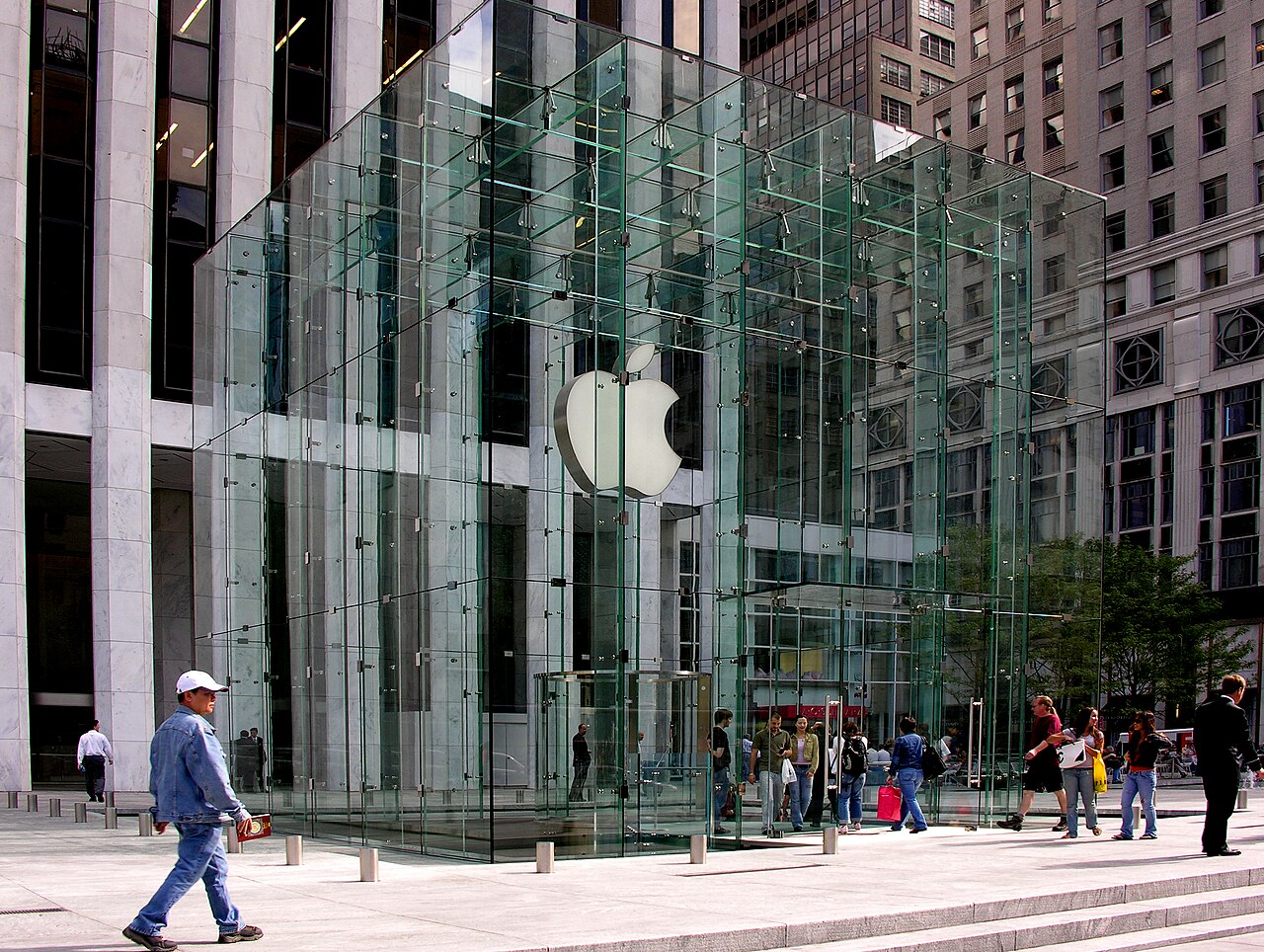
In-body figure: "Apple store fifth avenue" by Ed Uthman, MD, licensed under CC BY-SA 2.5. Source: Wikimedia Commons. Reviewed before publication; shows the Apple Fifth Avenue retail store in New York City, illustrating Apple's consumer-facing brand generally, not the ChatGPT-Siri integration specifically.