At the Open Compute Project (OCP) Global Summit in San Jose on October 12, 2026, Nvidia, AMD and Intel each put a different piece of AI infrastructure into the open: a rack architecture, a CPU-centric rack design and an inference accelerator. They address different layers of the data center, so they are best read side by side rather than as direct rivals.
 NVIDIA
 AMD
AMDNvidia: Vera Rubin racks and MGX 1.2
According to Nvidia's OCP blog post, the company contributed Vera Rubin rack and compute tray designs to OCP through its open MGX architecture. MGX 1.2 adds blind-mate liquid cooling at rack scale, a liquid-cooled 5,000A busbar, native 19-inch equipment support and fanless liquid-cooled compute trays. Nvidia says it supports rack deployments up to 250kW.
Nvidia also extended MGX with a Vera CPU rack specification aimed at agentic AI work such as tool calling, orchestration and sandboxed execution. Named partners include Cisco, Google, Meta and Microsoft. On the data center side, Visionbay unveiled K-1, an AI factory platform built on Nvidia's 800 VDC architecture with Vertiv power and thermal technology, which phases in 800 VDC rather than requiring a full switch at once.
The networking items are as notable as the racks. Meta is adopting Spectrum-6 102.4Tb/s Ethernet switches, and Nvidia and Cisco described USFP, a pluggable optics form factor with a path to 400Gb/s per lane and, per Nvidia, about four times the bandwidth density of 200Gb/s-per-lane optics.
The same week brought a rack standard, a CPU rack and an inference card: three layers of one open stack.
Reading of the OCP 2026 announcements
AMD: Helion, a CPU-centric rack
AMD's press release introduces Helion as agentic AI compute at rack scale. A CPU-only configuration uses 6th Gen AMD EPYC processors and supports up to 32,768 CPU cores, aimed at running large numbers of agents. An all-in-one configuration combines EPYC CPU nodes, AMD Instinct MI350P GPU nodes and general-purpose compute, with an integrated token router that directs model calls across frontier and open-source models. Both liquid-cooled and air-cooled versions are offered.
Two timing details matter. AMD says rack configurations are planned to be available in November 2026, and that it plans to contribute the Helion specification to OCP, so the contribution is a stated intention rather than a completed step. Launch partners named in the release include Cisco, Dell Technologies, Hon Hai, HPE, Lenovo, QCT, Supermicro and Wiwynn. The release does not give power, memory or per-node GPU counts.
Intel: the D270 inference GPU
Intel's D-series page lists the GPU D270 with up to 480 GB of LPDDR5X per card, 32 Xe3P cores, 256 XMX matrix engines, a 350 W air-cooled design and a standard PCIe 5.0 interface, with no high bandwidth memory. Intel's page does not state FP8 throughput or bandwidth. ServeTheHome reports 1.3 PFLOPS of FP8 matrix performance and 1.5TB/s of memory bandwidth, and notes that Intel's own card carries 160GB while ODM partners can offer up to 480GB. Intel is sampling to customers, has not announced a launch date or pricing, and ServeTheHome suggests buyers look toward 2027.
Comparing the numbers
Only one pair of figures is directly comparable across vendors in the sourced material: the D270 against AMD's MI350P, which ServeTheHome lists at 2.3 PFLOPS dense FP8 and up to 600W in its highest configuration.
Intel GPU D270 vs AMD Instinct MI350P
Vendor-listed peak figures as reported by ServeTheHome. MI350P power is its highest configuration. Peak specs, not measured workloads.
Simple arithmetic on those peak figures: the MI350P offers about 1.8 times the FP8 throughput (2.3 divided by 1.3), and draws about 1.7 times the power (600 divided by 350). Per kilowatt, that is roughly 3.7 PFLOPS for the D270 (1.3 divided by 0.35) and 3.8 for the MI350P (2.3 divided by 0.6), close to a tie on paper. The D270's distinguishing trait is memory capacity per card at a modest power level, which suits long-context serving, while the MI350P's is raw throughput. These are peak specifications, and none of the vendors has published measured tokens-per-second results for these parts in the sources cited here.
The rack-level numbers cannot be compared this way. Nvidia's 250kW is a deployment ceiling for MGX 1.2 racks, and AMD's 32,768 is a CPU core count for a CPU-only design, so they describe different things.
What it means for buyers
- Cooling is the common thread. Nvidia's blind-mate liquid cooling and AMD's liquid and air variants both point to facilities that must handle higher rack densities, while Intel's card targets air-cooled servers.
- CPUs are back in the AI rack. Both Nvidia's Vera CPU rack and AMD's CPU-only Helion target agent execution, such as tool calls and sandboxes, rather than model training.
- Timelines differ. Helion is slated for November 2026, while the D270 has no launch date. Specification contributions to OCP also vary in how complete they are.
For teams building on top of these systems, hardware diversity is a reason to keep application code model-agnostic, which is the approach platforms like Metir take with model providers.
Sources:
- OCP Global Summit: Vera Rubin and scaling AI factories - Nvidia
- Introducing AMD Helion, Agentic AI Compute at Rack Scale - AMD
- Intel GPU D270 - Intel
- Intel's Crescent Island AI Server GPU Gets a Name and Specs - ServeTheHome
Image credits
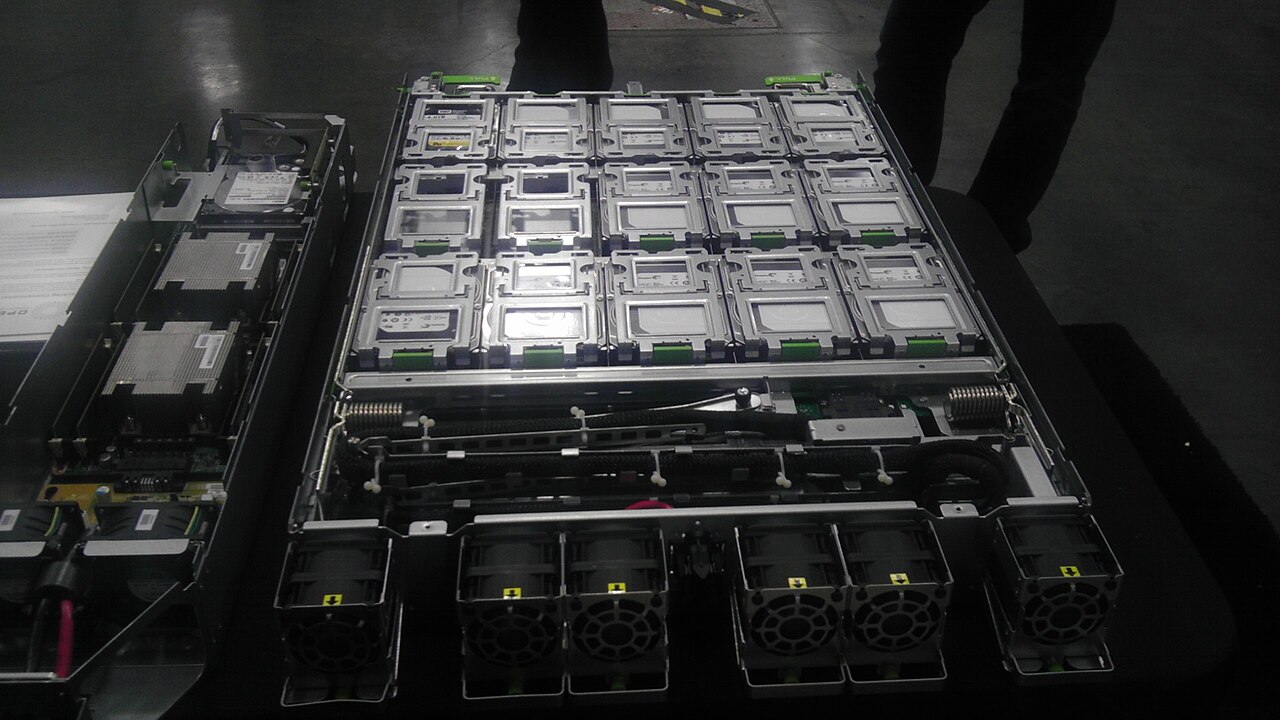
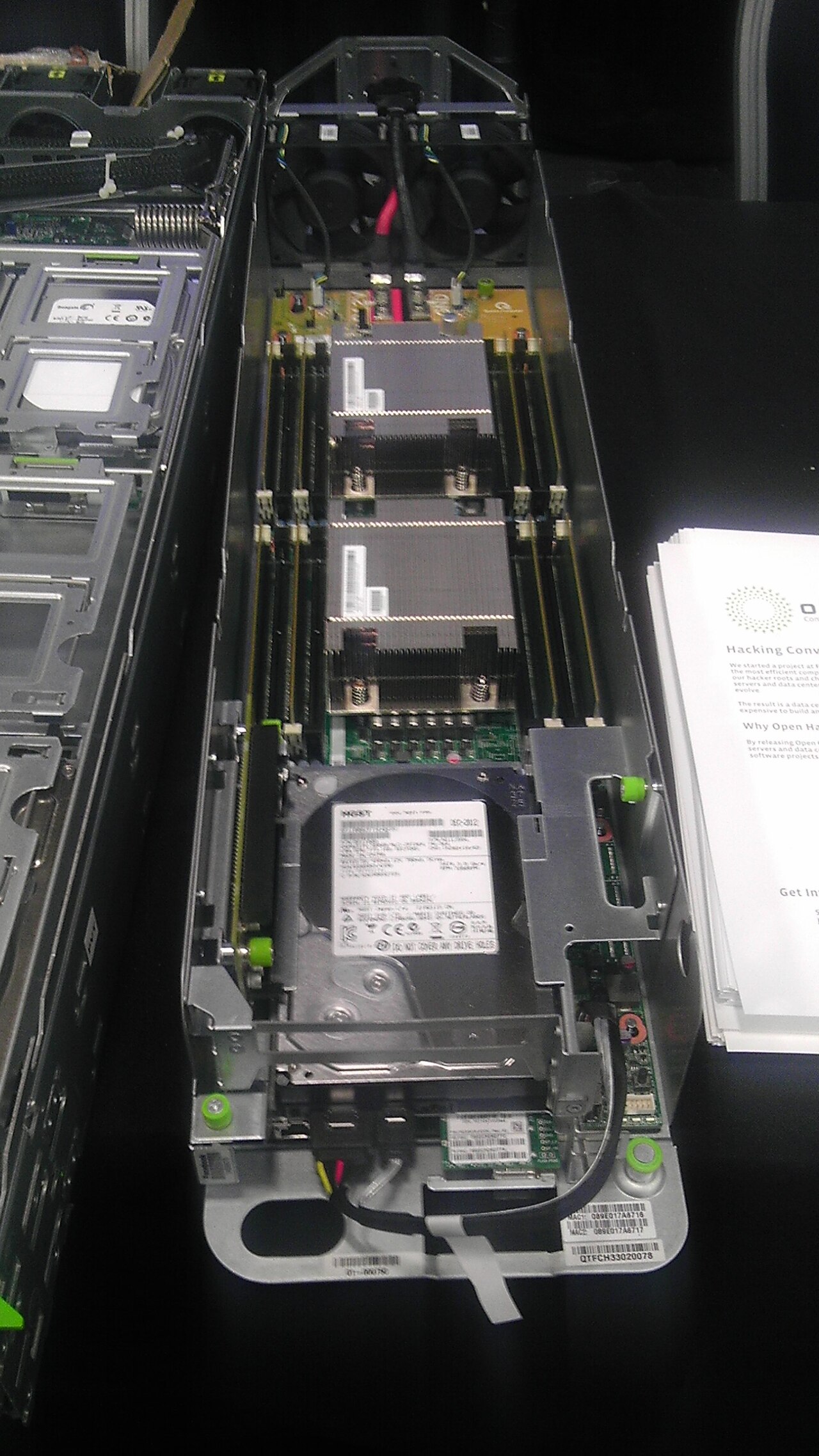
Header image: an Open Compute 1U drive tray and server sled on a display table, by Robert.Harker, Wikimedia Commons, CC BY-SA 3.0 (source); a file photo of early Open Compute hardware, not a 2026 product. In-body image: Open Compute server sled by Robert.Harker, Wikimedia Commons, CC BY-SA 3.0 (source).