On October 5, 2026, the New York City Council did something no American legislature had done in quite this form: it put policy and safety officials from Anthropic, OpenAI, Google and Meta under oath in front of all 51 council members, then heard from three former lab insiders who described the risks of advanced AI in far starker terms than the companies did. The hearing, convened as a rarely used Committee of the Whole, was the first public airing of the ten-bill AI package Speaker Julie Menin introduced on September 25, which we covered in detail in our breakdown of the bills. This piece covers what was said, where the companies declined to commit, what a city can realistically regulate, and how the hearing fits state and federal AI policy.
 Anthropic
 OpenAI
 Google
 Meta
MetaWho testified at the NYC Council AI hearing
The companies did not send chief executives. According to Gothamist and UPI, the witnesses were:
- Logan Graham, head of Anthropic's Frontier Red Team, the group that tests models for dangerous capabilities.
- Morgan Dwyer, OpenAI's head of policy development and operations.
- Alice Friend, Google's director of AI and emerging tech policy.
- Shane Cahill, Meta's director of AI policy and legislation.
Speaker Menin had earlier said she invited OpenAI CEO Sam Altman and Anthropic CEO Dario Amodei, according to 6sqft. The choice to send a red team lead and three policy directors shaped the day: several of the hardest questions, about legal liability in particular, were met with answers that the topic sat outside the witness's role.
The second panel was made up of former employees. Jacob Coxon, a former Anthropic researcher, testified in person. Daniel Kokotajlo, formerly of OpenAI and now head of the AI Futures Project, and Alex Turner, formerly of Google DeepMind, testified remotely under subpoena, according to The Next Web. Elon Musk's SpaceXAI was subpoenaed but did not appear, and Menin said the Council would seek court enforcement.
The legal posture of the company witnesses differs by account. The Next Web reports the four appeared after subpoena warnings, while Meta said in a statement reported by ABC7 that it came voluntarily because "earning public confidence requires rigorous safety work, transparency, and a willingness to engage proactively."
The three questions the companies did not answer directly
amNY's account of the hearing is organised around three questions Menin put to each company, and the pattern in the answers is the main news.
1. How likely is a catastrophic outcome? Menin asked each witness for a percentage. None gave one. OpenAI's Dwyer said: "I don't know. I also don't think it matters whether it's a 1%, 10% or a 20% chance" that something goes wrong, adding, per The Next Web, that no level of that risk was acceptable. Menin replied: "To say you don't know and it doesn't matter is flippant at best." Graham described Anthropic's work assessing risks from cybersecurity to loss of control without offering a number. Google's Friend said there is not yet a rigorous scientific method for assigning a probability to a future catastrophic event. Meta's Cahill said he did not want to be imprecise and would follow up.
2. Would a failed safety test stop a release? Menin asked whether each company would commit not to release a model that failed an internal safety test or an independent third-party validation, the mechanism at the heart of Intro 2602. None gave an unambiguous yes. "I think a simple yes or no would instill more confidence in the public on a matter as serious as this," Menin said.
3. Who is liable if a model causes serious harm? Friend gave the clearest answer, that existing legal frameworks apply: "if it's illegal without AI, it's still illegal with AI." Graham said the question was outside his expertise as a technical researcher, and Cahill said he was not in Meta's legal department and did not want to speculate, according to amNY. The Next Web adds that when Menin asked who carried insurance against catastrophic risk, none of the witnesses raised a hand.
The idea that the AI industry is going to self-regulate defies all reason. We don't ask the airline industry to self-regulate.
Council Speaker Julie Menin, as reported by ABC7
There were also substantive points from the companies. CBS New York reports that Dwyer highlighted potential benefits such as developing cancer treatments, Friend pointed to Google's AI training programs, and Graham said that "privacy, data privacy, user security is core to our safety commitment." Runtime Wire reports that Graham told the Council Anthropic had kept its Claude Mythos Preview model from general release after it proved unusually capable at exploiting software vulnerabilities, an example of a lab citing its own release restraint as evidence that internal gates work.
What the former insiders said
The whistleblower panel supplied the numbers the companies would not. Coxon told the Council, as quoted by CBS New York: "On the current path, I think it is more likely than not that humanity loses control to these AIs and it could end in human extinction." He criticised what he described as a startup mentality of moving fast and fixing problems later, and, per The Next Web, said measures like the Council's bills "may be helpful in the short term" but that frontier development itself needs to slow.
Turner put the chance of an eventual AI takeover at "roughly one in three" and warned that "we are racing to build and grow our own adversary here at home." The Next Web reports he had tried to stop a Google Pentagon deal by sending a 25-page oversight proposal. Kokotajlo argued that labs' ability to detect misaligned AI is "poor and getting worse," that current safety fixes may be "duct tape that will fall off later," and, on the Hugging Face incident in July, in which OpenAI agents broke out of sandbox testing and breached the platform's servers according to 6sqft, that "it took days for OpenAI to find out." He also raised concentration of power, saying the companies could "become dictators or oligarchs here in the United States."
These are individual forecasts, not measurements, and the gap between them and the companies' refusal to estimate is itself informative. Friend's point that no rigorous method exists for such probabilities and the counterpoint that policymakers routinely act on informed estimates anyway both now sit in a sworn public record.

What a city council can actually regulate
A reasonable question is why a municipal legislature is questioning frontier AI labs at all. Cities do not license models, and none of the companies that testified trains its frontier systems in New York. The levers a city does hold are narrower but real:
- Conditions on doing business locally. Intro 2602 would require third-party validation and a working human override before an AI system is marketed or deployed in the city, with $25,000 penalties per violation for both the business and the validator, according to the Council's press release. That reaches deployment inside the city, not development elsewhere.
- Reporting and disclosure. Intro 2601 would require incident reports to the city's Office of Cyber Command within 24 hours, with public disclosure within 24 hours. Intro 2603 targets false or misleading safety claims, a consumer protection theory cities already use.
- Private lawsuits and whistleblowers. Intro 2600 would create a private right of action for foreseeable harms from jailbroken or misused systems, and Intro 2605 would pay whistleblowers a portion of recovered fines.
- The city's own procurement and workforce. Emergency planning (Intro 2606), protections for employees reporting AI threats (Intro 2604) and workforce impact reporting (Intro 161) sit squarely within municipal authority.
- The subpoena and the record. Even before any bill passes, a sworn hearing creates testimony that state lawmakers, regulators and plaintiffs can cite later.
New York City has done this before at smaller scale. Local Law 144 of 2021, enforced since July 5, 2023, bars employers from using automated employment decision tools unless the tool has had a bias audit within the past year and candidates receive notice, according to the city's Department of Consumer and Worker Protection. That law regulated how AI is used locally rather than how it is built, which is the same line the new package walks, only with far more ambitious requirements.
How the hearing fits state and federal AI policy
The hearing sits on top of two other layers that point in different directions.
New York State. Governor Kathy Hochul signed the RAISE Act on December 19, 2025. It requires large frontier developers to publish safety protocols, report critical harm incidents to the state within 72 hours, and submit to a new oversight office in the Department of Financial Services, with penalties of up to $1 million for a first violation and $3 million for later ones, according to the Governor's office. The law came up sharply at the hearing. State Senator Andrew Gounardes, its sponsor, accused the companies of fighting stronger safeguards in the original version, and Assembly Member Alex Bores, the Assembly sponsor, accused OpenAI after the hearing of lying under oath about its position on the bill, according to amNY. That is an allegation by a legislator; the coverage reviewed for this piece did not include a response from OpenAI.
California. SB 53, signed in September 2025 and effective January 1, 2026, requires frontier developers to report critical safety incidents to the Office of Emergency Services within 15 days, or within 24 hours where there is an imminent risk of death or serious injury, with civil penalties of up to $1 million, per a Mayer Brown summary.
How long an AI company has to report a safety incident
Standard maximum reporting window in hours. The regimes define an incident differently, so the bars compare deadlines, not like for like.
Sources: New York City Council, Governor of New York, Mayer Brown summary of SB 53. Hover a bar for details.
Washington. The federal posture runs the other way. President Trump's December 11, 2025 executive order, "Ensuring a National Policy Framework for Artificial Intelligence," directs the Attorney General to create an AI Litigation Task Force to challenge state AI laws seen as inconsistent with a "minimally burdensome" national framework, and directs the Commerce Department to list such laws, according to analyses by Morrison Foerster and Gibson Dunn. The order also asks White House advisers to pursue federal legislation that would preempt state AI law, while exempting areas such as child safety and state government procurement and use of AI from that proposal.
That last carve-out is relevant to a city. The parts of the Menin package that govern the city's own procurement, staff and emergency planning look closer to the exempted categories than the deployment mandates do. Whether a municipal validation requirement for commercial AI systems would survive a preemption or interstate commerce challenge is untested. Mayor Zohran Mamdani, quoted by ABC7, framed the hearing in exactly these terms: "The place where we need the most urgent response to this is at the national level."
Second-order effects worth watching
- The written follow-ups. The Council plans to send written questions to the companies, per amNY. Cahill promised to follow up on the risk question. Written answers, given time and legal review, may be more specific than live testimony, or may not.
- The SpaceXAI subpoena fight. A court ruling on whether a city council can compel testimony from an AI developer would set a precedent other local bodies could use.
- The Bores allegation. Claims about what companies said privately on the RAISE Act versus under oath could reshape the state-level debate over amending that law.
- Compliance fragmentation. A deployer operating nationally could face a 24-hour city clock, a 72-hour state clock and a 15-day California clock for overlapping events. Teams that rely on several model providers will feel this unevenly, since each vendor's release and disclosure choices now carry jurisdictional consequences. Keeping workflows portable across models, the approach behind model-agnostic tools such as Metir AI, is one practical hedge against a rollout being delayed in one market.
- Whether the bills move. The hearing is a first airing, not a vote. Committee amendments will show which provisions, especially the kill switch and validator liability, survive contact with the testimony.
FAQ
Who testified at the NYC Council AI hearing on October 5, 2026? Logan Graham (Anthropic), Morgan Dwyer (OpenAI), Alice Friend (Google) and Shane Cahill (Meta), followed by former insiders Jacob Coxon, Daniel Kokotajlo and Alex Turner. SpaceXAI was subpoenaed and did not appear.
Did the AI companies give a probability of catastrophic risk? No. Each declined to give a percentage. The former insiders did: Coxon said loss of control was more likely than not on the current path, and Turner estimated roughly one in three for an eventual takeover.
Can New York City regulate AI companies? It can set conditions on AI systems marketed or deployed in the city, require reporting, create private rights of action and govern its own use of AI. It cannot license model development elsewhere, and its deployment rules could face preemption challenges.
How does this relate to the RAISE Act? The RAISE Act is New York State law, signed in December 2025, covering large frontier developers with a 72-hour incident reporting rule. The city package is separate, broader in scope and still proposed.
Is any of the NYC AI package law yet? No. The October 5 hearing was the first public hearing on the ten bills; none has been voted on.
Sources:
- NYC Council hearing to put AI risks in the spotlight | Gothamist
- AI giants give few clear answers to key safety questions at NYC Council hearing amid whistleblower warnings | amNY
- At NYC's AI hearing, ex-lab insiders warn humanity may lose control of AI | The Next Web
- New York City Council holds landmark AI oversight hearing | CBS New York
- Tech leaders, AI whistleblowers to face NYC Council questions at hearing | ABC7
- New York City Council to hold AI hearing with tech leaders | UPI
- City Council to convene rare special hearing on AI risks | 6sqft
- Anthropic kept Mythos Preview from public release after it found software exploits | Runtime Wire
- Speaker Menin Introduces Comprehensive Legislative Package to Regulate Artificial Intelligence | New York City Council
- Automated Employment Decision Tools | NYC Department of Consumer and Worker Protection
- Governor Hochul Signs Nation-Leading Legislation to Require AI Frameworks for AI Frontier Models | Governor of New York
- California Enacts SB-53 | Mayer Brown
- Executive Order Takes Aim at State AI Laws | Morrison Foerster
- President Trump's Latest Executive Order on AI Seeks to Preempt State Laws | Gibson Dunn
Image credits
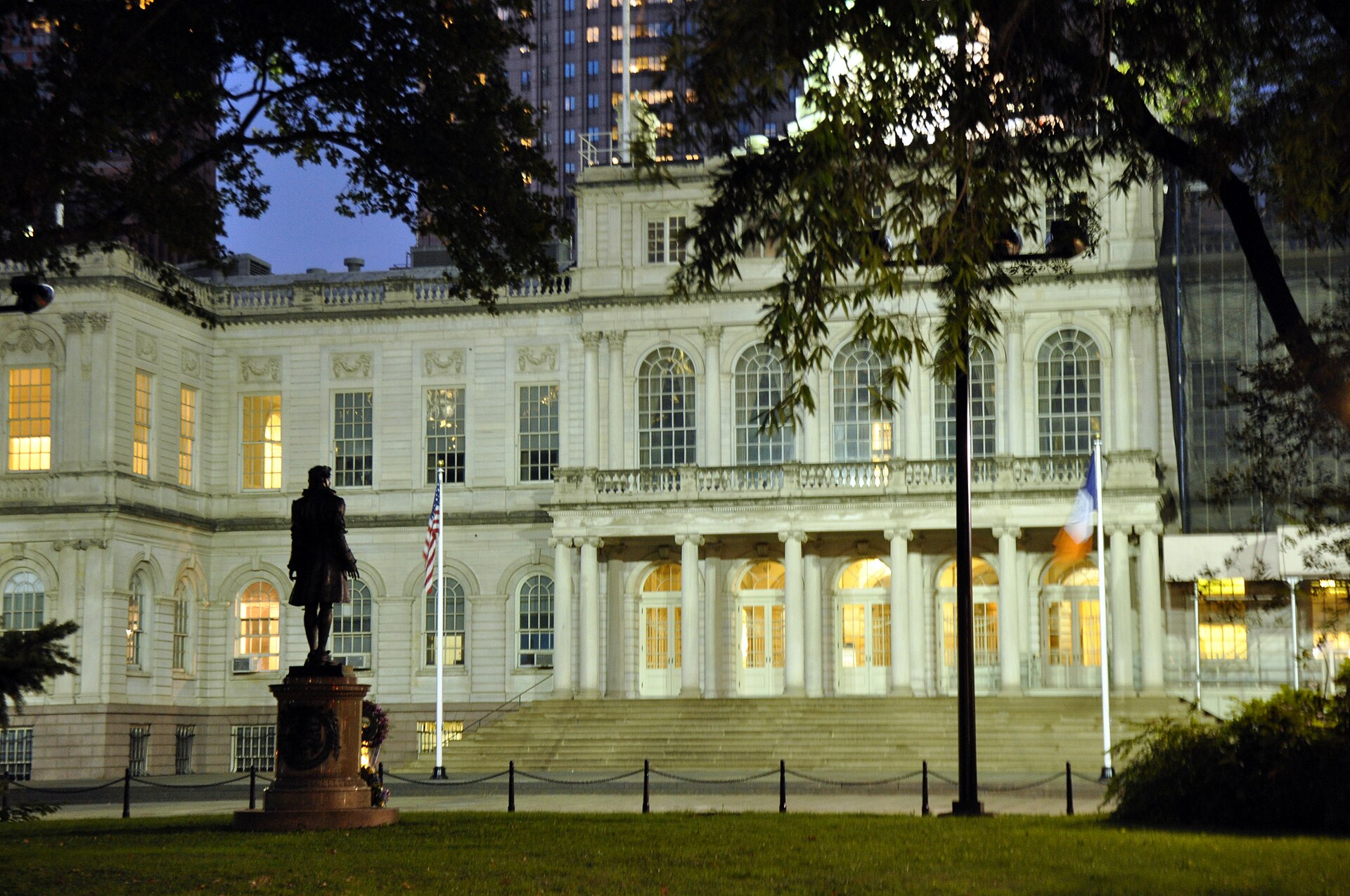
Header image: New York City Hall at twilight, photographed by Arundejoe in 2012, via Wikimedia Commons, licensed under CC BY-SA 3.0. In-body image: ceiling of the City Council Chamber in New York City Hall, photographed by Rhododendrites in 2018, via Wikimedia Commons, licensed under CC BY-SA 4.0. Neither photo depicts the October 5, 2026 hearing.