On August 20, 2026, Nvidia agreed to pay $6 billion to license AI model-development software from Poolside, a three-year-old startup that builds open-weight coding models, according to reporting by Eric Newcomer that was quickly confirmed by Bloomberg and The Information. The license is non-exclusive, meaning Poolside is still free to sell the same technology to other buyers. Alongside it, Nvidia is putting in a separate $1 billion equity investment at a $12 billion pre-money valuation, and extending job offers to 109 Poolside employees who work on its AI models. Poolside's three co-founders are staying, and the company says it will keep operating independently. Combined, Nvidia's commitment to a startup that has existed for barely three years comes to roughly $7 billion.
 NVIDIA
What Nvidia Is Actually Buying
The $6 billion license covers Poolside's "Model Factory," the internal pipeline the company built to train its "Laguna" family of open-weight coding models, the same lineage behind Laguna S 2.1, a small, sparse model that Metir covered in July for matching much larger systems on coding benchmarks. Model Factory is not a single model. It is the tooling, data pipeline, and training methodology Poolside uses to produce models, the kind of infrastructure a company would normally have to build in-house or acquire outright.
The three figures in Nvidia's reported Poolside deal
A $6 billion non-exclusive license for Poolside's Model Factory software, a separate $1 billion equity investment, and the $12 billion pre-money valuation that investment implies for the remaining company. Figures as reported in the August 20, 2026 letter to Poolside investors.
The license fee and the equity investment are separate line items; combined, Nvidia's reported commitment to Poolside totals about $7 billion.
Poolside intends to distribute the $6 billion license fee to its investors by the end of 2027, according to the letter reported by Newcomer. Nvidia had already flagged interest in an equity stake of up to $1 billion in Poolside back in October 2025, when reports pegged the startup's prospective valuation at the same $12 billion figure now confirmed in this letter, so the equity side of the deal has been visible to the market for close to a year. What is new in August 2026 is the license itself and the structure wrapped around it.
The "Acqui-License" Playbook
Poolside's letter to investors is explicit that "this is not an acquisition and it is not an acquihire." That framing matters, because the deal follows a template Nvidia already used with Groq in December 2025: a non-exclusive license to the target's core technology, paired with job offers to most of its technical staff, while the original company keeps operating and retains a separate line of business. Groq's cloud inference business stayed independent under its own CEO after that deal; Poolside's founders are staying to run whatever Poolside becomes next.
This is not an acquisition and it is not an acquihire.
Poolside's letter to investors, as reported by Newcomer
The appeal of this structure is straightforward. A traditional acquisition of a well-funded AI startup can trigger a Hart-Scott-Rodino antitrust filing and a waiting period, and Big Tech's AI acquisitions have drawn heightened scrutiny since 2024. Licensing software and hiring individual employees is not, on its face, a merger, so it does not automatically trigger the same review. The Nvidia-Groq deal already drew a formal inquiry from Senators Elizabeth Warren and Richard Blumenthal, who argued in a March 2026 letter that the structure was designed to evade merger review while achieving the same outcome, control of the technology and most of the people who built it. Whether that argument extends to Poolside is now an open question regulators have not yet weighed in on publicly.
Why Nvidia Wants Model-Building Software
Nvidia's dominance so far rests on chips and the CUDA software layer that runs on them. Model Factory is a different kind of asset: the methodology for turning compute into a trained model, tuned specifically for coding and agentic terminal work. That is the layer immediately above the hardware, where a company decides how to spend GPU-hours to produce a capable model rather than simply supplying the GPUs.
There is a reasonable read of why that layer is now attractive to a chip company. As frontier labs increasingly build their own custom silicon, Nvidia's leverage over the AI stack depends on offering value beyond raw compute. Owning, or at least having full access to, a proven pipeline for producing competitive coding models gives Nvidia a foothold in the software layer that determines how its chips get used, and a credible answer if customers start asking why they should buy hardware from a company that has no model-building expertise of its own. It also puts Nvidia in more direct contact with the same coding-agent market that OpenAI, Anthropic, and Google are all racing to serve.
What Non-Exclusivity Leaves Poolside
Because the license is non-exclusive, Poolside is not barred from continuing to license Model Factory, or a successor to it, to other customers. In practice, though, losing 109 of the employees who built and operate that system is a meaningful hit to the company's capacity to keep developing it, extending it, or supporting other licensees, whatever the contract technically permits. What remains at Poolside after this deal, beyond its three founders and the capital from the equity round, is not yet clear from public reporting, and analysts following the deal have raised the same question Groq faced after its own restructuring: what does the entity that is left behind actually do next.
The Bigger Picture
The Poolside deal is the second time in eight months Nvidia has paid billions to license a target's technology and hire most of its team rather than announcing an acquisition, and it will not be the last data point in the argument over whether "acqui-license" deals deserve the same antitrust scrutiny as a merger. For now, the honest reading is that both the strategic logic and the regulatory question remain open. Nvidia gets a proven coding-model pipeline and a team that built it without absorbing Poolside outright; Poolside's investors get a return years ahead of a typical exit; and the market gets another signal that the ability to build a good model, not just the chips to train one on, has become valuable enough on its own to be worth billions.
For companies building products on top of whichever model-building pipeline ends up inside which chipmaker, the practical lesson is the same one raised by Nvidia's other recent mega-deals: staying model-agnostic is a hedge against exactly this kind of consolidation. Metir AI is built to work across OpenAI, Anthropic, Google, and xAI models rather than tying a product to whichever lab a hardware vendor happens to have licensed or acquired.
Sources:
- Nvidia to Pay AI Startup Poolside a $6 Billion License, Newcomer Says | Bloomberg
- SOURCES: Poolside Strikes $6 Billion Licensing Deal with Nvidia & Raises $1 Billion for Remaining Company at $12 Billion Valuation | Newcomer
- Nvidia Pays $6 Billion to License Poolside AI Model-Development Software | PYMNTS
- Nvidia is acquiring Poolside's "Model Factory" and 109 employees for $6 billion | The Decoder
- Nvidia to Invest Up to $1 Billion in AI Startup Poolside | Bloomberg
- Nvidia-Groq deal is structured to keep 'fiction of competition alive,' analyst says | CNBC
- Senators Warren and Blumenthal letter to Nvidia on the Groq deal
- Poolside AI | Wikipedia
Image credits
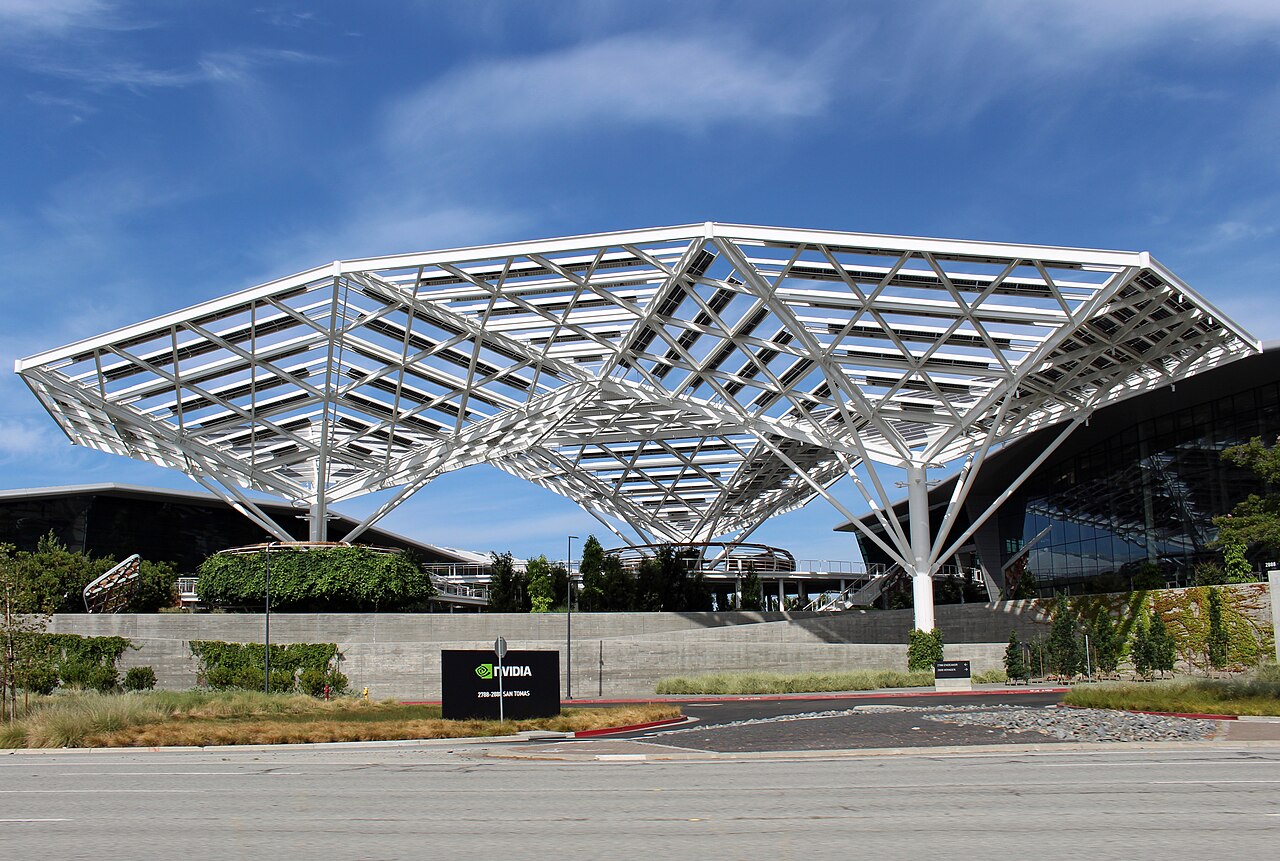
Header image: Nvidia's headquarters sign and canopy structure at 2788-2888 San Tomas Expressway, Santa Clara, California, by Coolcaesar via Wikimedia Commons, licensed under CC BY-SA 4.0. In-body photograph of the crowd and stage screen at Nvidia CEO Jensen Huang's CES 2025 keynote in Las Vegas, by Joseph Zadeh via Wikimedia Commons, licensed under CC BY-SA 4.0.