On August 11, 2026, reporting indicated that Nvidia is training Nemotron 4, an open-model family whose largest version is expected to contain at least a trillion parameters. Final training was said to be underway, with the flagship potentially ready as early as late fall. The same day, Nvidia released two smaller pieces of the stack: Nemotron 3.5 Lightning, a 30-billion-parameter mixture-of-experts model with about three billion active parameters, and a tooling release called NeMo Switchyard.
The obvious question is why the company that sells the shovels is now trying to mine the gold. Nvidia makes its money on hardware. Building a frontier-scale open model is expensive, gives the weights away for free, and pushes Nvidia directly into competition with its own largest customers, the labs that buy its chips to train their models. Understanding why Nvidia would do this anyway is the key to reading the release, and the answer is less about competing with OpenAI than it looks.
What is reported
Nemotron 4, per the reporting, would nearly double the scale of Nvidia's previous open flagship, Nemotron 3 Ultra, which stood at 550 billion parameters. It is said to be trained on 20 trillion text tokens, extended to a one-million-token context window, and built specifically for long-running agent tasks, the multi-step, tool-using workloads that increasingly define how AI gets deployed in production.
A big jump for Nvidia, still short of the Chinese open flagship
Total parameters of open-weight flagship models. Nemotron 4 would nearly double Nvidia's previous open model but remain below DeepSeek V4-Pro. Parameter count is scale, not a direct measure of quality.
Nemotron 4 is reported to train on 20 trillion tokens with a one-million-token context window, built for long-running agent tasks.
Two points of context keep the scale claim in proportion. First, a trillion parameters is a large open model but not the largest; DeepSeek's V4-Pro, released open-weight in the same window, lists 1.6 trillion total parameters. Nvidia's flagship would sit below the top Chinese open model by raw count. Second, parameter count is a measure of scale, not quality. A larger model is not automatically a better one, and the value of Nemotron 4 will be decided by evaluations that do not yet exist, not by its size. The reported specifications describe ambition; they do not settle performance.
It is also worth noting the status: final training underway and a possible late-fall release means this is a model in progress, not a shipped product. Reports of a model being trained are softer evidence than a model you can download. The strategic signal is clear regardless, but the specific numbers should be held loosely until the weights are public.
 NVIDIA
 Meta
Meta DeepSeek
 Qwen
QwenThe strategy: the model is marketing for the hardware
The cleanest way to understand Nemotron is to notice what Nvidia is not trying to do. It is not trying to build a consumer chatbot to rival ChatGPT, and it is not obviously trying to sell model access as a business. It is giving the weights away. A free, capable, openly licensed model is not a profit center. It is a demand lever for the thing Nvidia does sell: compute.
Why a chip company gives away a frontier model
Nvidia's open models are a demand lever, not a direct profit center. The weights are marketing for the hardware, and the loop reinforces itself.
The same logic explains why several hardware and cloud players fund open models: the weights expand the market for the compute they sell.
The loop is straightforward. Capable open weights widen the population of developers and enterprises building agentic systems. Those systems are tuned to run well on Nvidia's hardware and its software stack, from training through inference. More agent workloads running on more infrastructure means more demand for Nvidia silicon. In that framing, Nemotron is a marketing expense for the GPU business, and a rational one: even a very expensive training run is cheap relative to the hardware demand it can seed. The same logic explains why several hardware and cloud players fund open models. The weights expand the market for the compute they sell.
A free, capable open model is not a profit center. It is a demand lever for the thing Nvidia actually sells: compute.
On Nvidia's open-model strategy
There is a second, defensive motive. If the open-model layer were to consolidate around a small number of models, especially models optimized for someone else's hardware or for architectures Nvidia does not control, Nvidia's position at the base of the stack would be less secure than it looks. Shipping its own high-quality open models is a way to keep the most influential open weights aligned with its hardware and its tooling. Owning a strong option in the open layer is insurance against a future where that layer is shaped by others.
The tension with its customers
The awkward part of this strategy is that Nvidia's biggest customers are AI labs, and those labs sell models. A first-party Nvidia model that is good enough to use in production competes, at least at the margin, with the products its customers are trying to sell. Nvidia manages this tension by keeping its models open and positioning them as an ecosystem contribution rather than a commercial rival, and by pitching them at the builder who would otherwise use no frontier model at all rather than at the enterprise already paying a lab.
Whether that framing holds depends on how good Nemotron 4 turns out to be. A mediocre open model is a safe ecosystem gift. A genuinely frontier-competitive one starts to look like a substitute for the paid products its customers sell, and the diplomacy gets harder. Nvidia is betting it can be useful enough to drive hardware demand without being so good that it undercuts the labs whose chip orders it depends on. That is a narrow line to walk, and the release is worth watching as much for how Nvidia positions it as for the benchmark scores.
The read-through
Nemotron 4 is a signal that the boundaries between the layers of the AI stack are blurring. A hardware company is building frontier models; model labs are designing custom silicon; cloud providers are doing both. Each player is trying to secure its position by extending into the neighboring layer, and open weights are a favored tool because they expand a market rather than carving one up. For the ecosystem, the near-term effect is more capable open models available at no license cost, which is good for anyone building on top.
For builders, the practical takeaway is that the supply of strong models, open and closed, keeps widening, and the identity of the best option for a given task keeps shifting between labs, chipmakers, and regions. That is an argument for treating the model layer as something you route across rather than commit to. A model-agnostic approach, the design principle behind platforms like Metir AI, lets a new entrant like a trillion-parameter Nemotron be evaluated and adopted where it wins without rebuilding everything around it. Nvidia's move is a reminder that even the company at the base of the stack expects the model layer to stay plural and contested, and is positioning accordingly.
Sources:
- Nvidia trains 1-trillion-parameter Nemotron 4 open model | AI Weekly
- Nvidia is building a trillion-parameter open model, and it would still be smaller than China's | The Next Web
- Nvidia reportedly builds 1-trillion-parameter Nemotron 4 AI model | Tech Wire Asia
- Nvidia Nemotron 4 Targets OpenAI With 1 Trillion Parameters | Abacus News
Image credits
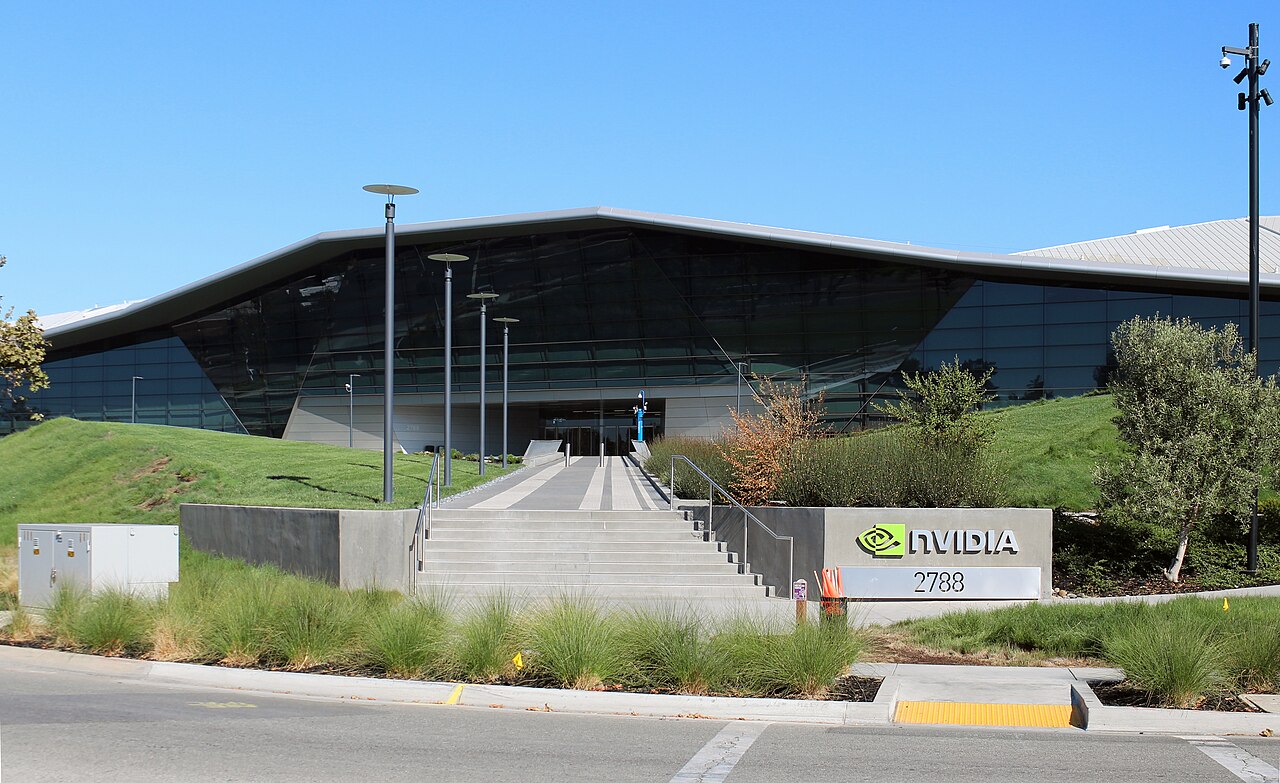
Header image: Nvidia's Endeavor headquarters in Santa Clara, California. By Coolcaesar via Wikimedia Commons, licensed under CC BY-SA 4.0.