Nvidia is in talks to invest in a new funding round that would value the AI data startup Mercor at $20 billion, according to reporting first published by The Information on August 19, 2026. The figure is roughly double the valuation Mercor commanded less than a year earlier, when it raised at around $10 billion in a late-2025 round. The new round is being led by General Catalyst, an existing Mercor investor, and neither the size of Nvidia's stake nor the total amount being raised has been disclosed.
 Nvidia
The deal, if it closes, would mark Nvidia's second significant bet on a company that supplies the human-generated data increasingly used to train and evaluate frontier AI models, following its 2024 investment in Scale AI. It is a small line item next to Nvidia's chip business, but it points at something larger: where the AI industry now believes its next bottleneck sits.
What Nvidia and Mercor Are Discussing
Mercor connects AI labs with vetted domain experts, lawyers, doctors, software engineers, bankers, scientists, who complete, review, and grade tasks that become training and evaluation data for AI models. That work spans building reinforcement-learning "environments" that give a model a task and a way to check its own output, writing benchmark questions, and labeling model responses for quality. It is a different business from the commodity crowdsourced labeling that dominated the earlier era of AI data work, and it prices accordingly, since a doctor grading a clinical-reasoning transcript costs far more per hour than a general-purpose annotator.
Mercor's annualized gross revenue reached about $2 billion in June 2026, roughly double what it was earlier in the year, according to The Information's reporting. Nvidia itself is already a Mercor customer: the startup earned "tens of millions of dollars" from Nvidia in the most recent quarter alone, revenue tied to Nvidia's push to build out its Nemotron family of open-source models. Nvidia also buys data from Turing and from Scale AI, in which it took a stake during Scale's 2024 round at a $14 billion valuation.
Mercor's valuation roughly doubled in under a year
Reported private-market valuations for AI data suppliers Nvidia has backed. Mercor's figure is the valuation under discussion in the round Nvidia is reported to be considering, not a closed price.
Mercor's annualized gross revenue reached roughly $2 billion in June 2026, up from about half that earlier in the year, implying a forward multiple near 10x run-rate revenue at the reported $20 billion figure.
From Scraped Web Text to Paid Expert Labor
For most of the last decade, the dominant scaling strategy for large language models was straightforward: gather as much text as possible from the public web, books, and code repositories, and train on it. That approach is running into diminishing returns as the highest-quality, most accessible text has largely already been used, and as labs increasingly compete on post-training techniques rather than raw pretraining scale.
Reinforcement learning from human and AI feedback, along with the RL environments Mercor builds, has become the layer where labs now compete hardest. A model does not learn to reason through a legal argument or debug a real codebase from web text alone; it needs structured tasks with a correct answer or a reliable way to grade partial credit, built and checked by someone who actually understands the domain. That is expensive, hard to automate, and increasingly treated as proprietary competitive advantage rather than a commodity input, which is part of why a company like Mercor can grow revenue as fast as it has.
The bottleneck in frontier AI training has shifted from how much text you can scrape to how much expert-verified reasoning you can afford to buy.
Analysis synthesized from reporting on Mercor's growth and Nvidia's data spending
Why a Chipmaker Buys Into Its Own Data Supplier
Nvidia's interest in Mercor is not only financial. Securing reliable access to high-quality training data supports the open-source Nemotron models Nvidia publishes, which in turn help sell more of its hardware by making it easier for developers to build on Nvidia's stack rather than a rival's. Taking an equity stake alongside that customer relationship gives Nvidia a claim on Mercor's growth and, potentially, some influence over pricing and access as demand for expert data intensifies.
Where Nvidia's capital sits in the expert-data supply chain
Nvidia is both a customer buying data from Mercor and, if the reported round closes, an investor in the company supplying it.
Nvidia also buys expert data from Turing and from Scale AI, in which it invested during Scale's 2024 round.

The pattern echoes the circular-financing arrangements Nvidia has drawn scrutiny for elsewhere, where it invests in customers that then spend on its products. A Mercor stake is a milder version of that dynamic: Mercor does not buy Nvidia chips with the investment, but Nvidia is still funding a supplier whose growth is substantially driven by Nvidia's own data purchases. Supporters of the arrangement would note that buying a stake in a key supplier, rather than only paying invoices, is standard practice in capital-intensive industries and gives Nvidia a hedge if expert-data pricing keeps rising. Critics would counter that it further blurs the line between organic demand for a supplier's services and demand manufactured by its own backers, a concern already attached to Nvidia's other 2026 investment activity.
The Valuation Math and the Risk Behind It
At $20 billion against roughly $2 billion in annualized revenue, Mercor would be valued at close to 10 times its current run rate, a rich but not unusual multiple for a fast-growing private AI company in 2026. The multiple assumes Mercor's revenue keeps compounding at something close to its recent pace, doubling roughly every few months, which is itself a bet that demand for expert-generated RL data and evals keeps accelerating rather than leveling off.
That is not guaranteed. Expert-data demand is downstream of frontier labs continuing to spend heavily on post-training, which is in turn downstream of continued investor appetite for funding that spending. If AI labs' own capital tightens, or if RL training approaches shift toward techniques that need less human-graded data, Mercor's growth could slow well before a $20 billion valuation is justified by revenue alone. There are also open questions specific to the category: data-quality and contamination risk as more of the training pipeline runs through paid, sometimes rushed, human labor, and the labor economics of relying on freelance domain experts whose pay and working conditions are less visible than a traditional workforce.
What to Watch
Three things will show whether this bet is working out. First, whether Mercor's revenue growth holds up through the second half of 2026, since a multiple this high depends on the trend line, not a single quarter. Second, whether Nvidia's own data spending with Mercor keeps rising in step with Nemotron's development, or whether it plateaus once Nvidia's immediate model-training needs are met. Third, whether other frontier labs disclose comparable increases in expert-data spending, which would suggest Mercor's growth reflects an industry-wide shift rather than one customer's unusually large purchases.
For teams building AI products rather than training foundation models, the underlying lesson is less about any single funding round and more about not betting everything on one lab's data pipeline or one model family's roadmap. A model-agnostic platform like Metir AI, which works across models from OpenAI, Anthropic, Google, and xAI rather than committing to a single provider, is one way to stay flexible as the inputs behind frontier models keep shifting.
Sources:
- Nvidia in Talks to Invest in AI Data Startup Mercor at $20 Billion Valuation | TechStartups
- Nvidia Discusses Funding AI Data Supplier Mercor at $20 Billion Valuation | The Information
- Nvidia Weighs Investment in Round Valuing Mercor at $20 Billion | PYMNTS
- Nvidia Mulls Mercor Investment at $20 Billion Valuation | MarketScreener
Image credits
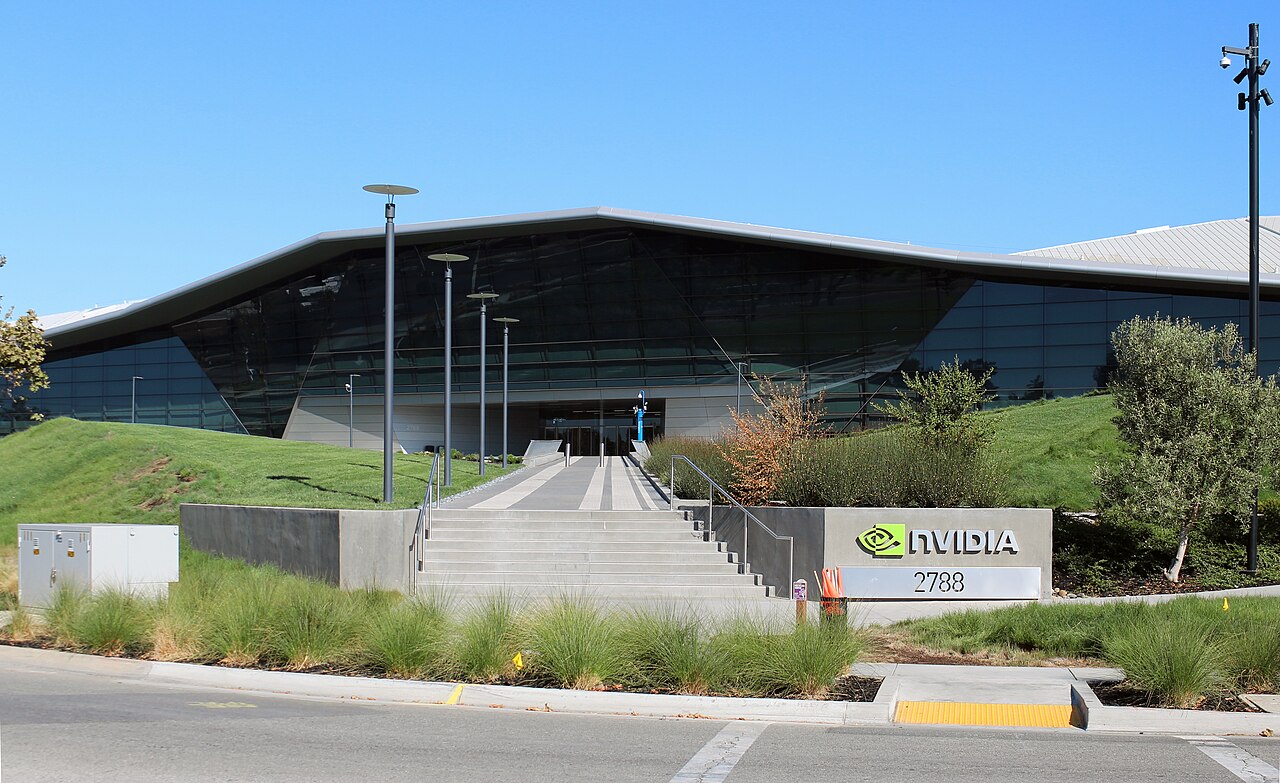
Header image: the entrance to Nvidia's Endeavor headquarters building at 2788 San Tomas Expressway, Santa Clara, California, by Coolcaesar via Wikimedia Commons, licensed under CC BY-SA 4.0. In-body photograph of the walkway to Nvidia's Endeavor headquarters entrance by Daniel J. Prostak / Crocodiletiger~commonswiki via Wikimedia Commons, licensed under CC BY-SA 4.0.