New data from IDC, reported by Reuters on October 13, 2026, shows Nvidia holding 34% of China's data-center AI chip market in the first half of 2026, with Huawei at 28%, according to coverage by Mexico Business News and Crypto Briefing. Nvidia shipped 678,000 accelerators in January to June, down 44% from a year earlier. Huawei shipped 572,000, up from just over 300,000.
 NVIDIA
What IDC reported
The same coverage lists total H1 2026 shipments in China at 2.008 million units, with IDC projecting 19% growth in total market volume for the full year. After Nvidia and Huawei, IDC puts Alibaba's T-Head at 7%, Cambricon at 5%, Baidu's Kunlunxin at 4% and Hygon at 3%. IDC tracks 11 Chinese suppliers, and nine of them grew shipments year over year.
China AI accelerator share by vendor, H1 2026
Percent of units shipped, per IDC. The six named vendors total 81%; the other 19% is not itemised in the coverage.
Source: IDC, as reported by Reuters on October 13, 2026 (via Mexico Business News and Crypto Briefing). Hover a bar for details.
The six named vendors add up to 81%, so roughly 19% of units sit with suppliers the coverage does not itemise. Mexico Business News also notes that IDC did not say which Nvidia models made up its 34%, or whether the figures include illicit imports of banned chips such as the B200 and B300.
The shift from GPUs to other accelerators
The split by chip type may be the more structural signal. GPU shipments fell 26% to 991,000 units, while non-GPU accelerators rose nearly 80% to about 1.016 million units, overtaking GPUs by volume. Huawei, T-Head, Kunlunxin and Cambricon together hold 95% of the non-GPU category.
A quick check on the arithmetic: 991,000 plus 1,016,000 is 2.007 million, matching the 2.008 million total within rounding. Non-GPU parts are therefore about 51% of units and GPUs about 49%. Dividing the vendor figures by the total gives roughly 33.8% for Nvidia (678,000 / 2.008 million) and 28.5% for Huawei (572,000 / 2.008 million), consistent with the reported 34% and 28%.
A 44% fall for the incumbent and a near doubling for its largest domestic rival can both be true while the market itself keeps growing.
Reading of the IDC figures above
Context: export controls and domestic substitution
Coverage attributes much of Nvidia's decline to US export controls, which narrow the products it can legally sell in China. Chinese authorities also require local firms to obtain regulatory approval before importing compliant Nvidia chips and encourage homegrown alternatives, per Mexico Business News. Nvidia did not respond to requests for comment, and the article quotes Jensen Huang as saying the policy "forced a US company to cede" a US$50 billion Chinese AI chip market to Huawei.

How this compares with 2025
IDC's earlier full-year 2025 data, reported by Reuters in April and summarised by The Decoder, put Nvidia at about 2.2 million cards and a 55% share of roughly 4 million shipped, with Chinese vendors at nearly 41% combined and Huawei at about 812,000 chips. Moving from 55% to 34% is a large swing, but the two datasets are not identical: the 2025 figure covers the AI accelerator server market for a full year, while the 2026 figure is a half-year data-center AI chip share. Treat the comparison as directional rather than exact.
Huawei's H1 2026 shipments of 572,000 are already about 70% of its 2025 full-year total (572,000 / 812,000), on a half-year basis. Whether the second half repeats that pace is not something the IDC release can answer.
What to watch
- Unit counts versus capability. Shipments say nothing about per-chip performance, software maturity or how much work each unit does.
- Grey-market volume. IDC's treatment of illicit imports is unspecified, so the true Nvidia footprint in China could differ from the 34% figure.
- Full-year totals. IDC expects total volume to grow 19% in 2026 and GPU shipments to fall 9%, so the second half will show whether the GPU decline narrows.
- Policy changes. Both US licensing rules and Beijing's import approvals directly shape what each vendor can sell.
For teams building on AI, the practical takeaway is that hardware supply differs by region and can change quickly, which is one reason model-agnostic tooling such as Metir is designed to avoid tying workloads to a single provider.
Sources:
- Nvidia's China AI Chip Share Drops to 34% as Huawei Gains Ground - Mexico Business News
- Nvidia's share of China's AI chip market falls to 34% as Huawei closes in - Crypto Briefing
- Chinese chipmakers now control 41 percent of China's AI accelerator market - The Decoder
Image credits
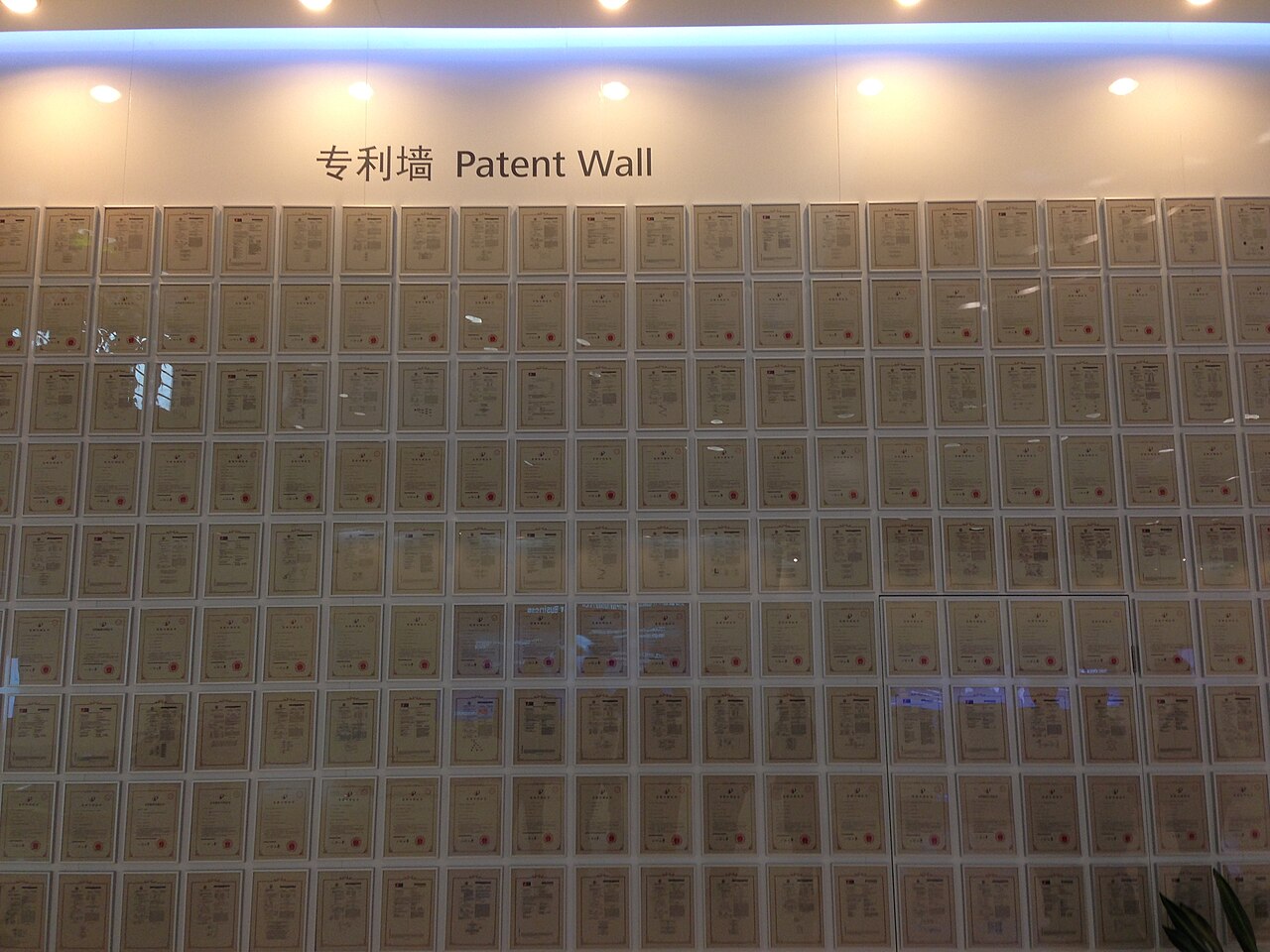
Header image: the "Patent Wall" display of framed patent certificates inside Huawei's Shenzhen campus, by RG72, Wikimedia Commons, CC BY-SA 4.0 (source); a file photo, not an image of an AI chip or of the IDC data. In-body image: a 5G exhibit at the same campus, by RG72, Wikimedia Commons, CC BY-SA 4.0 (source).