On August 5, 2026, NVIDIA made Alpamayo 2 Super available for commercial use, publishing the weights of a 34-billion-parameter vision-language-action model for autonomous driving on Hugging Face under the permissive OpenMDW-1.1 license. First previewed at GTC Taipei in late May, the model is aimed squarely at Level 4 robotaxi development, and NVIDIA says the broader Alpamayo family has now passed 500,000 downloads, which it describes as the most-adopted open reasoning model family for autonomous driving on the platform. Two things make this notable. One is architectural: Alpamayo is a "reasoning" driving model that explains its decisions, not just a black box that outputs a steering command. The other is strategic: a frontier driving model is now something a developer can download rather than something only a handful of well-funded labs possess. This piece unpacks both, and is careful about what each does and does not deliver.
What a vision-language-action model is
Traditional self-driving stacks were built as a pipeline of specialized parts: one system to detect objects, another to predict where they will move, another to plan a path, another to control the car. Each piece is engineered and tuned separately. That design is legible but brittle, and it tends to struggle most with the situations that matter most: rare, ambiguous, multi-agent scenes that do not resemble the training data.
A vision-language-action (VLA) model collapses much of that pipeline into a single learned system. Alpamayo 2 Super pairs a 32-billion-parameter vision-language backbone, built on NVIDIA's Cosmos 3 Super Reasoner and post-trained with reinforcement learning, with a 2.3-billion-parameter diffusion-based action decoder. From a single pass over full-surround camera video, it produces three things at once: a planned trajectory, a causal explanation of why it chose that plan, and a discrete meta-action. Its stated design target is precisely the long tail, the rare multi-agent situations that conventional detection-and-prediction stacks handle poorly.
Inside Alpamayo 2 Super: a vision-language-action model for driving
The model reads what the car sees, reasons about it, and outputs not just a maneuver but a stated reason for it. That explanation is the feature autonomous-driving teams have long wanted.
The causal explanation is what separates a "reasoning" driving model from a black-box end-to-end network that outputs a steering command with no inspectable rationale.
The explanation is the part worth dwelling on. An end-to-end network that maps camera pixels straight to steering is powerful but opaque; when it does something surprising, there is no inspectable reason. A model that outputs a causal rationale alongside its plan is far more useful to the engineers who have to debug it and, eventually, to the regulators who have to trust it. NVIDIA reports that Alpamayo 2 Super leads on the LingoQA Lingo-Judge metric, a benchmark of exactly this kind of driving-scene question answering, with a score of 79.2, first among nearly 40 models evaluated. Interpretability is not a nice-to-have in safety-critical autonomy; it is close to a requirement, and building it into the model rather than bolting it on afterward is the substantive design choice here.
What open weights actually change
The second story is about distribution. By releasing the weights under a license that permits commercial use, NVIDIA has changed the starting line for autonomous-driving developers. Instead of every company training a frontier driving model from scratch, a team can begin from a strong, downloadable baseline and specialize it for their vehicles, sensors, and operating domains. Reporting around the launch noted that a real carmaker had already licensed the technology.
That lowers the barrier to entry meaningfully, and it fits NVIDIA's broader commercial logic. NVIDIA does not primarily sell driving models; it sells the compute, the in-vehicle hardware, and the simulation and training platforms that autonomous programs run on. Giving away a capable base model seeds an ecosystem that consumes more of exactly those products. Open weights, in this frame, are demand generation for the platform beneath them, much as open software has long expanded the hardware it runs on.
Open weights versus the closed AV stack
Releasing a frontier driving model under a permissive license lowers the barrier to entry. It does not hand anyone a finished self-driving car. Both things are true.
- •Each company trains and guards its own driving model.
- •Full control, but every team pays the full cost of building a frontier model from scratch.
- •Little shared scrutiny; behavior is opaque to outsiders and regulators.
- •A capable base model is downloadable and usable commercially.
- •Developers start from a strong baseline and specialize, rather than starting at zero.
- •Shared weights invite inspection, but a base model is not a finished, road-ready system.
Open weights shift where the hard work sits: from building a base model to the validation, safety casework, and real-world testing that turn a model into a certified system.
Open weights change where the hard work sits, from building a base model to proving one is safe enough to drive.
What open weights do not change
It is just as important to be precise about the limits, because "open frontier driving model" can sound like more than it is.
A base model is not a self-driving car. The overwhelming majority of the effort and risk in autonomy lives after the model: validation across millions of scenarios, safety casework, redundancy and fallback systems, sensor calibration, mapping, regulatory approval, and the grinding real-world testing that surfaces the failures no benchmark captures. Downloading Alpamayo 2 Super gets a team to a much better starting point; it does not get them to a certified vehicle. The distance between the two is where autonomous-driving companies have historically spent years and billions.
A benchmark score is also not road safety. Leading on LingoQA is a real signal that the model reasons well about driving scenes in a test setting. It is not evidence of collision rates, disengagement frequency, or performance in the specific rare events that cause real crashes. Those are established only through deployment and independent scrutiny, and a strong benchmark is a reason for interest, not a substitute for that evidence.
Finally, open weights concentrate as much as they democratize. Lowering the barrier for developers also deepens their reliance on the platform the model was built for and runs best on. Access broadens; dependence on the underlying stack can quietly grow at the same time. That is not a criticism so much as a feature of how open ecosystems tend to work, and it is worth naming plainly.
The read-through
For the wider field, Alpamayo 2 Super is a clean example of a pattern that has already reshaped language models arriving in a physical domain: a capable frontier model released as open weights, resetting where teams start and pushing the hard, differentiating work downstream toward data, validation, and deployment. The same dynamic is visible across AI, and the durable strategy for anyone building on top of models is consistent whether the model drives a car or answers an email: start from the best available baseline, keep the freedom to swap it as better options appear, and avoid hard-wiring a product to a single provider's stack. Model-agnostic tools such as Metir AI reflect that stance in software; NVIDIA's open release reflects the supply side of it in autonomy.
The bigger picture
Alpamayo 2 Super matters on two levels. Technically, it advances the case that autonomous driving is moving toward large, reasoning models that plan and explain in one system, with interpretability built in rather than added later, and it puts a leading example of that approach in the open. Strategically, it shows NVIDIA using open weights to seed an ecosystem around its platform, broadening who can build a robotaxi while deepening what that building depends on. The measured conclusion is that the release lowers the barrier to entry and raises the baseline for the field, which is genuinely significant, without shortening the long, unglamorous road from a capable model to a car that is proven safe enough to carry passengers on its own.
Sources:
- NVIDIA Alpamayo 2 Super, the Frontier Open Model for Robotaxis and Autonomous Vehicles, Now Available for Commercial Use | NVIDIA Blog
- NVIDIA Launches Alpamayo 2 Super Open Reasoning Model for Robotaxis | NVIDIA Newsroom
- NVIDIA Releases Alpamayo 2 Super: A 34B Open Vision-Language-Action Model for Robotaxis and Autonomous Driving Under OpenMDW-1.1 | MarkTechPost
- NVIDIA's Alpamayo 2 Super Opens Robotaxi Development to Commercial Use | Unite.AI
Image credits
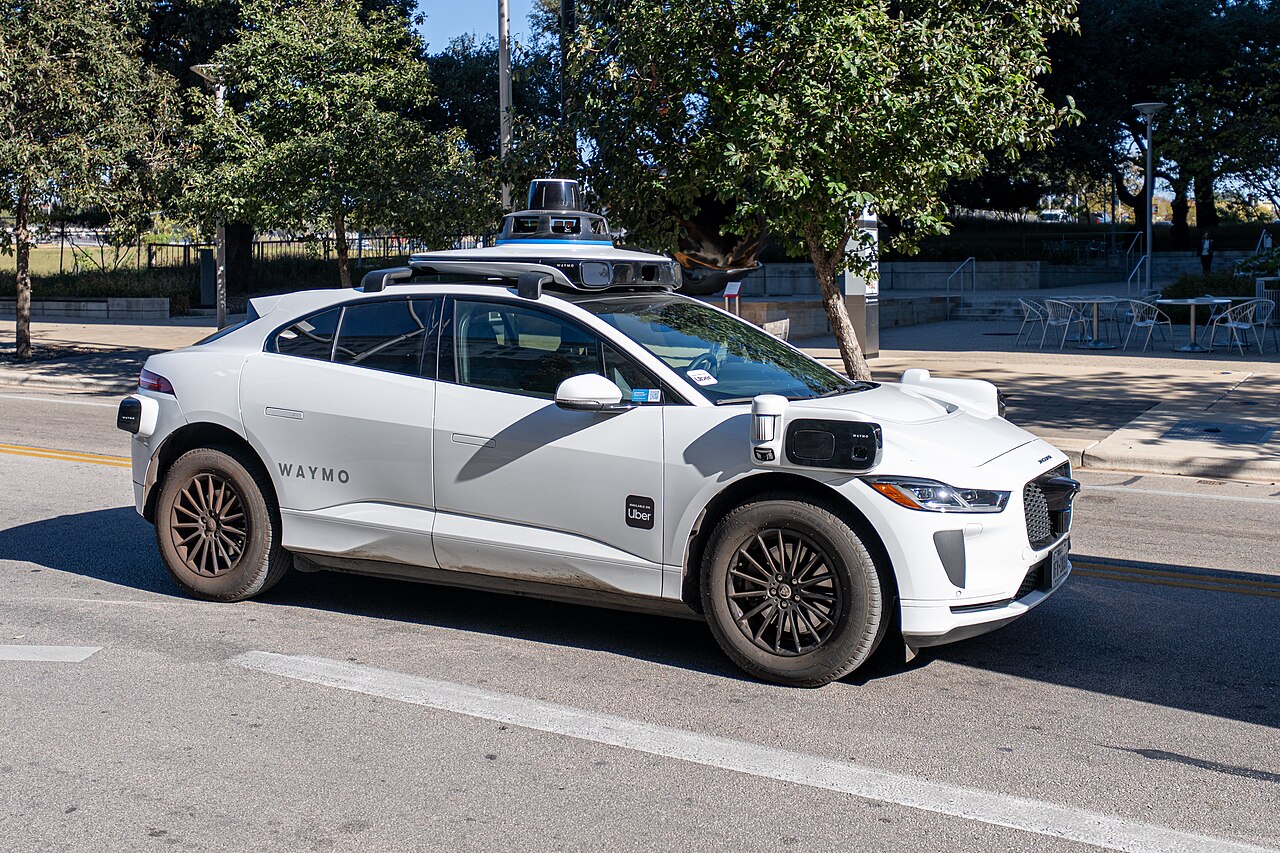
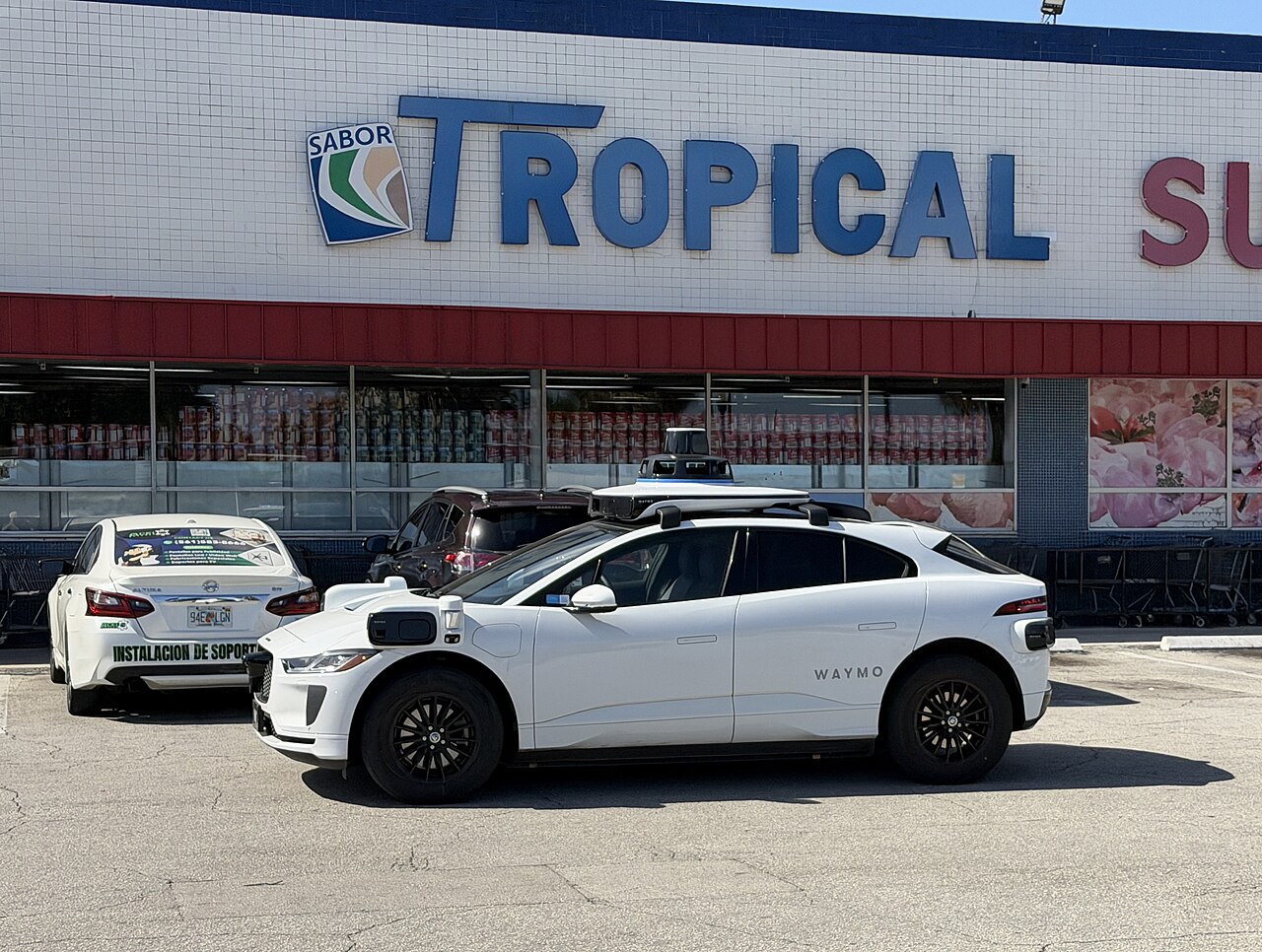
Header image: a Waymo autonomous Jaguar I-PACE on a street, by ajay_suresh via Wikimedia Commons, licensed under CC BY 4.0. In-body photograph of a Waymo robotaxi in West Miami by Phillip Pessar via Wikimedia Commons, licensed under CC BY 4.0. Both images illustrate the Level 4 robotaxi category; the vehicles shown run their operators' own systems, not Alpamayo 2 Super.