On July 8, 2026, Mistral released Robostral Navigate, an 8-billion-parameter model that lets a robot find its way through an unfamiliar building using a single ordinary camera and a sentence of plain-language instruction. No LiDAR, no depth sensors, no multi-camera rig. That constraint, one RGB camera doing the work a whole sensor stack usually does, is why the release drew attention well beyond the robotics community. It is also a useful window into where "physical AI" is actually heading in 2026.
This is an analytical look rather than a product review: what the model does, why the single-camera choice is significant, how this class of model works, and what the open questions are. The neutral reading is that Robostral Navigate is a meaningful data point, not a finished revolution.
 Mistral AI
What the model does
Robostral Navigate takes two inputs: an image from the robot's camera and a natural-language command such as "Leave the lobby, walk through the corridor, enter the supply room, and stop to face the second shelf." From those, it outputs either a pointing coordinate in the current view, a target to move toward, or a small local displacement, a step in a direction. The robot acts, the camera produces a new frame, and the loop repeats until the instruction is satisfied.
Crucially, Mistral reports that the model generalises across body types. The same model is described as working on wheeled, legged and flying robots, and across suppliers, rather than being tuned to one chassis. That portability across form factors is part of the claim, and if it holds up in the field, it matters as much as the raw score.
The number that mattered
On unseen tasks in R2R-CE, a standard benchmark for following language instructions to navigate through continuous, previously unseen environments, Robostral Navigate reached a 76.6% success rate. The headline figure is not the absolute number, though, but the comparison.
Navigation success without the sensor stack
Success rate on unseen R2R-CE navigation tasks, July 2026. The reference figures are derived from Mistral’s reported margins over the best single-camera and best depth or multi-camera systems. Higher is better.
The result that drew attention was not the top score alone, but that it came from a single ordinary camera rather than a depth-and-LiDAR rig.
Mistral reports that the model beats the best prior single-camera approach by 9.7 points and, more strikingly, beats the best depth or multi-camera system by 4.5 points. The second margin is the interesting one. For years the assumption in navigation was that richer sensing wins: give the robot depth cameras and LiDAR and it will understand space better than a system working from flat RGB frames. A single-camera model matching and exceeding that hardware suggests the bottleneck has been shifting from sensors to the model doing the interpreting.
The bottleneck has been shifting from sensors to the model doing the interpreting.
Why a single-camera result drew notice
A note on the chart: the two reference bars are derived from Mistral's reported margins rather than independently published scores, so they should be read as the article's reconstruction of the gap, not as separate official figures. The takeaway does not depend on the exact reference values; it depends on the direction and size of the lead.
Why "one camera" is the real story
Removing the sensor stack is not a party trick. It changes the economics and reach of robot deployment in several concrete ways.
- Cost. LiDAR units and depth-camera arrays are among the more expensive components in a mobile robot. A capable single-RGB approach lowers the bill of materials, which widens the set of tasks where a robot is worth building at all.
- Form factor. Fewer sensors mean smaller, lighter, simpler machines. That especially helps flying robots, where every gram of sensing hardware is a tax on flight time and agility.
- Retrofit. Ordinary cameras are already everywhere. A navigation model that runs from a single RGB feed can, in principle, be added to existing hardware rather than requiring a purpose-built sensor platform.
- Generalisation. A model that learned to navigate from plain images, rather than from a specific depth-sensor configuration, is less tied to one hardware setup, which is consistent with Mistral's cross-form-factor claim.
The counterpoint deserves equal weight. Depth and LiDAR earned their place because they are robust in conditions where cameras struggle: darkness, glare, featureless corridors, transparent or reflective surfaces. A benchmark win on curated unseen scenes is genuine evidence, but it is not yet the messy, safety-critical reality of a warehouse at 3 a.m. The honest position is that single-camera navigation has become viable and competitive, not that dedicated sensing is obsolete.
How this class of model works
Robostral Navigate belongs to a family often called vision-language-action, or VLA, models. The idea is to fuse three things a robot needs and that used to be handled by separate, hand-built subsystems: seeing the world, understanding an instruction in ordinary language, and choosing an action. Instead of a perception module feeding a mapping module feeding a planner, a single learned model maps pixels and words directly to a next move.
The training approach is as notable as the architecture. Mistral reports the model was trained entirely in simulation, on roughly 400,000 trajectories across about 6,000 scenes, then applied to real robots. Training in simulation is attractive because data is cheap and safe to generate at scale, and the fact that a simulation-trained policy transfers to physical machines at all reflects how far sim-to-real methods have come. The standing caveat, the "reality gap" between simulated and real physics, lighting and sensor noise, is exactly where field performance will be won or lost, and it is not something a benchmark can fully settle.
The strategic frame
Robostral Navigate did not appear in isolation. It follows Mistral's May 2026 acquisition of Emmi AI and reads as a deliberate push into industrial robotics by a lab previously known for language models. That a frontier language-model company is now shipping embodied navigation is itself the trend: the same organisations that built text and code models are extending into physical action, and the week's robotics conversation, alongside continued humanoid demonstrations from established players, reflected that widening scope.
Two structural threads run through it. First, the value in robotics is migrating from bespoke hardware and sensing toward general, learned models that can sit on top of many machines, much as it earlier migrated in software from custom systems toward general-purpose models. Second, releasing a navigation model that works across suppliers and form factors nudges the field toward a layered stack, hardware from one vendor, the "driving" intelligence from another, echoing how the software AI market already separates the model from the application on top of it.
Where a builder should keep perspective
For anyone outside robotics, the practical relevance is less about this specific model and more about the direction it marks. "AI work" is broadening from text and images toward action in the physical world, and the same lesson that applies to language models applies here: the intelligence layer and the thing it runs on are becoming separable, and betting everything on one vendor's full stack is riskier than keeping the layers loosely coupled. Whether the work is drafting a document across the best available model or, eventually, directing a machine, the durable posture is to treat the model as a swappable component rather than a permanent foundation, the same flexibility that model-agnostic tools like Metir AI bring to knowledge work today.
The takeaway
Robostral Navigate is a strong signal wrapped in appropriate caveats. Matching and beating multi-sensor systems from a single RGB camera, generalising across robot bodies, and doing it from a simulation-trained 8B model is a real advance in how cheaply and broadly navigation can be deployed. It is not a claim that dedicated sensing is finished, nor proof that benchmark success survives contact with the hardest real-world conditions. Read plainly, it is one more marker that the frontier is moving from models that talk toward models that act, and that the intelligence, not the sensor, is increasingly where the differentiation lives.
Keep your AI flexible as it moves into the physical world
Embodied AI is early, but its lesson is familiar: the model is a component, not a commitment. Metir AI lets you work across the leading AI models in one place, so you can always reach for the best tool as the field evolves. Try Metir AI free and keep your options open.
Sources:
- Robostral Navigate: single-camera AI navigation | Mistral AI
- Mistral AI's First Robot Model Navigates Using a Single Camera | eWeek
- Mistral Introduces Robotics AI That Requires Only One Camera | PYMNTS
- Mistral's Robostral Navigate Steers Robots With a Single Camera | Technology.org
- Mistral Launches Robostral Navigate, Its First Robotics Model for Physical AI | Nerova
Image credits
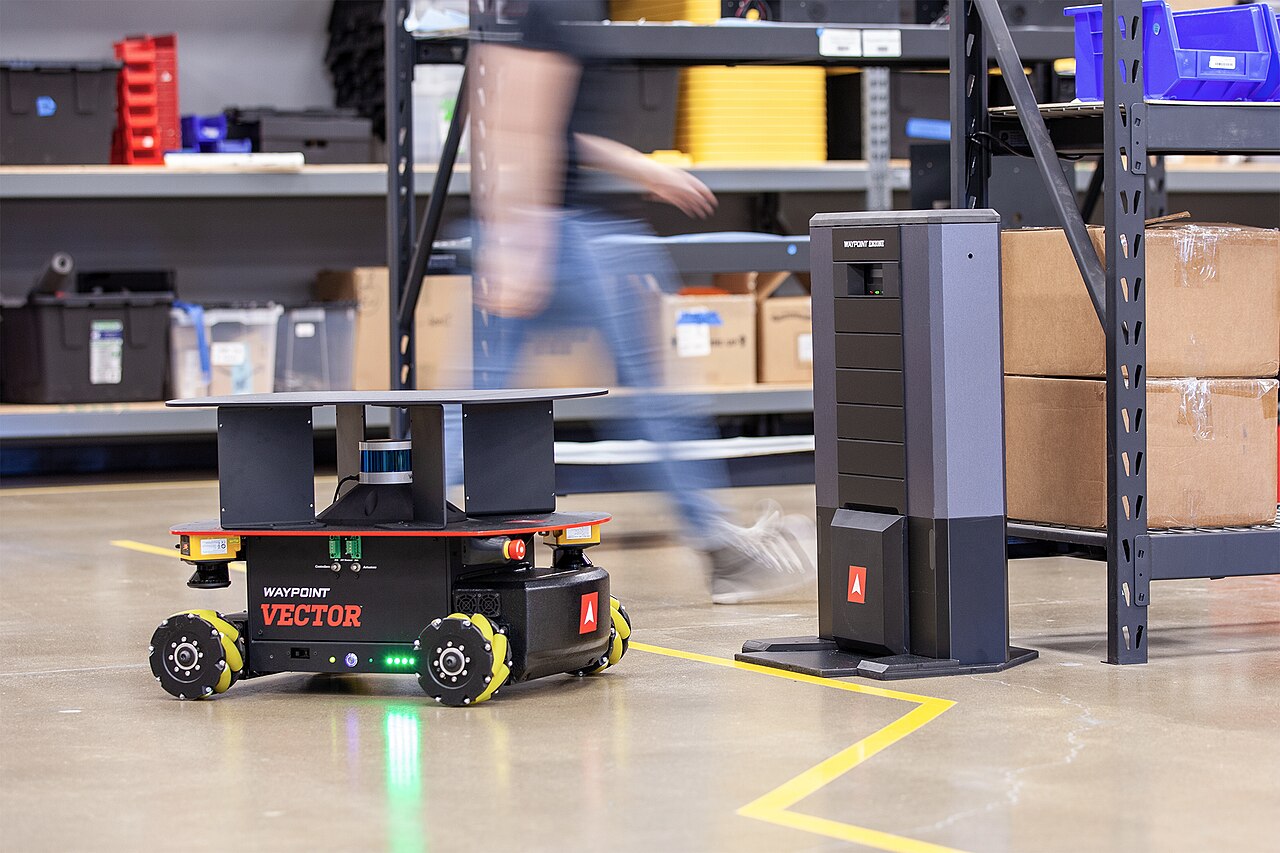
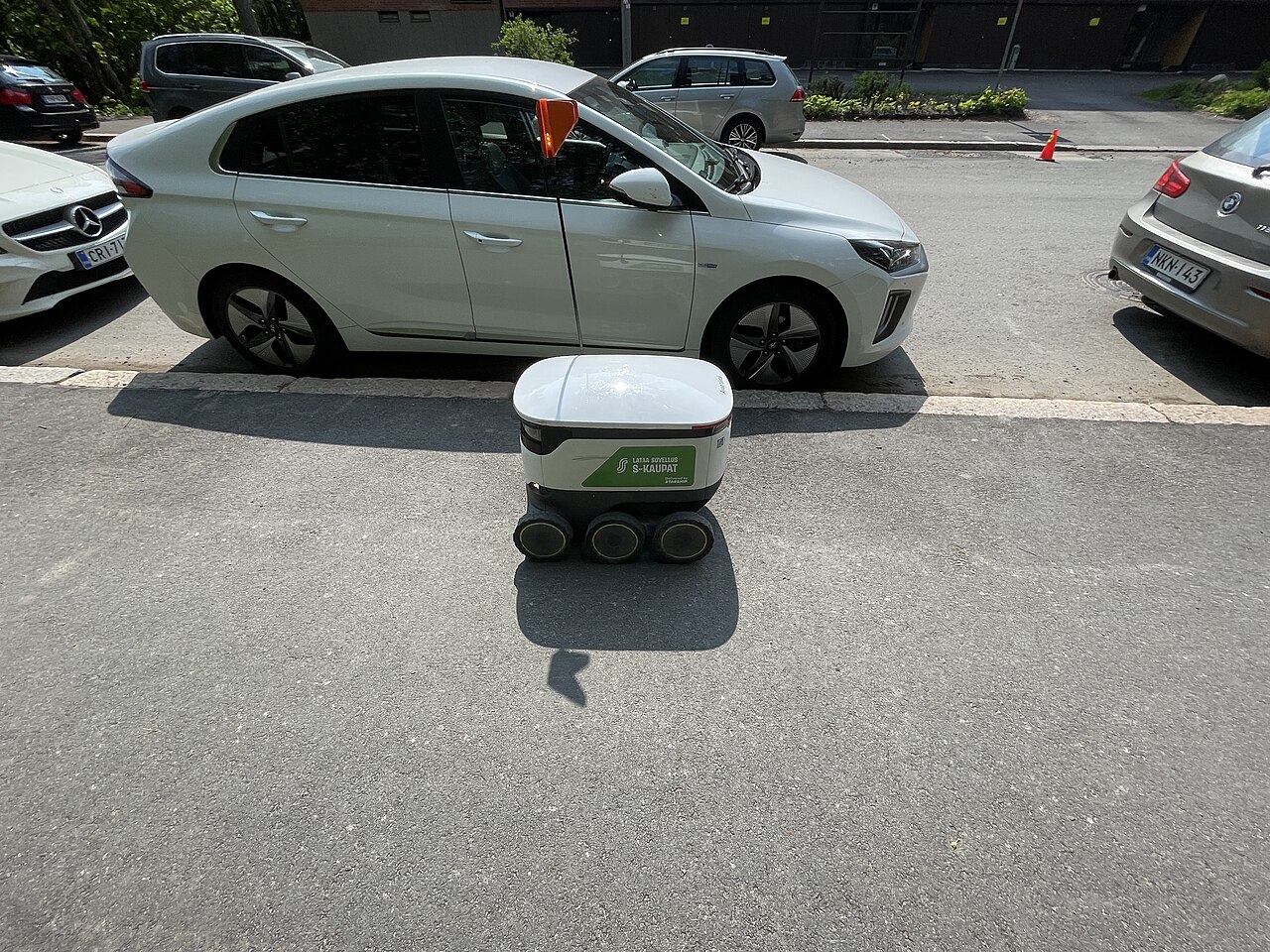
Header image: Waypoint Vector autonomous mobile robot, by PattyK33 via Wikimedia Commons, licensed under CC BY-SA 4.0. The robot's roof-mounted LiDAR is the kind of sensor hardware single-camera navigation aims to do without. In-body image: grocery delivery robot by Ypsilon from Finland via Wikimedia Commons, released under CC0.