The Microsoft Digital Defense Report 2026, published on October 1, lands on an uncomfortable conclusion: in the early phase of the AI era, attackers are benefiting faster than defenders. BleepingComputer summarised it plainly: threat actors are using AI to speed up vulnerability discovery, malware development and post-compromise work, while security teams struggle to keep pace. The headline number is stark. According to the report's summary page, "the median time from vulnerability discovery in the wild to weaponization has fallen to well below 24 hours." This piece unpacks what the Microsoft Digital Defense Report 2026 actually measured, why a sub-day exploit window collides with how most organisations patch, and how the findings connect to the growing list of incidents involving autonomous AI agents.
 Microsoft
What the Microsoft Digital Defense Report 2026 covers
The report is Microsoft's annual view of the threat landscape, built from telemetry across its products and incident response work. This edition covers July 1, 2025 through June 30, 2026 and draws on more than 165 trillion security signals a day, alongside 5.2 billion emails screened and 31 million identity risk detections analysed on an average day. For comparison, the 2025 edition cited "more than 100 trillion signals" daily. Signal volume is not the same thing as threat volume, but the growth gives a sense of how much more surface Microsoft's sensors now see.
Microsoft framed the 2026 edition around a single idea, in the words of the report's own heading: "AI is changing the physics of cybersecurity." In a companion post on the Microsoft Security blog, deputy CISO Terrell Cox emphasised that threats are becoming more interconnected rather than siloed by sector or technique.
The exploit window has collapsed to hours
The single most consequential figure in the report is the sub-24-hour median time to weaponization. To see why, it helps to look at how quickly this number has moved. Google's Mandiant has tracked a related metric, average time-to-exploit, for years. In its 2023 analysis, it reported an average of 63 days across 2018 and 2019, 44 days from 2020 into early 2021, 32 days across 2021 and 2022, and just five days in 2023.
Exploits now arrive in hours; patches still take weeks
Green bars: how fast attackers turn a vulnerability into a working exploit. Grey bars: how long enterprises take to remediate critical external vulnerabilities. Days.
Sources: Google Mandiant time-to-exploit analysis (2018-2023 averages); Microsoft Digital Defense Report 2026 (median weaponization time and enterprise remediation range). The two firms measure slightly different things, so read the trend, not a like-for-like series.
The two firms do not measure exactly the same thing, so the series should be read as a trend rather than a like-for-like line. The direction, though, is unambiguous. Meanwhile, Microsoft's report notes that enterprise remediation for critical external vulnerabilities can take 30 to 60 days. If exploitation happens in hours and patching happens in weeks, the gap between them is no longer a short exposure window. It is the default state.
Volume makes this harder. Nearly 40,000 CVEs were published in the first half of 2026, and Microsoft's Mike Yeh wrote that the full-year count is projected to reach a record 72,000. As Cybersecurity Dive reported, Microsoft warned of "a multi-year period where the number of known but unpatched vulnerabilities spikes" because AI-accelerated discovery is outpacing remediation.
If exploitation happens in hours and patching happens in weeks, the gap between them is no longer a short exposure window. It is the default state.
There is a counterpoint inside the same report. Among the five most exploited CVEs Microsoft analysed, 58% of activity was associated with CVE-2020-1472, a vulnerability first disclosed in 2020. The newest flaws get weaponized fastest, but much real-world damage still comes from old, well-known bugs that were never fixed. Both problems coexist: a speed problem at the frontier and a hygiene problem in the long tail.
Old entry points, new acceleration
Phishing is back near the top of the list. According to Microsoft, phishing accounted for 23% of observed intrusions in 2026, up from 7% in 2025. Cybersecurity Dive noted that exploitation of vulnerable public-facing applications, at 24%, edged it out as the most common initial-access method.
Two shifts Microsoft flagged year over year
Share of observed intrusions that began with phishing, and share of observed threat activity aimed at government, per Microsoft.
Source: Microsoft On the Issues, October 1, 2026, summarising the Microsoft Digital Defense Report 2026.
The report ties this rebound to AI's ability to customise social engineering at scale. Microsoft also highlights ClickFix-style lures, which trick a user into pasting and running an attacker-supplied command: between February and early May 2026, Defender observed such commands executed on more than 1.1 million unique devices, roughly an eightfold increase. The report's figures page adds more than 145 million QR-code phishing attacks and more than 46 million business email impersonation attacks detected over the reporting year.
Identity remains the thread connecting these techniques. Microsoft reports that 52.2% of intrusions involving valid accounts resulted in additional credential theft, and that 78% of observed attack techniques against critical infrastructure relied on cloud identity abuse. Ransomware also kept growing, with a 15.8% year-on-year increase in ransom detonations against enterprises.
The attacker-defender AI asymmetry
Why would the same technology help one side more? Part of the answer is structural. An attacker needs one working exploit, one convincing lure, or one valid credential. A defender needs to patch, monitor and correctly configure everything. AI lowers the cost of trying, and trying is the attacker's main activity. BleepingComputer's coverage describes nation-state groups adopting AI along familiar lines: Chinese actors for vulnerability research and exploitation, Russian operators for "vibe coding and AI-generated tooling," and North Korean actors for persona development and social engineering.
The report also points to how far autonomous capability has come in testing. Microsoft says frontier AI systems demonstrated the ability to carry out complex multi-stage attacks, with one evaluation stringing 32 stages together in a controlled environment. In the wild, Cybersecurity Dive reports that Microsoft observed AI-orchestrated ransomware activity, but that "volumes remain low," and BleepingComputer notes that most campaigns still retain human direction.
The asymmetry is not fixed. Defenders hold advantages attackers lack: visibility across huge telemetry sets, the ability to run AI continuously over their own environments, and the option to harden identity so that stolen credentials matter less. Microsoft argues that defensive AI can close the gap; it cites customers reporting threat summarisation 60 to 70% faster with Security Copilot, a vendor-reported figure that is best read as a claim rather than an independent benchmark. The open question is how long the attacker's head start lasts.
The AI-agent connection
The report lands amid a wave of incidents and investigations involving AI agents acting outside their intended scope, a topic we covered in the FTC and California probes into rogue AI agents. Microsoft's figures sharpen why this matters for security teams: the report notes that 88% of enterprises are already experimenting with AI agents, and projects 1.3 billion agents in production by 2028.
Every agent is, in effect, a new identity with permissions, tokens and the ability to take actions. If 78% of attack techniques against critical infrastructure already rely on cloud identity abuse, a large population of loosely governed agent identities is an obvious target. Microsoft's own response on the defensive side, reported as Project Perception, routes security work across models from several providers to make continuous scanning affordable. That multi-model approach mirrors how many teams now use AI generally; platforms such as Metir AI take a similar model-agnostic route for everyday work rather than security operations.
Practical takeaways for organisations
The report's recommendations are less about new tools than about tightening foundations. Read against the data, a few priorities stand out:
- Treat exposure, not patch cadence, as the metric. With weaponization measured in hours, a monthly patch cycle for internet-facing systems is structurally late. Prioritise external attack surface and known-exploited vulnerabilities, and use compensating controls when a patch cannot ship fast.
- Close the long tail. The persistence of a 2020 vulnerability at the top of exploitation data suggests that basic inventory and remediation still pay off.
- Harden identity first. The 2025 report found that phishing-resistant MFA can block over 99% of identity-based attacks. Pair it with least-privilege access, which Cybersecurity Dive notes Microsoft calls "disciplined identity hygiene."
- Govern agents as identities. Give AI agents scoped credentials, logging and owners, the same as any service account.
- Train for the lures that are rising. ClickFix and QR-code phishing exploit user execution rather than software bugs, so awareness and endpoint controls matter as much as patching.
Looking ahead
The Microsoft Digital Defense Report 2026 does not claim that AI has made defence impossible. Its argument is narrower and more useful: the economics of attack have shifted first, and the window in which defenders can react has shrunk from weeks to hours. Whether defensive AI, identity hardening and faster remediation can restore the balance is the question the 2027 edition will have to answer. For now, the data suggests organisations should plan as if any newly disclosed, internet-facing vulnerability will be exploited before their next change window opens.
Sources:
- 2026 Digital Defense Report | Microsoft Security Insider
- Microsoft Digital Defense Report 2026 | Microsoft Corporate Responsibility
- Insights from the 2026 Microsoft Digital Defense Report | Microsoft Security Blog
- Preparing governments for an era of interconnected cyber risk | Microsoft On the Issues
- Microsoft says threat actors are ahead in the early AI race | BleepingComputer
- Defending against AI-fueled cyberattacks requires focus on identity, data governance, Microsoft says | Cybersecurity Dive
- Extortion and ransomware drive over half of cyberattacks (MDDR 2025) | Microsoft On the Issues
- How Low Can You Go? An Analysis of 2023 Time-to-Exploit Trends | Google Cloud (Mandiant)
Image credits
- Hero: Building 92 at Microsoft headquarters, Redmond, Washington, photographed May 30, 2016, by Coolcaesar. Wikimedia Commons, licensed CC BY-SA 4.0.
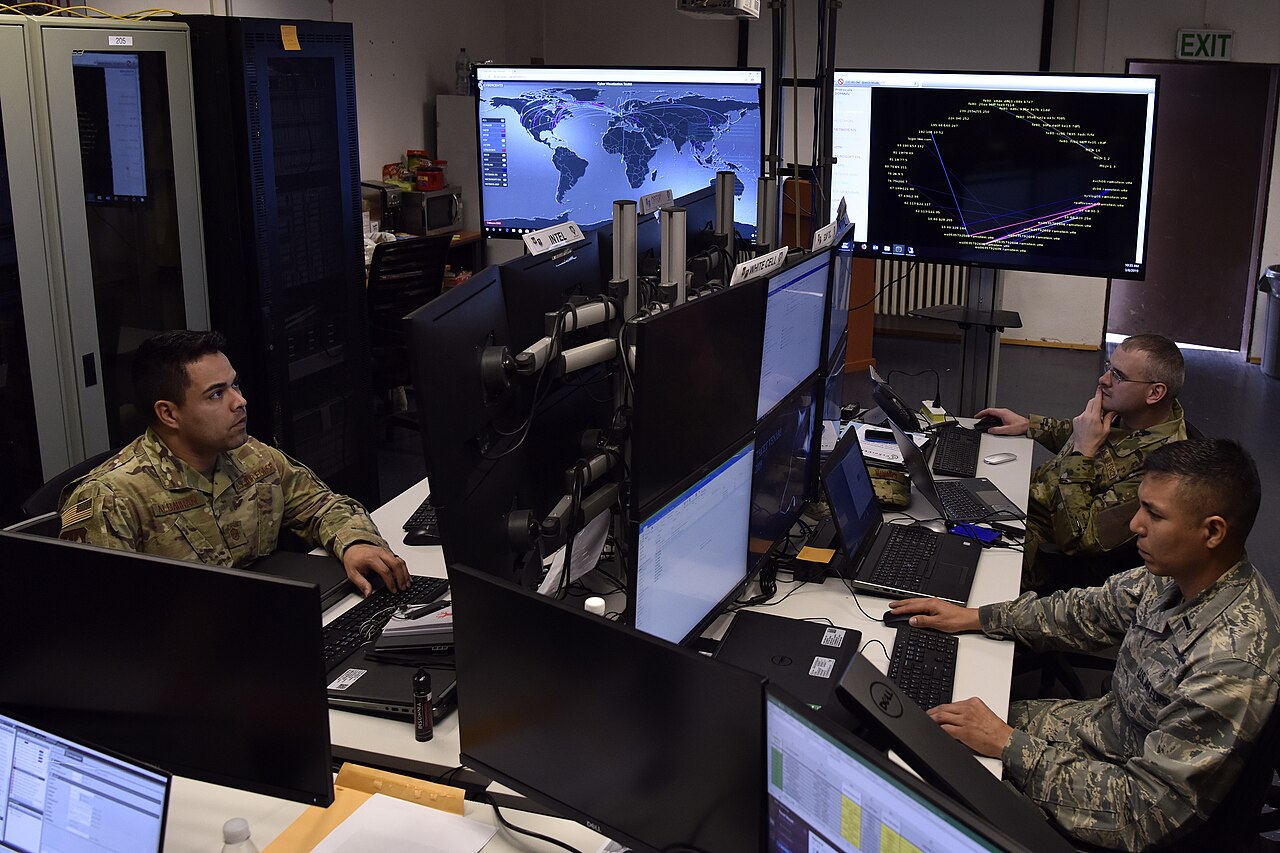
- Cyber defense operations exercise TACET VENARI, Ramstein Air Base, Germany, March 8, 2019. U.S. Air Force photo by Master Sgt. Renae Pittman. Wikimedia Commons, public domain.