Microsoft is planning to nearly triple its global data center power capacity, from roughly 12 gigawatts today to more than 38 gigawatts by 2032, according to a Bloomberg report published September 10, 2026, and corroborated by subsequent coverage from Reuters, Dataconomy and Yahoo Finance. The plan adds about 26 gigawatts of new capacity across owned and leased facilities, a build-out scale that puts the number in the same conversation as national power grids rather than ordinary corporate real estate. This piece walks through what the plan actually says, why the industry now talks in gigawatts instead of dollars, an accounting change buried inside the capex guidance that is easy to misread, and what the buildout implies for anyone who depends on cloud AI capacity.
 Microsoft
 NVIDIA
 OpenAI
What Microsoft actually announced
The reported plan is a capacity target, not a single facility or a single check. Microsoft's compute footprint today sits at approximately 12 gigawatts of total power capacity across its data centers worldwide. The 2032 target of more than 38 gigawatts would add roughly 26 gigawatts of new capacity over the intervening years, spread across new construction and additional leased space from third-party data center operators. Bloomberg's reporting frames the expansion partly as a response to capacity constraints that have already cost Microsoft cloud business, a signal that demand for Azure compute, including AI workloads, has outrun the company's ability to bring capacity online fast enough.
The pace of recent construction gives some sense of what a plan this size requires in practice. According to a September 11 roundup from Dataconomy citing Microsoft's own disclosures, the company brought 88 data center sites online during fiscal 2026, including 31 in a single quarter. Reaching 38 gigawatts by 2032 would mean sustaining or exceeding that build rate for several more years, a logistics and construction challenge as much as a financial one.
Why gigawatts, not dollars, is the number that matters
For most of the past decade, cloud capacity was measured and discussed in terms of servers, racks or dollars of capex. The shift to gigawatts as the headline unit reflects a real change in what constrains the industry. Accelerator chips from suppliers like Nvidia are, at this point, available in large volumes to hyperscalers willing to pay for them. What is scarce is the electricity to run those chips, the substations and transmission lines to deliver that electricity to a building, and the cooling infrastructure to remove the heat the chips generate. A rack of accelerators is only useful if there is power to feed it and a grid interconnect that can supply that power reliably.
That is why capacity is now quoted in gigawatts: it is the unit that actually caps how much AI compute a company can stand up, independent of how many chips it can buy. A company that has ordered enough GPUs to fill 20 gigawatts of data centers but has only 12 gigawatts of grid-connected capacity is, for practical purposes, a 12 gigawatt company until the power arrives. Microsoft's plan to more than triple its capacity is, read this way, less a statement about ambition and more an acknowledgment that power and interconnect access, not chip supply, is the binding constraint on how fast AI infrastructure can grow.
The AI-specific mix is shifting faster than the total
Inside the 12 gigawatts Microsoft operates today, only about 2 gigawatts is dedicated to AI-specific chips, with the remainder serving general-purpose cloud computing, storage and the rest of Azure's traditional workloads. By 2032, AI-specific capacity is expected to reach roughly one third of the 38 gigawatt total, which works out to somewhere in the range of 12 to 13 gigawatts of AI-dedicated infrastructure. That is a roughly six-fold increase in AI-specific capacity, compared with the overall tripling of total capacity.
That mix shift is the more informative number than the total, because it shows where the new capacity is actually going. General-purpose cloud growth tends to track existing enterprise IT demand fairly predictably. A six-fold increase in AI-dedicated power, against a threefold increase overall, indicates Microsoft is building for a future in which AI inference and training account for a much larger share of its infrastructure than they do today, a bet shared to varying degrees by Amazon and Google as they pursue their own capacity expansions.
 Amazon
 Google
The accounting change hiding inside the capex number
Microsoft's capital expenditure guidance for calendar year 2026 is now reported at approximately $175 billion, with a further $50 billion guided for fiscal first quarter 2027. Coverage of the plan notes that the calendar-2026 figure was previously closer to $190 billion, and the reduction did not come from cutting construction or scaling back the buildout. It came from an accounting change: Microsoft extended the amortization schedule for data center lease expenses from 15 years to 25 years.
Stretching the amortization period spreads the same total cost over a longer span, which lowers the expense recognized in any single year, including the near term. It is important to be precise about what this does and does not mean. It changes how much capital spending shows up on the income statement and balance sheet in a given period. It does not change how much cash Microsoft is committing to build data centers, how many sites it plans to bring online, or the underlying 26 gigawatt expansion target. A company can report a smaller headline capex number in a given year for the same physical construction plan simply by changing how the expense is spread over time. Readers comparing Microsoft's capex guidance across quarters should treat the $190 billion to $175 billion change as a reporting artifact rather than evidence of a smaller buildout.
The accounting change lowers the headline number; it does not lower the number of buildings Microsoft plans to build.
Reading the capex guidance accurately
Second-order questions worth tracking
A buildout of this size raises questions beyond Microsoft's own balance sheet. Grid capacity and interconnect queues are already a bottleneck across the US and Europe, and adding 26 gigawatts of new demand, even spread over roughly six years and across many regions, will compete with other users for scarce transmission capacity and, in some markets, put upward pressure on electricity prices for nearby residential and commercial customers. Microsoft is not alone in this buildout; Amazon, Google and Oracle are each pursuing their own multi-gigawatt expansions, meaning the aggregate demand on power grids from hyperscale AI infrastructure is larger than any single company's plan suggests.
There is also a return-on-investment question that applies to the industry as a whole and that this reporting does not resolve. Committing tens of billions of dollars a year, plus long-term lease and power obligations, is only a sound bet if AI workloads eventually generate revenue commensurate with the infrastructure built to serve them. That question sits alongside, and is distinct from, the accounting nuance above; a lower headline capex figure says nothing about whether the underlying capacity will be used profitably.
What it means for buyers of AI capacity
For companies and developers who consume cloud AI capacity rather than build it, the practical takeaway is that supply constraints at the infrastructure layer, not model capability, are currently shaping what is available and at what price. Capacity that is scarce today at one provider may ease as new gigawatts come online, while a competitor facing its own interconnect delays could tighten. That volatility argues for not committing a workload permanently to a single provider's infrastructure and pricing, since the constraint driving availability and cost can shift between providers as their respective buildouts land on different timelines. Staying flexible about which provider and which model handles a given task, rather than locking into one vendor's capacity and roadmap, is the model-agnostic approach Metir AI takes at the application layer, routing work to whichever provider can serve it well.
The takeaway
Microsoft's plan to grow from roughly 12 gigawatts to more than 38 gigawatts of data center capacity by 2032 is a real and large commitment, driven by power and grid access rather than chip availability, with AI-specific capacity growing roughly six times faster than the total. The reduction in headline 2026 capex guidance, from about $190 billion to about $175 billion, reflects a change in how lease expenses are amortized, not a smaller physical buildout. Both facts matter, and conflating them, either by treating the capex cut as belt-tightening or by treating the capacity target as a done deal, would misread what has actually been reported.
Sources:
- Microsoft's AI-Focused Data Center Plan to Add 26 Gigawatts of Compute | Bloomberg
- Microsoft Plans 38 Gigawatts of Data Center Capacity by 2032, Bloomberg News Reports | Reuters via Investing.com
- Microsoft to Triple Data Center Capacity to 38 Gigawatts | Dataconomy
- Microsoft Eyes Massive Data Center Expansion | Yahoo Finance
Image credits
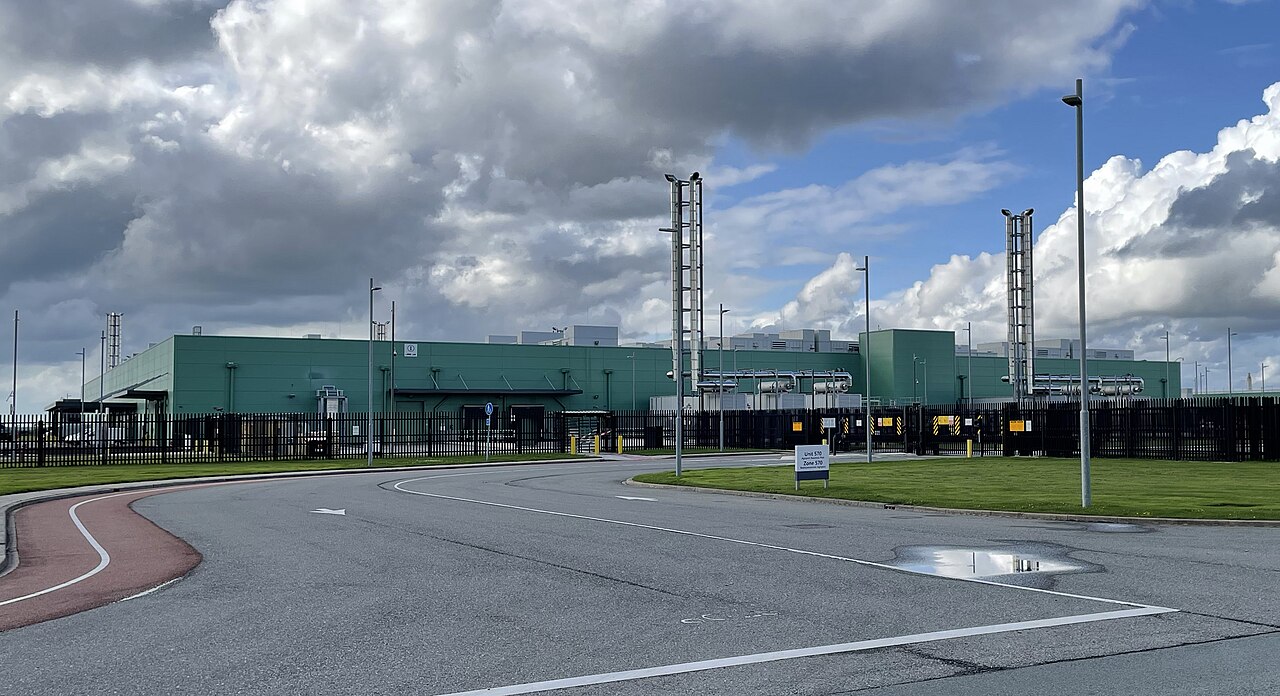
Header and in-body photograph: Microsoft data center, Middenmeer, the Netherlands, Hay Kranen, via Wikimedia Commons, licensed under CC BY 4.0.