Meta has begun asking some individual contributors inside its Applied AI division whether they want to move back into management roles, according to reporting first published by Business Insider and followed by Fortune in September 2026. The move is described as voluntary. It is also a quiet reversal of one of the most publicized organizational experiments of the past three years: Mark Zuckerberg's push to flatten Meta and let engineers, not managers, sit closest to the work.
The reversal is small in scope so far. But it lands at a moment when every large technology company is restructuring around AI, and it raises a question that matters well beyond Menlo Park: when a team's output depends on fast-moving models and constant coordination, does removing managers make it faster, or does it just move the coordination cost somewhere less visible?
What actually changed
Earlier in 2026, Meta reassigned roughly 7,000 employees into its Applied AI (AAI) group as part of a broader reshaping of its AI organization. Some of those people had previously been managers who moved into individual-contributor roles during the 2023 restructuring. Now a portion of them are being asked whether they would take management responsibilities back.
To read the shift, it helps to separate two things that often get merged. The first is headcount: how many people a company employs. The second is structure: how those people report to one another. The 2023 layoffs were about the first. The flattening was about the second, and it is the second that Meta is now adjusting inside its AI unit.
Why Meta flattened in the first place
In 2023, Zuckerberg branded the year the "year of efficiency." Meta cut roughly 10 percent of its workforce, scrapped thousands of open positions, and asked many managers and directors either to return to hands-on individual-contributor work or to leave. Internally the process was called flattening. The stated logic was that fewer layers between a decision and the code would speed the company up and cut the overhead of managers managing managers.
Meta was not alone in the idea. Wide reporting spans, sometimes summarized as a high "span of control," became a fashionable target across the industry, and the promise that AI tools would absorb routine coordination work made the case sound cleaner still. If software could track tasks, summarize status, and draft updates, the argument went, a manager could oversee far more people, or a team could need fewer managers at all.
 Meta
MetaMeta's management pendulum
The same organization can swing between removing layers and adding them back as the work changes.
Managers and directors are asked to return to hands-on roles or leave. Layers are removed to shorten the path from decision to code.
The flat model spreads. In 2026 roughly 7,000 staff are consolidated into the Applied AI division, concentrating interdependent work.
Some individual contributors in Applied AI are asked, voluntarily, to take management responsibilities again.
Sources: Fortune and Business Insider reporting, September 2026; Meta 2023 restructuring disclosures. Directional summary, not an internal org chart.
The part the model did not absorb
The current adjustment suggests the theory met a limit inside a large, fast-moving AI organization. There are two plausible readings, and the honest position is that both are consistent with what has been reported.
One reading is about capacity. A manager's job is not only status tracking, which software genuinely does help with. It is also prioritization across competing projects, unblocking dependencies between teams, performance calibration, hiring, and absorbing ambiguity so the people below can focus. Those tasks scale poorly with the number of direct reports, and they are exactly the tasks that a fast reorganization, thousands of new transfers into one division, tends to multiply.
The second reading is about coordination surface. When a company consolidates 7,000 people into a single AI push, the number of connections between teams grows much faster than the headcount does. Flattening removes the people whose explicit job was to manage those connections, so the work does not disappear. It reappears as meetings, as senior engineers spending their time on coordination instead of building, or as decisions that stall because no one owns them.
Span of control is a tradeoff, not a target
The useful way to think about this is not "flat is good" or "hierarchy is good." It is that span of control, the average number of people reporting to one manager, is a dial with costs at both ends.
Turn it too low and you get many layers, slow decisions, and managers whose main input is other managers. Turn it too high and each manager is stretched thin, coaching and calibration degrade, and the work of coordination quietly shifts onto the individual contributors who were supposed to be freed by the change. The right setting depends on how interdependent the work is. Loosely coupled work tolerates wide spans. Tightly coupled work, where one team's output constantly feeds another's, does not.
Removing a layer of managers does not remove the work those managers did. It relocates it, and the new location is often less visible than the old one.
Metir analysis
Frontier AI development is unusually tightly coupled. Data, training infrastructure, model teams, safety evaluation, and the product surfaces that ship the result all depend on one another on short cycles. That is the profile where a very wide span tends to break down first, which makes an AI division a logical place for a flattening experiment to be walked back before the rest of the company.
What it signals for AI-era org design
Meta's adjustment is a data point, not a verdict. The change is voluntary, limited to one division, and easy to overstate. What it does show is that the popular narrative, that AI tools let companies run dramatically flatter with far fewer managers, is being tested against reality inside the firms best equipped to automate management work, and the early result is more nuanced than the pitch.
The realistic conclusion is that AI is changing what coordination work looks like rather than eliminating the need for someone to own it. Tooling can compress the mechanical parts of a manager's week, the standups, the status reports, the note-taking, the follow-up tracking. It compresses far less of the judgment. Teams that treat software as a way to reduce coordination overhead, rather than as a reason to remove the people accountable for coordination, tend to get the durable version of the gain. That is also the case for keeping an organization's tools and knowledge portable across vendors rather than fused to a single model provider, so that a structure change does not force a tooling migration on top of it.
For now, Meta is doing the sensible thing an experiment is supposed to enable: reading the result and turning the dial back. The broader lesson is older than this news. Structure is a tool, its correct setting depends on the work, and the fastest-moving work usually needs more coordination, not less.
Sources:
- Mark Zuckerberg's Meta bet that AI would shrink its management ranks. Now it's quietly rebuilding them | Fortune
- Meta reversing course on flat org structure in Applied AI division | Quartz
- Meta Asks Some AI Employees To Become Managers Again In New Reorganization | RTTNews
- Mark Zuckerberg's Meta bet that AI would shrink its management ranks | Yahoo Finance
Image credits
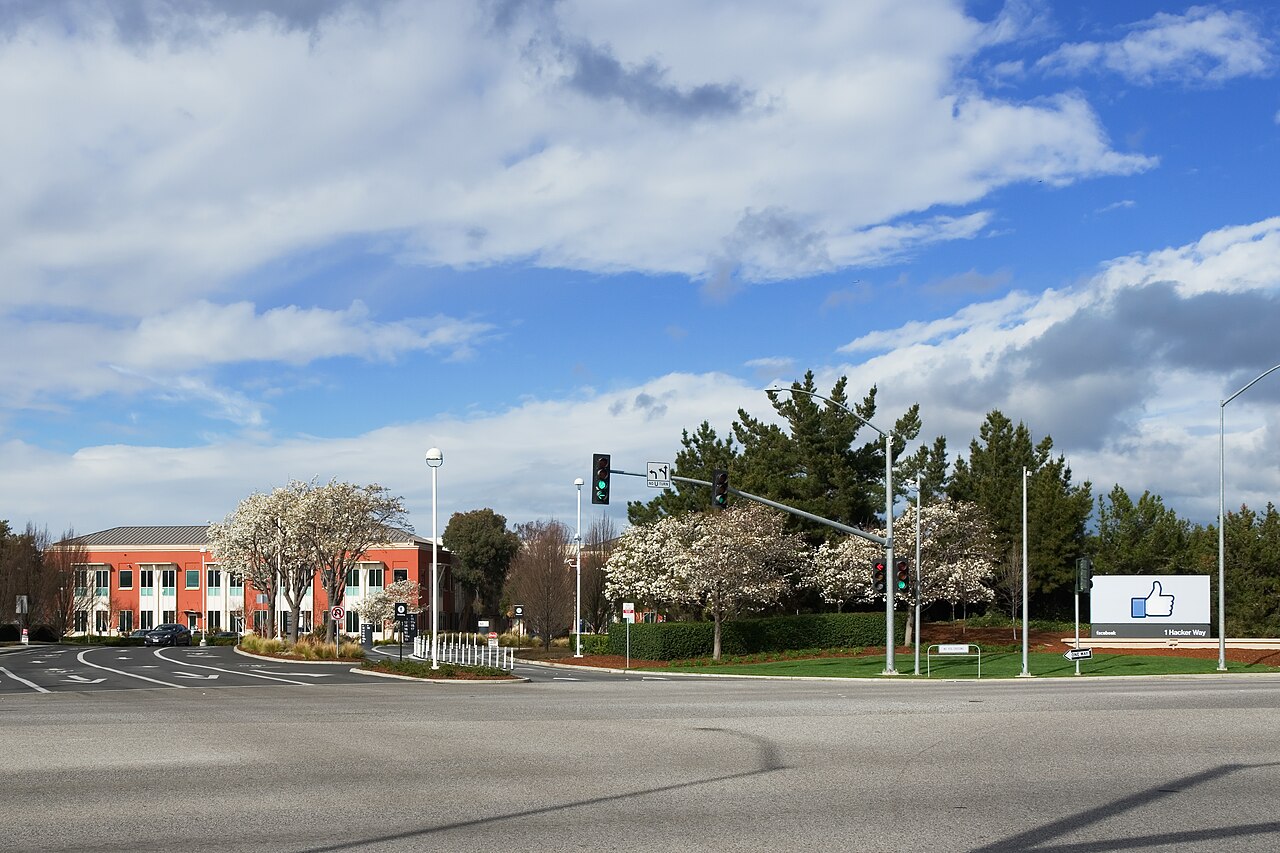
Meta headquarters, 1 Hacker Way, Menlo Park, by LPS.1, via Wikimedia Commons, released under CC0 1.0.