
Meta reported second-quarter 2026 results on July 29, and the numbers told two stories that sat uneasily together. The advertising business remained strong, with revenue up 28 percent year over year to $60.8 billion. But free cash flow collapsed 91 percent to $784 million, from $8.55 billion a year earlier, as capital spending on artificial intelligence infrastructure reached $31.1 billion in a single quarter. The stock fell in after-hours trading despite the revenue beat. This piece explains the gap between a healthy top line and a punished share price, and what it reveals about how the market is now weighing AI spending.
 Meta
Meta NVIDIA
 Microsoft
The two-sided quarter
Start with what went right. Meta's revenue of $60.8 billion, up 28 percent, beat estimates and showed the core advertising engine still running well, with AI-driven improvements to targeting and ranking often cited as a tailwind. Operating cash flow rose 25 percent to $31.86 billion. On the top line and on the underlying business, this was a strong quarter.
Now the other side. Adjusted earnings per share of $6.18 missed the roughly $7.13 consensus, dragged down by a $2.4 billion legal charge and $1.18 billion in severance costs. More consequentially for the market's reaction, capital expenditures reached $31.1 billion in the quarter, nearly double the $17.0 billion Meta spent in the same quarter of 2025. Because that capital came out of the same cash the business generated, free cash flow, the money left after investment, fell to $784 million, a 91 percent drop, according to reporting from CNBC, Axios and others.
Why a revenue beat still sank the stock
The instinct is to see a 28 percent revenue increase and expect the stock to rise. The reason it did not is that investors are no longer valuing these companies on revenue growth alone; they are watching what the AI buildout does to cash. Free cash flow is the number that funds buybacks, dividends and financial flexibility, and a 91 percent decline in it is a vivid illustration of how much of the business's cash generation is now being redirected into infrastructure.
Capex nearly doubled as free cash flow all but vanished
Meta's quarterly capital expenditure and free cash flow, Q2 2025 versus Q2 2026. Spending rose while the cash left after investment fell 91 percent.
Operating cash flow actually rose 25 percent to $31.86B; the fall in free cash flow came from the near-doubling of capital spending, not weaker operations.
The chart above shows the mechanism plainly. A year ago, Meta converted a strong quarter into $8.55 billion of free cash flow. This quarter, an even stronger revenue quarter produced $784 million, because capital spending nearly doubled and consumed almost all of the operating cash the business threw off. The revenue is real and growing; the cash it leaves behind, for now, is not.
Investors are no longer valuing these companies on revenue growth alone. They are watching what the AI buildout does to cash.
Guidance compounded the concern. Meta narrowed its 2026 capital-expenditure outlook to a range of $130 billion to $145 billion, lifting the floor of the range even as it held the ceiling, and some analysts expect the figure to keep climbing in 2027. For context, Meta's full-year 2025 capital expenditure was $72.22 billion, so the 2026 guidance implies roughly a doubling of an already large number in a single year. A third-quarter revenue outlook whose midpoint sat below some expectations added to the after-hours decline.
The capex trajectory in context
The scale of the increase is easier to grasp on a timeline than as isolated figures. Meta's annual capital spending has moved from the low tens of billions to a guided range of $130 to $145 billion for 2026, with the quarterly run rate already at $31.1 billion. This is a company reshaping its cost structure around the belief that leadership in AI requires owning enormous compute capacity.
Meta's leadership has consistently framed the spending as a deliberate bet that the cost of underinvesting in AI would exceed the cost of overinvesting, and that building capacity ahead of demand is the safer error. That is a coherent strategic position, and it may prove correct. The market's discomfort is not a verdict that the strategy is wrong; it is a repricing of the near-term cost of that strategy, now that the cash impact is showing up in the statements rather than sitting in guidance. The tension is between a multi-year bet and a quarterly scorecard, and this quarter the scorecard flinched.
Reading it alongside the rest of big tech
Meta's report is most informative when read against its peers reporting in the same window. Companies whose heavy AI spending came paired with clearly accelerating cloud or AI revenue were treated more gently by the market than Meta, whose spending is largely internal, aimed at its own products and research rather than at a cloud business that resells capacity to customers. Meta does not have an external cloud line where the return on its data centers shows up directly as third-party revenue; the payoff has to arrive through better engagement and advertising, which is harder to attribute cleanly to a given tranche of capex.
That structural difference helps explain the sharper reaction. When the return on AI investment has to travel through an advertising business rather than appearing as a cloud revenue line, investors demand more patience and give less benefit of the doubt when free cash flow falls. The spending is not obviously less productive; it is simply harder to see the return in the near term, and markets discount what they cannot yet measure.
What it means for the broader AI economy
For everyone downstream of these decisions, the takeaway is that the largest AI infrastructure buildouts are now large enough to move the cash flows of some of the most profitable companies in the world. That has a paradoxical benefit for AI users: the more these giants spend building capacity, the more compute becomes available, which over time tends to push the cost of running models down and the availability up.
The strategic response for organizations that use AI rather than build the infrastructure is to stay positioned to benefit from that competition without being captive to any one provider's spending priorities or pricing. As capacity and cost dynamics shift with each of these enormous capital cycles, teams that keep their workloads model-agnostic and portable across providers can route to whatever offers the best terms at a given moment. That flexibility, which Metir AI builds in by giving teams access to leading models from multiple providers, turns the industry's capital arms race into a source of options rather than a source of lock-in.
The takeaway
Meta's Q2 2026 results are a clean case study in how the market's evaluation of AI spending has matured. A 28 percent revenue increase was not enough to offset a 91 percent collapse in free cash flow, because investors have shifted their attention from how fast revenue is growing to what the AI buildout costs in cash and when it will pay back. Meta's bet, that owning vast compute capacity is worth reshaping its cost structure, remains intact and may well be vindicated over the years its data centers are in service. But this quarter showed the near-term price of that bet in the plainest possible terms, and the market, for now, chose to focus on the price rather than the promise.
Sources:
- Meta's stock drops on disappointing guidance, dwindling free cash flow | CNBC
- Meta's free cash flow sinks | Axios
- Meta Q2 Earnings: Revenue Up 28% to $60.8B | StockTitan
- Meta expects Q3 2026 revenue of $61B-$64B while narrowing 2026 capex to $130B-$145B | Seeking Alpha
- Meta Q2 2026 Earnings: $2.4B Legal Charge, Revenue Up 28% to Over $60B | Variety
- Meta Reports Second Quarter 2026 Results | Meta Investor Relations
Image credits
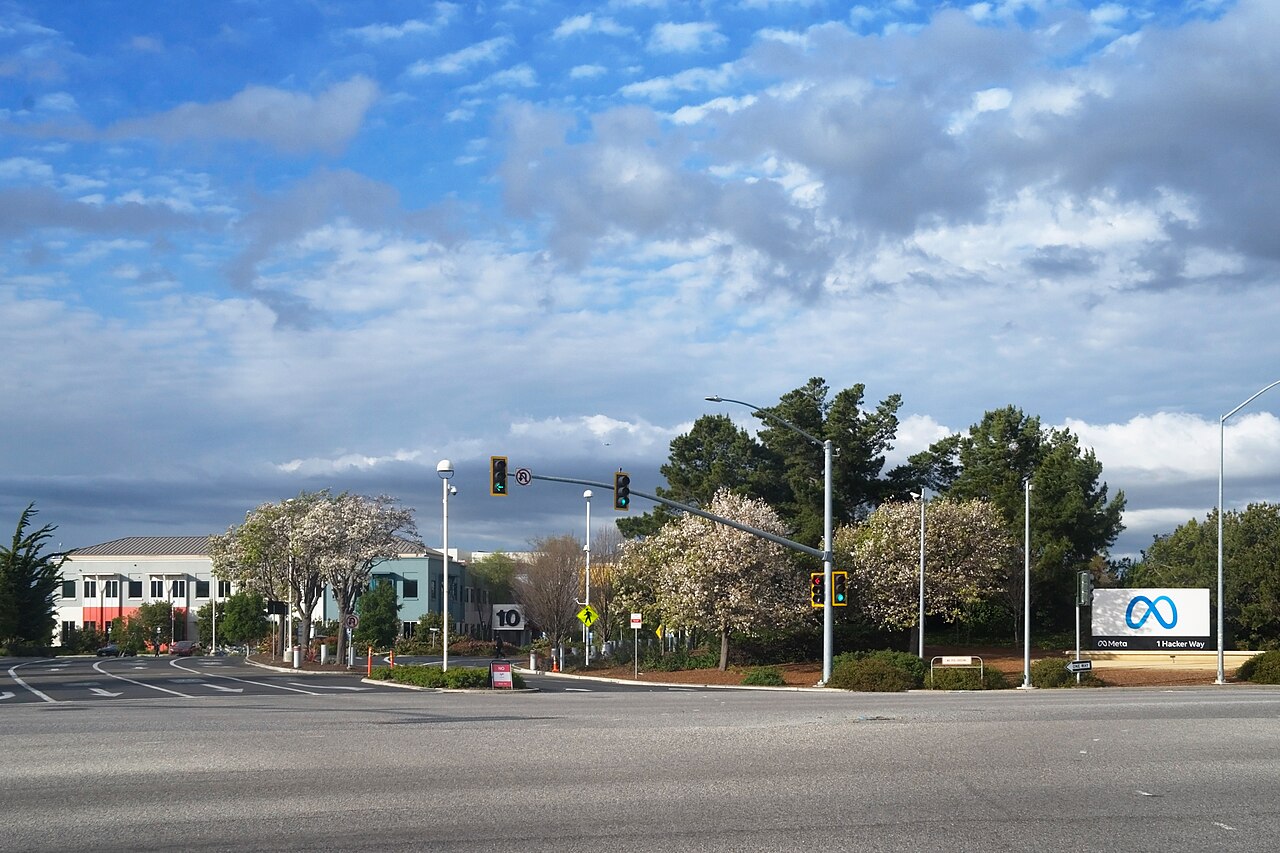
Header image: Mark Zuckerberg, CEO of Meta Platforms, at the F8 2019 keynote, photographed by Anthony Quintano, via Wikimedia Commons, licensed under CC BY 2.0. In-body photograph: Meta Platforms headquarters, Menlo Park, California, via Wikimedia Commons, released under CC0.