Thinking Machines released Inkling 2 Mini on November 20, 2026, a small open-weights model built around an unusual idea: reuse the same layers several times per token instead of storing more of them. According to Thinking Machines' release page, it has 26.4B total parameters and a memory footprint of about 20GB, which the lab says is small enough for consumer laptops and desktop AI computers. VentureBeat's coverage highlighted the same point, and Artificial Analysis published an independent evaluation the same day.
What the model is
Per the vendor page, Inkling 2 Mini is a mixture-of-experts model. Its 24 stored layers are split into four blocks of six. The first and last blocks run once, and the two middle blocks run three times, so each token passes through 48 layer applications while only 24 layers are stored. This is the "looped transformer" design. Thinking Machines says each extra pass also reads a "message" from the previous pass through a learned gate that starts closed, so the looped model begins training identical to a non-looped one.
How 24 stored layers become 48 layer applications
Each block holds 6 layers. Looped blocks reuse the same weights on every pass.
Total per token: 48 layer applications from 24 stored layers (our arithmetic from the vendor description).
The lab reports that looping the middle 12 layers beat looping the last 12 on 27 of 28 evaluations, with a compute-equivalent gain of 1.51x to 1.91x versus 1.24x to 1.36x for the last layers. These are vendor-reported ablation results and we have not seen them independently reproduced.
Parameter counts depend on how you count
The sources give slightly different active-parameter figures, which is a useful reminder that looped models do not fit the usual "active parameters" label cleanly:
| Source | Figure | What it counts |
|---|---|---|
| Thinking Machines (prose) | 3.4B active | One standard pass |
| Thinking Machines (table) | 5.4B activated / 26.4B total | Weight activations per token including looping |
| Artificial Analysis | 5.4B active, 3.1B unique weights per text token | Three passes through looped layers |
For a looped model the memory you must hold (about 20GB) and the compute you spend per token (5.4B activations) are decoupled in a way they are not for a conventional dense or sparse model. That decoupling is the point of the design.
Training choices that shaped the size
According to the release page, training began with a sparse routing setup of 8 of 384 experts per layer. At midtraining, two-thirds of the experts were pruned, leaving the 128 most-used per layer, and about 1 trillion tokens of distillation from a larger internal Inkling model recovered performance. Post-training combined supervised fine-tuning and reinforcement learning totaling 2.2 trillion tokens over 2,000 steps. The lab also states that 20 layers run in NVFP4 and 4 in MXFP8, which is how the weights fit in roughly 20GB. Looping is fixed at three passes in the released model; a separate research model, TML-d24-varloop-research, supports one to five.
Where it runs
Thinking Machines says launch support covers any Mac with at least 32GB of RAM through Ollama, plus NVIDIA's DGX Spark. VentureBeat adds that quantized GGUF builds from Unsloth and llama.cpp support run on 16GB or more, and that community members reported speeds including 210 tokens per second decode on a 96GB M5 Ultra Mac Studio and 104 tokens per second on an RTX 5090 (partner and community reports cited by VentureBeat, not independently verified by us). The demos used a 48GB M5 Pro MacBook Pro in airplane mode, which is a demonstration setup rather than a minimum requirement.
Benchmarks: vendor claims and independent measurement
Thinking Machines lists these headline results (vendor-reported):
| Benchmark | Inkling 2 Mini |
|---|---|
| DeepSWE v1.1 | 48.2% |
| SWE-bench Verified (bash only) | 79.2% |
| SWE-bench Pro v2 (Hard) | 77.9% |
| Terminal Bench v2.1 | 71.6% |
| BrowseComp (with compaction) | 79.0% |
| DeepSearchQA | 85.3% |
| MCP Atlas Public | 82.7% |
| Vals Index v2.2 | 46.5% |
The lab says the model leads every open-weights model under 100B total parameters on DeepSWE v1.1. Artificial Analysis, the independent source, scores it 20 on its Intelligence Index (v5.0), matching Qwen3.8 27B and Nanbeige4.3-33B, and reports an AA-Omniscience score of -8.6 with a 63.4% non-hallucination rate.
A pattern worth noting: the strongest vendor numbers are on agentic and coding evaluations, where a model works in a loop with tools, while the independent index is a general composite that places the model alongside, not above, comparable open models. Both can be true because the two measure different things.
The vendor numbers show where the design shines, and the independent index shows where it lands as a generalist. Reading both is the only fair way to place the model.
The cost-per-task comparison
Artificial Analysis reports that running its index cost $0.59 and took 9.0 minutes per task for Inkling 2 Mini, versus $3.53 and 38.2 minutes for Qwen3.8 27B, at first-party API rates.
Running the same index: Inkling 2 Mini vs Qwen3.8 27B
Artificial Analysis Intelligence Index tasks, first-party API rates. Both models score about 20.
Two details sharpen the picture. First, Inkling 2 Mini used about 38% more output tokens than Qwen3.8 27B for the same score (about 152K versus 110K per task, per Artificial Analysis), so it is not cheaper because it writes less. Second, list prices differ: VentureBeat's table shows $0.15 input and $0.50 output per million tokens for Inkling 2 Mini against $0.50 and $3.00 on Alibaba Cloud for Qwen3.8 27B, with third-party hosts listing Qwen3.8 27B from $0.08 and $0.50. We have not reconciled which price basis Artificial Analysis used for Qwen, so the 6.0x cost ratio (our arithmetic from $3.53 divided by $0.59) should be read as specific to that measurement, not as a general price gap.
Limits the lab states itself
The release page includes a limitations section, which is unusual and useful:
- It is "not the strongest small model for multi-turn chat or for instructions with many constraints": MultiChallenge is 50.0% and ComplexConstraints v1.1 is 33.4%, both behind Qwen3.8 27B.
- It trails larger models on reasoning-heavy evaluations such as HLE-Diamond (15.2%).
- Looping does not add stored knowledge: factuality is in line with other models of the same size.
- Chain-of-thought controllability is poor, at most 0.1% instruction-following in the 750 to 1,250 token band, which matters for monitoring research.
- The released model refuses many side tasks in an agent-monitoring test, so a helpful-only fine-tune was used for that evaluation.
VentureBeat also notes that a minority of early testers reported occasional task failures and quantization quirks.
What this means in context
 NVIDIA
 Anthropic
- The compute-versus-memory trade is the story. Looping spends more compute per token to avoid storing more weights. That suits devices where memory is the binding limit, and suits workloads where latency per task matters less than local control.
- Small models are specialising. The mix of strong agentic scores and weaker multi-turn chat suggests teams will pick small models per workload rather than one default.
- Open weights shift where the model runs. An Apache 2.0 licence (per Artificial Analysis and VentureBeat; the vendor page we read only says open weights) allows local, private deployment, which changes the privacy and cost calculation for some uses.
For builders, the practical lesson is to test on your own tasks. Tools that let you switch between hosted frontier models and local open models from one interface, as Metir does for hosted models, make that comparison cheaper to run, but the decision should rest on your own evaluation, not on any single leaderboard.
What to watch next
- Independent reproductions of the looping ablations and the DeepSWE result.
- Real-world local speeds across more hardware, since the figures so far are partner and community reports.
- Whether variable looping ships. The research model supports one to five passes, which would let users trade compute for quality per request.
Sources:
- Thinking Machines: Inkling 2 Mini
- Artificial Analysis: Inkling 2 Mini
- VentureBeat: Thinking Machines wows with Inkling 2 Mini looped transformer model that runs locally on laptops
Image credits
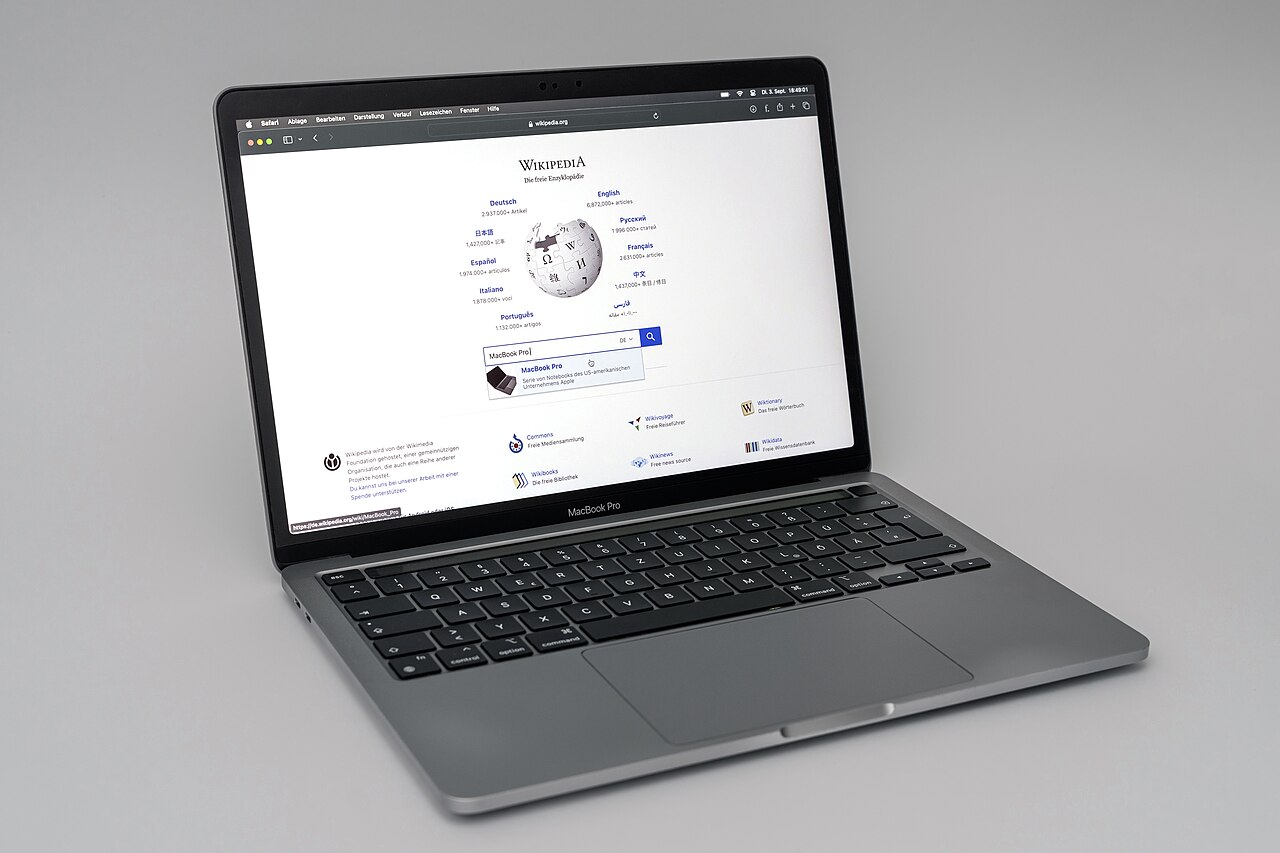
- 13-inch MacBook Pro (2020) on a grey background: DYVER, CC BY-SA 4.0, via Wikimedia Commons. Illustrative of laptop hardware only.