
On August 17, 2026, Higgsfield announced a $400 million Series B at a $5.4 billion valuation, led by DST Global. The round more than quadruples the company's prior $1.3 billion mark and lands alongside a figure that draws most of the attention: an annualized revenue run-rate that the company puts at roughly $700 million, up from about $20 million a year earlier. Higgsfield is an AI video and image generation platform, founded in 2023 by Alex Mashrabov, who previously ran generative AI at Snap. This piece looks at what the numbers actually say, why enterprise adoption is the part that matters, and how to read a re-mark this size without overstating it.
What Higgsfield does, in one sentence
Higgsfield generates video and images from text and reference inputs, aimed at professional creators, brands, agencies, and studios that need visual content at production quality and volume. It sits in the fast-moving generative media category, where a text prompt or a reference pack turns into a clip or a still without a camera, a set, or an edit suite. The pitch to enterprises is straightforward: the cost and time of producing marketing and brand content collapse when a model can render it on demand.
The valuation, and the pace
The re-mark is the headline. A jump from a $1.3 billion valuation to $5.4 billion is roughly four-fold, and it happened inside the same year. That pace is consistent with a broader 2026 pattern across generative AI, where companies perceived as holding a strong position in a scarce category have been re-priced far faster than revenue typically moves.
A roughly four-fold re-mark inside a year
Higgsfield's valuation at its prior round versus the August 2026 Series B. The $5.4 billion mark is about four times the earlier $1.3 billion figure.
Private-market valuations are negotiated marks, not audited figures, and move faster than revenue. Prior valuation as reported alongside the Series B announcement.
A step-up of this size is a statement about the private-market environment as much as about the business. Valuations at this level are negotiated marks tied to a financing event, not audited figures, and they respond to competition among investors for allocation in a hot category. The right way to hold the number is as a signal of demand for the position, kept separate from the operating results, which are reported on their own terms below.
The revenue figure, read carefully
The growth the company reports is unusually steep: from roughly $20 million to about $700 million in annualized revenue over a year. Two clarifications matter for reading it honestly. First, this is annualized revenue, which annualizes a recent run-rate rather than summing a trailing twelve months of recognized revenue, so it captures the most recent momentum and will overstate the full-year figure if growth is front-loaded. Second, the jump is as reported by the company and the press, not an audited disclosure. With those caveats in place, a move of this magnitude still describes real and rapid commercial traction rather than a rounding artifact.
Annualized revenue, from tens of millions to $700 million
Higgsfield's annualized revenue as reported: roughly $20 million a year earlier against about $700 million this month. The company attributes the jump to enterprise adoption.
Annualized revenue annualizes a recent run-rate and is not the same as trailing recognized revenue. The growth figure is as reported by the company and press.
Enterprise is the part that matters
The more durable signal is who is paying. Higgsfield says it serves more than 30 million users across 238 countries and territories, and that 390 of the Fortune 500 use the platform. It describes enterprise as now the majority of its revenue, spanning advertising and marketing, media and entertainment, broadcasting, fashion, retail, consumer, technology, finance, and pharmaceuticals. That mix is the interesting detail. A consumer novelty tool and an enterprise production tool can look similar in a demo and behave very differently on a balance sheet.
The scarce and defensible thing in generative media is not any single model. It is being the layer a brand actually ships production work through.
Analysis
Enterprise revenue tends to be stickier than consumer subscriptions, carries larger contract values, and implies the output has cleared internal bars for brand safety, rights, and quality that a hobbyist tool never has to meet. Reported enterprise concentration across regulated and brand-sensitive sectors like finance and pharmaceuticals is the strongest evidence in the announcement that AI video is being used in production, not just experimented with. It is also the claim most worth scrutinizing over time, because usage breadth inside a large customer is harder to verify than a logo on a slide.
The competitive frame
Higgsfield is not alone in this category. Generative video and image capability is being pushed hard by the largest labs, including OpenAI with its video models and Google with its own, alongside a field of specialist startups. That competition cuts both ways. It validates the market, since the biggest players do not build video models for a niche, and it pressures any single company's position, because the underlying capability is improving everywhere at once and is not easy to fence off.
 OpenAI
 Google
This is the tension worth holding. Higgsfield's revenue traction and enterprise penetration are real, and they are also being earned in a category where the core capability is abundant and advancing fast. The value that survives that abundance is less about owning the single best model on any given week and more about owning the workflow, the integrations, and the trust that make a brand route production work through you rather than a competitor. A financing round does not settle which companies hold that position durably; it funds the attempt.
The through-line for people building with generative media
For teams actually producing content, the strategic lesson sits one level above any single vendor. Generative video and image models are improving on a weekly cadence, and the leader on quality, price, or a specific capability shifts as new models arrive. A creative pipeline welded to one model has to be rebuilt every time a better option appears; a pipeline that treats the model as a swappable component absorbs those releases as upgrades instead of migrations.
That portability principle is the same one that shows up across the AI stack, and it applies to the tools around generation as much as to generation itself. A model-agnostic workspace such as Metir AI keeps the workflow as the fixed point and the model as a setting, so adopting a different generative or reasoning model for a task is a choice rather than a rebuild. Keeping the workflow portable is how a fast-moving model market becomes a menu of options rather than a source of churn.
The neutral read
Higgsfield's Series B is a credible data point that generative video has moved from experiment toward production use, carried by reported enterprise adoption that would be hard to fake at the scale claimed. The $400 million raise and the roughly four-fold re-mark are real signals of investor conviction in that thesis. At the same time, the valuation is a negotiated private-market number, the revenue growth is annualized and reported rather than audited, and the category's core capability is abundant and fiercely contested. Held together, the picture is coherent: AI video is becoming a real enterprise line item, and the companies that turn that demand into durable businesses will be the ones that own the workflow, not just the model.
Sources:
- Higgsfield Raises $400 Million Series B Financing at $5.4 Billion Valuation with Annualized Revenue Reaching $700 Million | PR Newswire
- Higgsfield raises $400M at $5.4 billion valuation to scale video and image generation platform | SiliconANGLE
- Higgsfield raises $400 million Series B at $5.4 billion valuation | Yahoo Finance
- AI Creator Platform Higgsfield Closes $400M Series B Led by DST Global | citybiz
- Higgsfield raises $400M from Goldman Sachs, DST Global at $5.4B valuation | Tech Funding News
Image credits
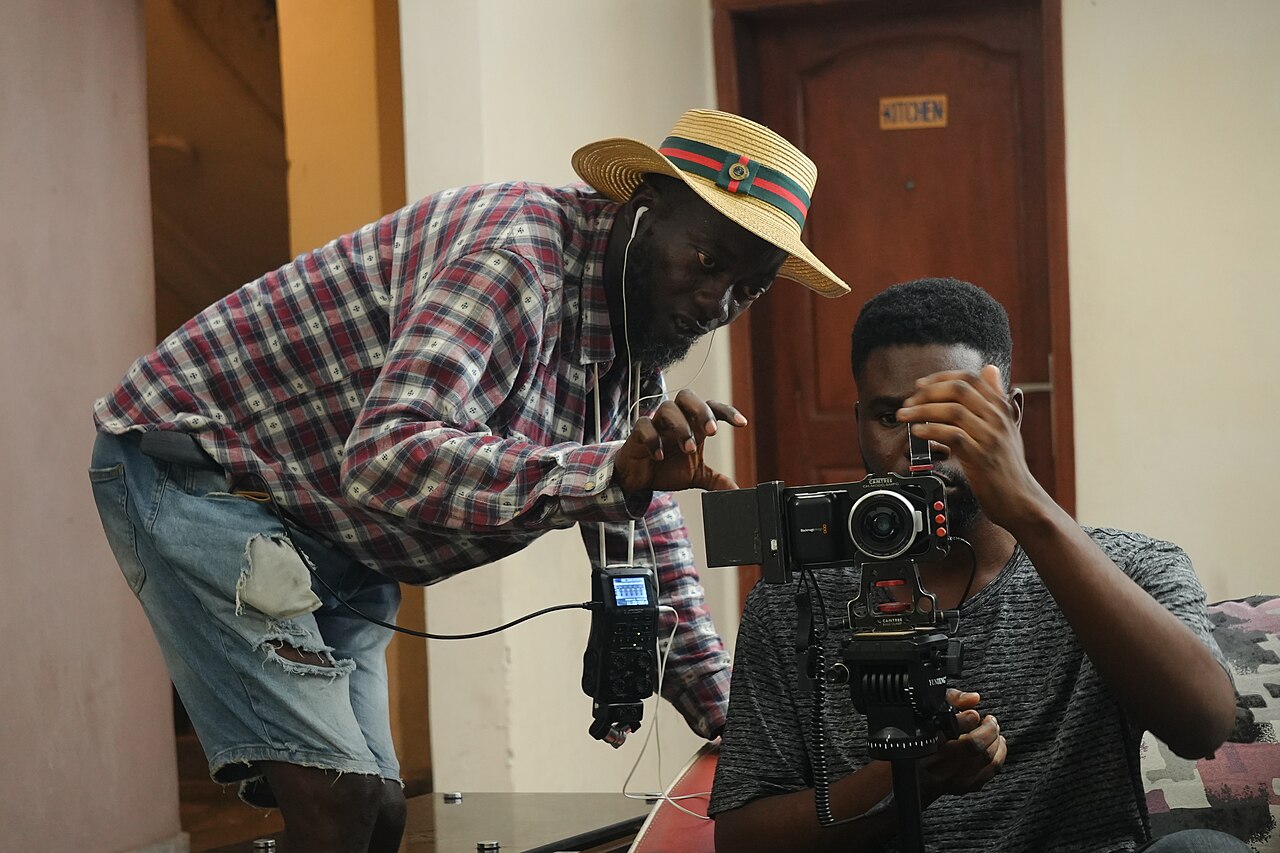
Header image: a film crew operating a professional video camera, by Thukuk via Wikimedia Commons, licensed under CC BY-SA 4.0. In-body photograph of a film production set by Yemi festus via Wikimedia Commons, licensed under CC BY-SA 4.0. Both images are illustrative of the professional video and content-creation market, are not Higgsfield output, and were reviewed before use.