On August 17, 2026, TechCrunch reported that Groq had raised $350 million at a $3.5 billion valuation, in a round led by Disruptive with planned participation from Nvidia. The number that draws attention is not the raise itself but the mark attached to it. The new valuation sits below the $6.9 billion Groq carried in September 2025, and it lands as the company completes a fundamental change in what it actually is. Groq is no longer a company trying to sell its own inference chips. It is becoming a neocloud, a cloud infrastructure provider that delivers AI inference on Nvidia GPUs. This piece looks at what changed, how to read a valuation that fell while the business was being rebuilt, and why the shift matters beyond one company.
What Groq used to be
Groq was founded on a hardware bet. Rather than run AI models on general-purpose graphics processors, it designed its own chip, the LPU, short for language processing unit, purpose-built for inference, the stage where a trained model answers a query rather than the training stage where it learns. The pitch was that a chip designed only for inference could deliver tokens faster and more cheaply than a GPU built for a wider range of work. For years, that made Groq one of the more visible attempts to compete with Nvidia on the economics of running models, not training them.
 Nvidia
That is a hard place to compete. Designing and manufacturing a bespoke accelerator is capital-intensive, and the buyer has to be persuaded to adopt a non-standard part when the rest of the ecosystem is built around one dominant vendor. The pivot now underway is, in effect, a decision to stop fighting that battle on those terms.
What Groq is becoming
The company is repositioning as a neocloud. The term describes a newer class of cloud provider that specializes in AI compute, renting out GPU capacity and inference services rather than the broad menu of a traditional hyperscaler. Instead of selling access to its own silicon, Groq now runs inference on Nvidia GPUs and sells that capacity to developers and enterprises. The diagram below lays out the shift.
From chip designer to GPU renter
The pivot moves Groq from building its own inference silicon to operating a neocloud that delivers AI inference on Nvidia GPUs. The company it once positioned against on hardware is now the vendor it builds on.
Designed and manufactured its own inference chips
Sold access to a bespoke, self-built accelerator
Positioned against the dominant inference-hardware vendor
Runs inference on the market-standard accelerators
Cloud infrastructure provider, not a chip maker
Sells capacity across 13 data centers to developers
The shift followed a December 2025 licensing deal in which Nvidia hired founder Jonathan Ross and other talent, reported at roughly $20 billion, and a $650 million raise in June 2026 that initiated the pivot.
The scale it is operating at is concrete. Groq reports 54 megawatts of capacity today and is targeting more than 200 megawatts by 2027. It says it runs 13 data centers across North America, Europe, the Middle East, and Asia Pacific, serving more than 6 million developers and enterprises. Those are the metrics of an infrastructure operator, measured in power and footprint, not the metrics of a chip designer measured in tape-outs and yield.
A company that set out to beat the dominant GPU vendor on inference hardware is now renting that vendor's GPUs and selling the result as a service.
The context that reframes the valuation
The pivot did not happen in isolation. In December 2025, Nvidia hired Groq founder and chief executive Jonathan Ross, along with other top talent, through a licensing arrangement reported at roughly $20 billion. That deal is the hinge. It moved the company's founder and key people to Nvidia and, per the reporting, set up the licensing terms that reshaped what remained. Groq then raised $650 million in June 2026 to initiate the pivot, and the $350 million August round continues funding the new direction.
This is why the valuation is nuanced rather than a simple down round. On its face, $3.5 billion is lower than the $6.9 billion Groq carried in September 2025, and a lower mark after a higher one is the textbook definition of a down round. But a Groq spokesperson characterized the figure differently, describing it as a new baseline for what the company calls the post-Nvidia-licensing-deal version of itself, rather than a markdown of the same business. Both readings are defensible, and the honest position is to hold them together.
Two valuation marks, eleven months apart
Groq's last two disclosed valuations. The new $3.5 billion mark sits below the $6.9 billion mark from September 2025. A company spokesperson framed it as a baseline for the post-licensing-deal business rather than a conventional down round.
Marks are separate private financings, not audited valuations. The August 2026 round of $350 million was led by Disruptive, with planned participation from Nvidia. Financials remain private.
The case for reading it as a genuine down round is straightforward: the number went down, and investors set it. The case for the company's framing is that the entity being valued in August 2026 is not the entity valued in September 2025. The founder has moved to Nvidia, a roughly $20 billion licensing deal has been struck, and the core product has shifted from proprietary silicon to rented GPUs. When that much of a business changes, comparing the two marks directly is less clean than it looks. Financials remain private, so neither reading can be settled from the outside.
Why the direction matters beyond Groq
Strip away the specifics and the move is a data point about a broader question: how hard is it to compete with Nvidia on inference hardware. Groq was one of the better-funded, more visible attempts to build an alternative accelerator. Its decision to become an operator of Nvidia GPUs rather than a maker of its own chips is a signal about where the economics landed, at least for this company. Building differentiated silicon and persuading the market to adopt it proved to be a steeper climb than renting the standard part and competing on how well you run it.
 Meta
Meta Mistral AI
 DeepSeek
 Qwen
Qwen Gemma
GemmaThe other half of the signal is the rise of the neocloud model itself. As demand for inference compute has grown, a layer of specialized providers has emerged to run GPUs at scale and sell that capacity, sitting between the chip vendor and the application developer. It is a business measured in megawatts and utilization rather than in a proprietary technical edge. That is a more capital-intensive and more commoditized position than owning a unique chip, but it is also a position that scales with the market for inference rather than betting against the dominant hardware.
The through-line for people building on AI
For anyone building on top of models rather than making the hardware underneath them, the useful lesson is about portability. The company that once bet its future on a specific, proprietary way of running inference has moved to the standard substrate that everyone else uses. Applications face a smaller version of the same choice every day: how tightly to couple to one provider's stack, one model, or one way of running it.
Keeping the model and the infrastructure as swappable decisions, rather than foundations you cannot move, is what lets a workflow absorb a fast-changing market instead of being stranded by it. A model-agnostic workspace such as Metir AI applies that principle to everyday work, treating the choice of model as a setting rather than a rebuild, so a shift in the underlying market is something you adapt to rather than something that breaks you.
The bigger picture
Groq's $350 million raise is a small headline attached to a large change. A company built to challenge Nvidia on inference silicon is now an operator of Nvidia GPUs, its founder has moved to Nvidia, and its valuation has been reset in a way that reads as a down round or a new baseline depending on which lens you use. The neutral read is that all of it is true at once: the number is lower, the business is genuinely different, and the direction says something real about the difficulty of competing with the dominant vendor on hardware and about the growing pull of the neocloud model. On the underlying economics, the move is coherent. In a market where inference demand keeps rising and one vendor's GPUs remain the standard, running those GPUs well is a more durable place to stand than trying to replace them.
Sources:
The figures in this piece, including the $350 million round and $3.5 billion valuation, the prior $6.9 billion September 2025 mark, the roughly $20 billion December 2025 Nvidia licensing deal that brought over founder Jonathan Ross, the $650 million June 2026 raise, and the 54 megawatt to 200-plus megawatt capacity, 13 data centers, and 6 million-plus developer metrics, are as reported by TechCrunch on August 17, 2026. Financials remain private.
Image credits
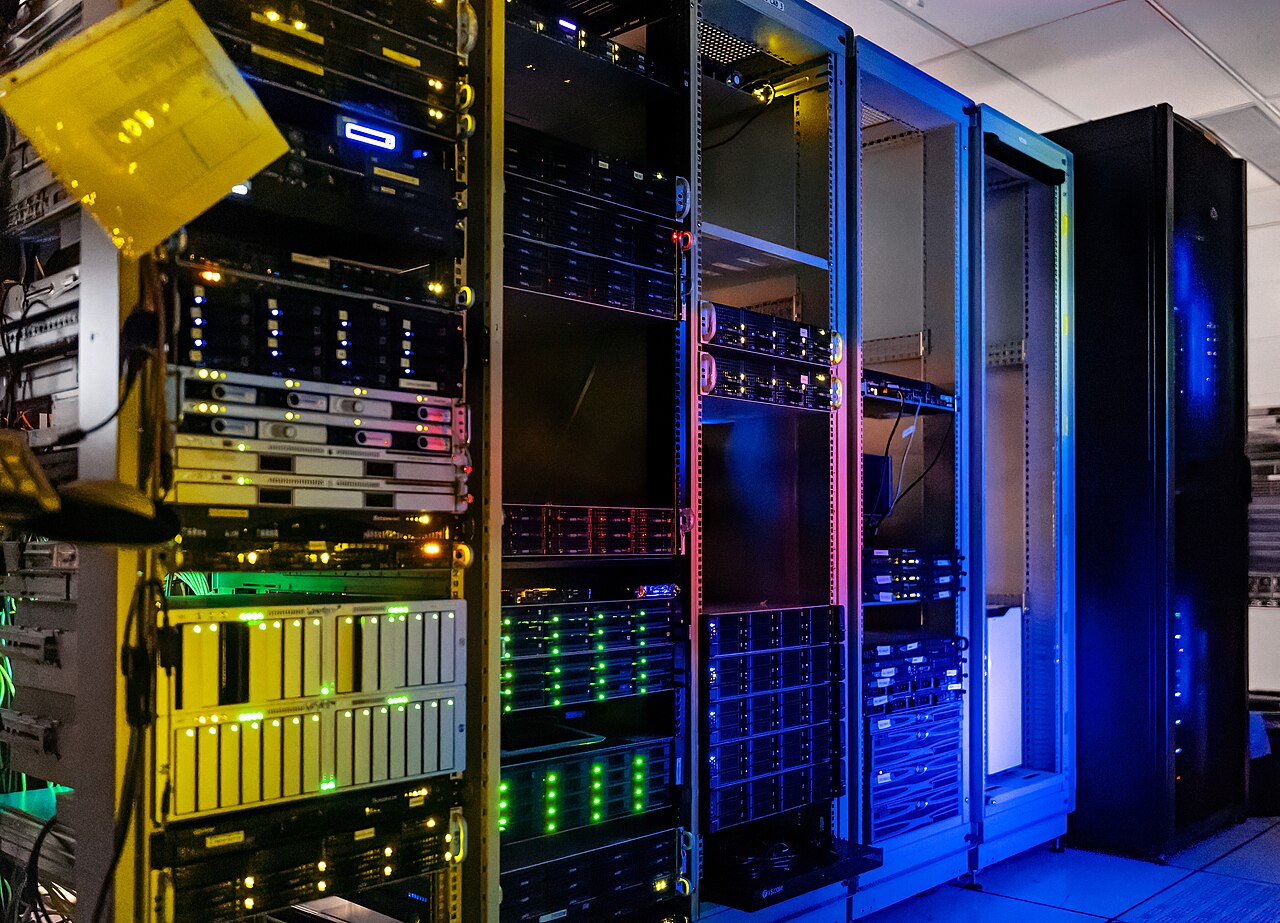
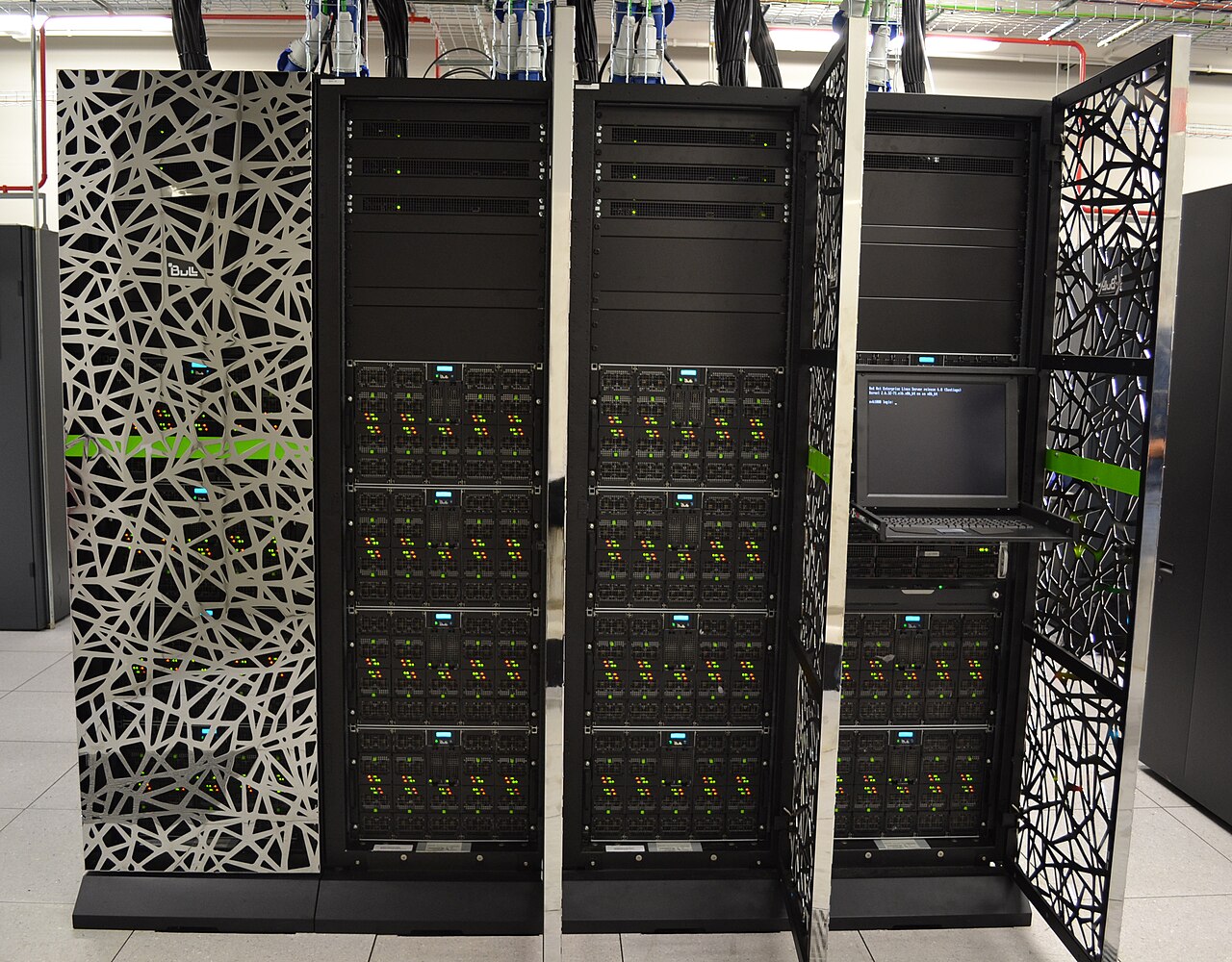
Header image: server racks in the computer server room at the NOIRLab Headquarters in Tucson, Arizona, by NOIRLab/NSF/AURA/T. Slovinský via Wikimedia Commons, licensed under CC BY 4.0. In-body photograph of a GPU compute cluster at the Barcelona Supercomputing Center by the Barcelona Supercomputing Center via Wikimedia Commons, licensed under the Free Art License. Both images reviewed before use. The photographs illustrate data-center hardware and are not images of Groq's own facilities.