Most AI headlines this year have been about chatbots, agents and the compute needed to run them. On September 3, 2026, Google DeepMind put out something in a different category: WeatherNext 3, a new global AI weather model that it calls its most accurate yet, and one that is being wired directly into products hundreds of millions of people already use. It is a good reminder that the most consequential AI is not always the kind you talk to.
 Google
 Gemini
The interesting thing about WeatherNext 3 is not that an AI model can forecast weather. AI models have been competitive with, and often better than, traditional physics-based forecasting for a couple of years now. The interesting thing is where the improvement landed. This release is less about a single headline accuracy number and more about resolution and refresh rate, the two properties that decide whether a forecast is actually useful for the local, fast-changing weather people care about.
What is new
Physics-based weather prediction works by simulating the atmosphere on a grid using the equations of fluid dynamics. It is powerful and expensive, and its resolution is limited by how much supercomputer time you can afford. AI weather models learn patterns from decades of historical data instead, which lets them produce a forecast in a fraction of the time and cost once trained. WeatherNext 3 pushes on the two numbers that matter most for everyday use.
What changed from WeatherNext 2 to WeatherNext 3
The jump is less about a single accuracy number and more about resolution and refresh rate, the two things that make a forecast useful for fast-changing local weather.
Figures as stated by Google for surface temperature and moisture forecasts.
WeatherNext 3 produces forecasts for surface temperature and moisture at up to 5 kilometer resolution, updated every hour. Its predecessor, WeatherNext 2, worked at 25 kilometers every six hours. That is roughly five times sharper and six times more frequent. Google also says the new model draws directly from raw satellite imagery rather than relying only on pre-processed analyses, which is part of what lets it refresh hourly and track fast-moving systems like rain and snow.
The accuracy claims, read carefully
Google's stated accuracy gains are real improvements, and they are also vendor figures phrased as "up to," which is worth keeping in mind. The company says WeatherNext 3 can deliver up to 50% more accurate precipitation forecasts when looking a day or more ahead, and up to 30% better station-level temperature accuracy than WeatherNext 2.
Google's stated accuracy gains over WeatherNext 2
Both figures are Google's own "up to" claims for the new model against its predecessor. Independent leaderboards, not vendor numbers, are the check on these.
WeatherNext 3 took the top spot on Operational WeatherBench, an independent leaderboard run by the startup Brightband.
"Up to" is doing work in those sentences. It describes the best case across conditions and lead times, not the average you would see everywhere, every day. The more persuasive evidence is external: WeatherNext 3 has taken the top spot on Operational WeatherBench, an independent leaderboard run by the AI weather startup Brightband that compares leading AI and traditional models on a level playing field. A vendor claiming a 50% gain is a starting point; an independent benchmark ranking it first is the check that matters, and it is the number to watch as other labs respond.
Why the distribution is the real story
A better model that stays in a research paper changes nothing for ordinary users. What makes WeatherNext 3 notable is that Google is putting it where the traffic is. The model is being integrated into Google Search, the Gemini app, Google Maps, the Google Maps Platform Weather API, and Google Earth Engine. That means the forecast improvements reach consumers through the weather answer in Search and developers through the Maps Platform API, all at once.
This is the part that is easy to underrate. The gap between "state of the art in a benchmark" and "the number a billion people see when they check whether to bring an umbrella" is usually enormous, and it is usually where good research goes to die. By shipping the model straight into its highest-traffic surfaces, Google collapses that gap. It also builds a quiet moat: the more the forecast is embedded across Search, Maps and the developer platform, the harder it is for a competitor to displace, regardless of who tops the next benchmark.
A better forecast in a research paper changes nothing. A better forecast inside the weather answer in Search changes what a billion people plan around.
Metir AI analysis
The renewable-energy angle nobody is talking about
One capability in the release deserves more attention than it is getting. WeatherNext 3 adds forecasts aimed specifically at renewable energy production: wind speeds about 100 meters above the ground, which is roughly the height of a modern wind turbine, along with cloud cover and solar radiation. Those are exactly the variables a grid operator needs to predict how much power a wind or solar fleet will generate in the next few hours.
As grids lean more heavily on intermittent renewables, the ability to forecast generation accurately becomes a direct operational and financial input, not a nicety. Better short-term wind and solar forecasting reduces the amount of expensive backup capacity an operator has to hold in reserve, and it lowers the risk of costly imbalances between supply and demand. It is a concrete example of a weather model producing value well outside the "will it rain on my walk" use case, and it hints at where the commercial pull for these models is heading.
Where this sits in the bigger AI picture
WeatherNext 3 is worth reading as one instance of a broader pattern in 2026: the move from general-purpose models that do a bit of everything toward specialized models that go deep on one domain and get deployed where they create measurable value. Weather is an unusually clean case because the ground truth is objective. Tomorrow either matches the forecast or it does not, so progress is measurable in a way that fuzzier tasks rarely allow. That makes it a useful bellwether for scientific AI generally.
It also reframes what "AI" means for most people. The version that quietly makes a forecast sharper, or predicts wind output for a grid operator, may end up touching more lives more often than the version you chat with, precisely because it disappears into infrastructure. The teams building AI into their own products are increasingly making the same choice Google made here: pick the right model for the specific job rather than routing everything through one general system. Platforms like Metir AI exist to make that choice easy across the general-purpose models, giving teams access to the leading models from multiple labs in one place so each task can go to whichever one fits it best. Specialized models like WeatherNext 3 are the domain-specific end of the same idea: the best result comes from the model built for the problem.
The takeaway
WeatherNext 3 is not a flashy release, and that is rather the point. Google DeepMind made its global forecasts about five times sharper and six times more frequent, fed the model raw satellite data, topped an independent benchmark, and shipped the result straight into Search, Maps and its developer platform. The accuracy claims are vendor "up to" figures that independent leaderboards will keep honest, and the quietly important pieces are the hourly local resolution and the renewable-energy forecasts. It is a clear example of AI creating value by disappearing into the tools people already rely on.
Match the model to the task
The lesson from specialized models like WeatherNext 3 is that the best result comes from the right model for the job. Metir AI gives you unified access to leading models from Google, OpenAI, Anthropic and xAI in one workspace, so every task goes to the model that handles it best. Try Metir AI free.
Sources:
- Introducing WeatherNext 3 (Google blog)
- WeatherNext 3 (Google DeepMind)
- Google DeepMind launches WeatherNext 3 with hourly 5-kilometer forecasts (Unite.AI)
- Google's latest AI weather model gives you no excuse to forget your umbrella (TechCrunch)
Image credits
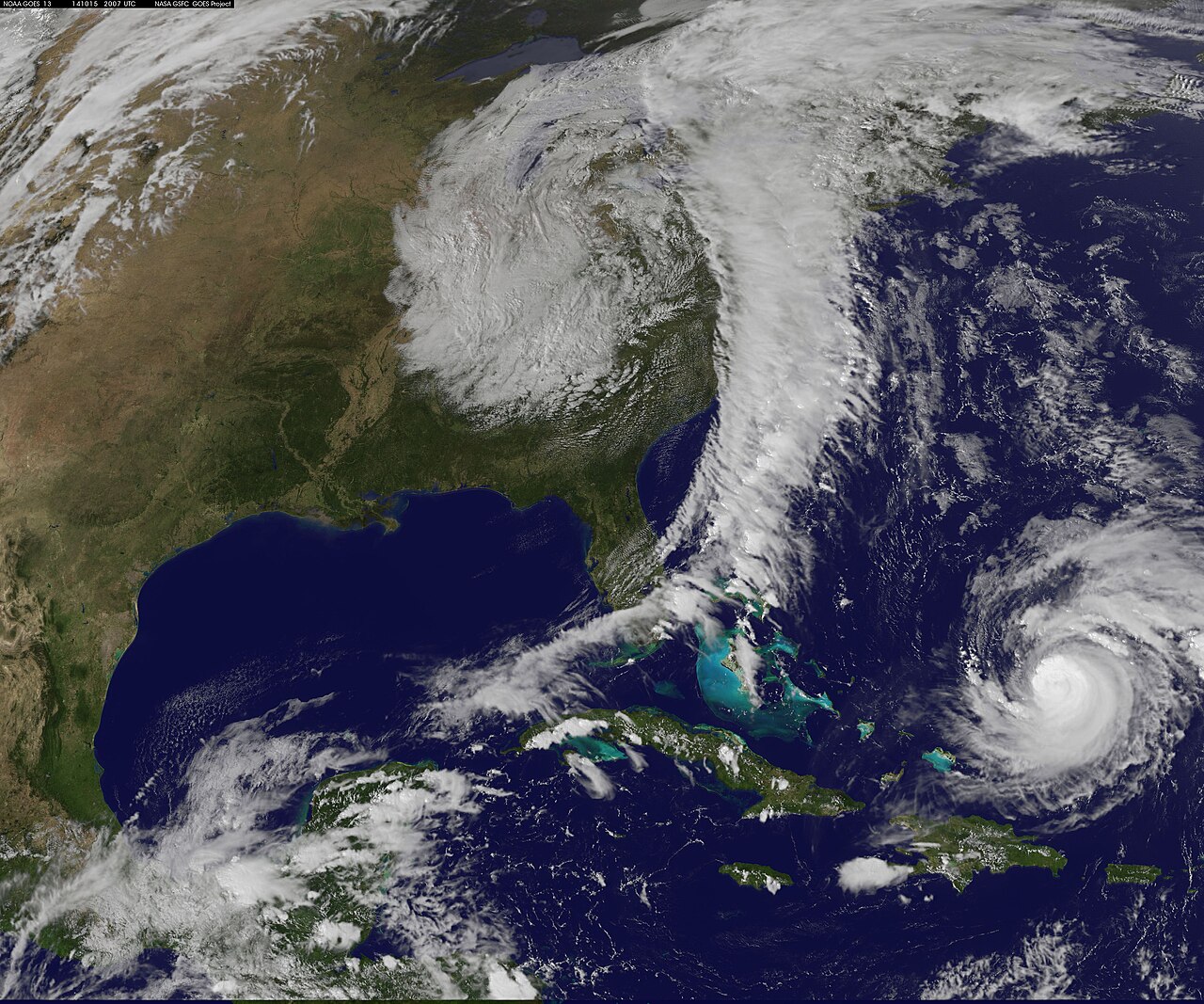
Header image: a NASA GOES satellite view of a major Atlantic hurricane and surrounding weather systems, by NASA Goddard Space Flight Center via Wikimedia Commons, in the public domain. The image is illustrative of raw satellite weather imagery and is not WeatherNext 3 output.