On August 24, 2026, TechCrunch reported that General Intuition, a startup building what the field calls world models, is in talks to raise new funding at a valuation of 6 billion dollars, with Valor and Point72 Ventures among the new backers and existing investors Khosla Ventures and General Catalyst participating. The number alone would be unremarkable in a year full of large AI rounds. What makes it worth a closer look is the pace and the premise: the valuation is roughly triple the mark the company carried only weeks earlier, and the company's core bet is that hundreds of millions of hours of video-game footage can teach an AI to reason about space and motion well enough to eventually control a robot. Both the speed and the thesis deserve a careful read.
 NVIDIA
 Google
 Tesla
TeslaWhat General Intuition is building
Most of the AI systems that reached the public are language models: they predict text. A world model is a different kind of system. It learns a predictive representation of an environment, how a scene evolves, how objects move, what happens next if an agent takes an action, so that an agent can plan and act within it. The ambition is spatial and physical rather than linguistic: an intelligence that understands movement through time and space.
General Intuition's distinctive asset is where it gets its training data. The company was spun out in October 2025 from Medal, a platform for sharing video-game clips, and it uses hundreds of millions of hours of gameplay, paired with "action labels" that record what the player did, as its initial dataset. In a video game, the environment, the actions, and their consequences are all captured together, which makes gameplay an unusually rich and cheap source of the exact signal a world model needs: not just what a scene looked like, but what an agent did and what happened as a result.
Why the gameplay thesis is interesting
The data argument is the most substantive part of the story, so it is worth taking seriously rather than dismissing as a gimmick.
Training a system to understand physical cause and effect usually runs into a data problem. Real-world robot data is expensive and slow to collect, because it requires physical robots acting in physical environments, one interaction at a time. Video is abundant but usually passive: it shows what happened without recording the actions that produced it, which is the part a control policy most needs to learn. Gameplay footage with action labels sits in a useful middle ground. It is generated at enormous scale, it comes with the actions attached, and it spans a vast range of simulated environments and dynamics. If the patterns a model learns from game worlds transfer usefully to reasoning about the real one, that is a genuine data advantage.
The bet is that a model can learn how to act from game worlds, and that the intuition transfers to the real one.
On the core premise of the gameplay-data thesis
The open question, and it is a real one, is exactly how much transfers. Game physics are not real physics. A model trained on driving games has not felt a real tire lose grip. The company's own framing acknowledges this by describing a path from its general model toward robotic embodiments over time, rather than claiming the jump is already made. The honest assessment is that the approach is promising and unproven at the thing that ultimately matters, controlling physical systems in the real world, and that the transfer from simulated to physical is precisely where world-model research is hardest.
Reading the valuation
The valuation trajectory is the part that most invites scrutiny. General Intuition raised a 134 million dollar seed in October 2025, a 320 million dollar Series A in June 2026 at a 2.3 billion dollar valuation, and is now reported to be raising at roughly 6 billion. That is close to a tripling in about eight weeks.
From $2.3B to a reported $6B in about eight weeks
General Intuition's disclosed valuations. The seed round's valuation was not disclosed, so that row shows funding raised instead.
$134M raised.
$320M raised.
reported round.
The August round is reported as in talks, not closed. Total disclosed funding before it was about $454M.
Two readings coexist, and a neutral account should hold both. On one hand, this is what a genuinely contested market looks like: world models and embodied AI are seen by many investors as one of the most important frontiers beyond language models, the pool of teams credibly working on them is small, and capital concentrates hard on the few that look like leaders. A fast step-up can reflect real competition for a scarce asset. On the other hand, a valuation that triples in two months, at a company still advancing a research thesis rather than shipping a product with revenue, is exactly the pattern that should prompt questions about how much of the price reflects fundamentals versus momentum. Both things can be true at once, and the reporting's careful "in talks" framing is a reminder that the round is not closed.
Two different kinds of model
World models are not language models with more data. They learn a different thing, from different data, for a different purpose.
The two are complementary. A capable embodied system is likely to compose several specialized models rather than rely on one.
Where it fits in the larger picture
General Intuition is one entry in a broader move: capital and talent flowing toward AI that acts in the physical world, not just AI that generates text. That branch of the field increasingly runs on world models, control policies, and simulation, and it is being funded aggressively while still early in its research arc. The same week's news that a Chinese carmaker's robotics unit raised a record round at a multi-billion-dollar valuation, before selling a single robot, is the hardware side of the same phenomenon. General Intuition is a bet on the software and intelligence side of it.
It is also a reminder that the intelligence layer for embodied systems is unlikely to be a single monolithic model. Perception, prediction, planning, and low-level control are different problems, and the systems that endure will probably compose several specialized models rather than routing everything through one. That plurality is the same reason the broader AI stack is trending toward model-agnostic design, the instinct behind flexible platforms like Metir, where the right model is chosen per task rather than fixed in advance. A world model may become one important component in that mix. It is unlikely to be the only one.
The measured summary is straightforward. General Intuition is reported to be raising at a 6 billion dollar valuation on the strength of a distinctive data thesis and a fast-moving market for world-model talent. The gameplay-data idea is genuinely interesting and genuinely unproven at real-world control. The valuation reflects both real scarcity and real momentum. Which of those dominates is the thing the next few years will reveal.
Sources:
- Valor, Point72 back General Intuition at $6B valuation as AI startup pushes into robotics (TechCrunch, Aug 24, 2026)
- General Intuition Aims to Raise Capital at $6 Billion Valuation to Power AI Robotics (PYMNTS, 2026)
- General Intuition in talks to raise at $6B valuation as physical AI race accelerates (Tech Funding News, Aug 2026)
Image credits
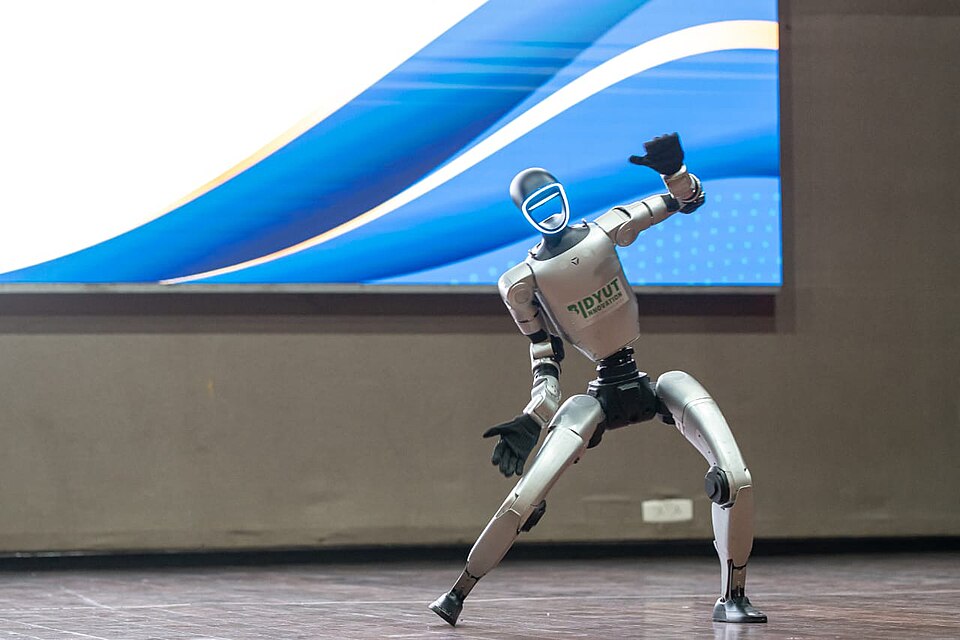
- Hero: "Humanoid Robot at International Exhibitions" (via Wikimedia Commons), licensed CC BY-SA 4.0. Retrieved August 25, 2026. Illustrative of embodied AI, not General Intuition hardware.