The Gates Foundation has committed $1 billion over the next two years to expand access to artificial intelligence in health care, education and agriculture, with the money aimed squarely at the low-income communities that the current AI build-out largely passes by. The pledge was announced on September 15, 2026, alongside the foundation's annual Goalkeepers report, which carried an unusually direct warning: that AI risks widening the gap between rich and poor countries unless governments, technology companies and philanthropies act inside a narrow window.
This piece breaks down where the money is going, why the foundation is framing AI as both a risk and an opportunity, and whether $1 billion is a meaningful number against a problem this large.
Where the money goes
The billion dollars is not a single grand project but a spread across four buckets. Roughly $400 million is directed at health care and about $400 million at education, the two largest slices. Around $100 million goes to agriculture, and a further $100 million is earmarked for something less obvious but arguably foundational: building AI training datasets in the languages spoken by underserved communities.
Where the $1 billion is pointed
Approximate allocation of the two-year commitment, in millions of US dollars. Health and education take the bulk; a tenth is set aside for language data.
Figures are approximate and staged over two years. The Foundation's CEO has described the $1 billion as a down payment rather than the final figure.
That last allocation is the tell for how the foundation is thinking. Most large AI systems are trained overwhelmingly on English and a handful of other well-resourced languages, drawn from the parts of the internet that wealthy countries produce. A model that cannot understand a community's language, or that performs far worse in it, cannot deliver a health chatbot to a rural clinic or a tutor to a classroom in that community. Funding the underlying language data is an attempt to fix the input problem rather than just deploy tools built for someone else's context. It is slow, unglamorous work, and it is the kind of public-good investment that a commercial market has little incentive to make on its own.
Risk and opportunity in the same breath
The framing around the pledge is notable for refusing to pick a side in the usual AI-optimist versus AI-pessimist split. The Goalkeepers report presents AI as a genuine opportunity to accelerate progress on global health and development, and in the same document warns that, left to market forces, the technology will deepen existing inequalities. The foundation's argument is that the default path concentrates AI's benefits in the countries and companies that build it, and that closing the gap requires deliberate, early intervention.
The $1 billion is a down payment, not the final figure.
On Mark Suzman's framing of the commitment
That urgency is tied to a specific and sobering piece of context. This year's report noted that progress on some core development metrics has stalled or reversed, and the foundation has pointed to child mortality rising for the first time in decades against a backdrop of shrinking aid budgets. In that environment, the pitch for AI is not that it is exciting but that it might help do more with less at exactly the moment traditional funding is contracting. Foundation CEO Mark Suzman has framed the $1 billion as a down payment, saying he expects the figure to grow significantly after the first two years.
Is a billion dollars actually a lot here?
The honest answer is that it depends entirely on the comparison. Set against the sums moving through frontier AI, $1 billion is small: individual data-center deals in 2026 have run to tens of billions of dollars, and the largest labs raise more than this pledge in a single financing round. Judged as a slice of total AI capital, the foundation's commitment is a rounding error.
Judged as targeted philanthropic capital aimed at a segment the market is ignoring, it looks different. The value of money like this is less the raw amount than its willingness to fund things with no commercial return: language datasets for small populations, health tools for clinics that cannot pay, pilots in places a venture-backed startup would never prioritise. Concentrated capital directed at a neglected problem can move a field even when it is dwarfed by the headline numbers elsewhere, because it funds the work no one else will.
The open questions are the ones that dog all development spending. Whether the tools reach the communities they are meant for, whether local institutions can sustain them after the grant period, and whether "AI for global development" produces measurable outcomes rather than pilots that never scale are all unresolved, and the two-year horizon is short for answering them. The foundation is betting that seeding the ecosystem now, while the technology is still taking shape, is cheaper and more effective than trying to retrofit access later.
What it signals
The larger significance is who is making the argument. When one of the world's most influential philanthropies frames the central AI question as one of distribution rather than raw capability, it reframes the debate away from which lab has the smartest model and toward who gets to use these systems at all. That is a different axis of competition than the one the industry usually measures itself on, and it is one where the deciding factor is access, not benchmark scores.
Access, in turn, is partly a question of not being locked to a single tool. The capability to reach many models, in many languages, through one interface is exactly what makes AI useful across wildly different contexts, and it is the principle behind model-agnostic platforms like Metir AI, which keep Claude, GPT, Gemini and Grok available side by side rather than betting everything on one. The Gates commitment works the same logic at the level of global development: the goal is not one perfect model but broad, durable access to whatever works.
What is verifiable is the commitment itself: $1 billion over two years, weighted toward health and education, with a deliberate slice for the language data that makes any of it usable, announced as a down payment rather than a conclusion. Whether it moves the outcomes it targets is a question only the next few years can answer.
Sources:
- Gates Foundation pledges $1 billion for AI in global health and education | Quartz
- Gates Foundation bets $1B on AI to boost global health, agriculture and education | GeekWire
- Gates Foundation pledges $1B for AI in health, farming, education | Connecting Africa
- Gates Foundation commits $1 billion to equitable AI for health, education, agriculture | Gazette
- Bill Gates Says No Government Is Ready for AI | Technology.org
- Gates Foundation pledges $1 billion to bring AI to health care, agriculture, and education in low-income countries | Complete AI Training
Image credits
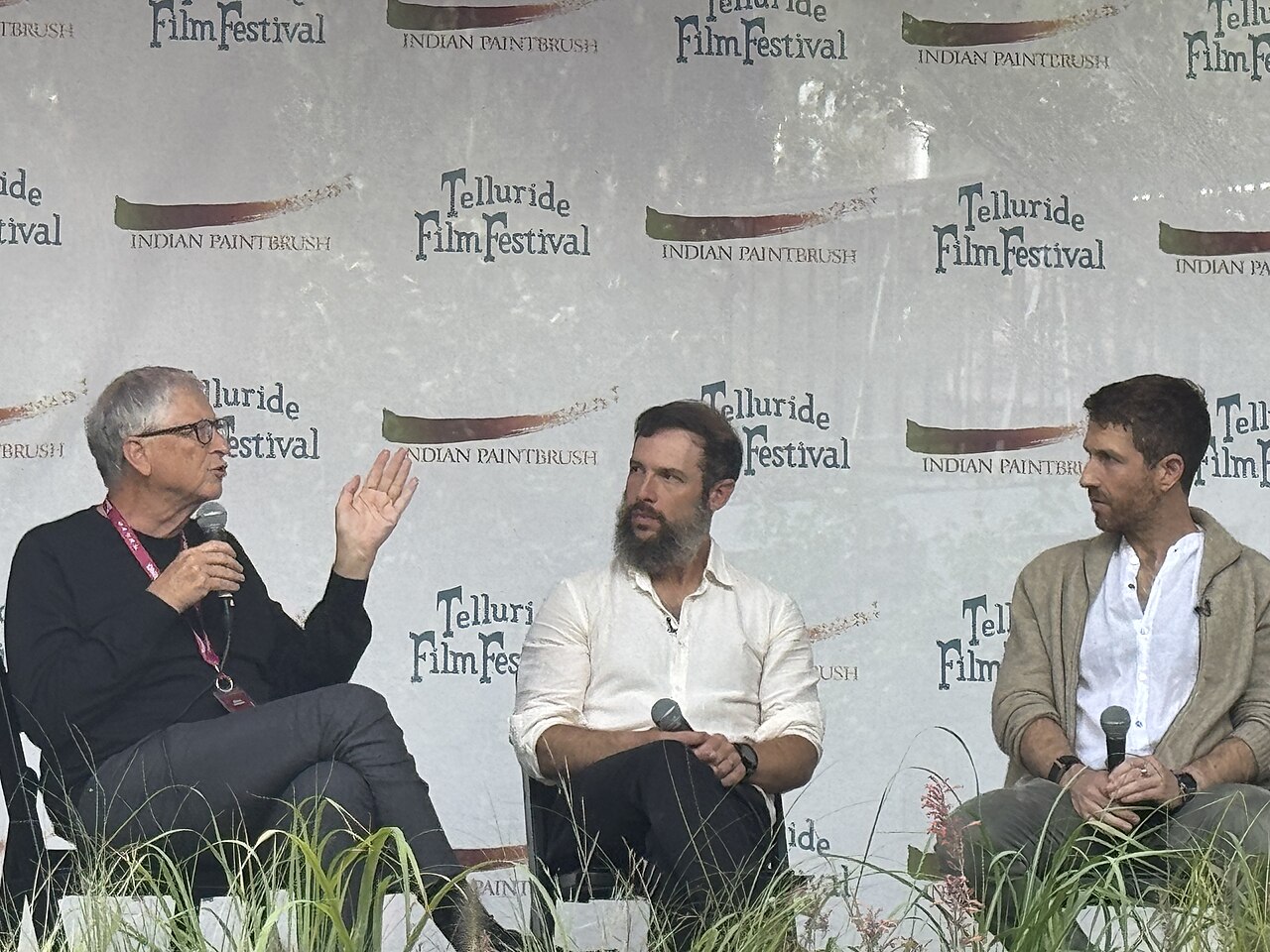
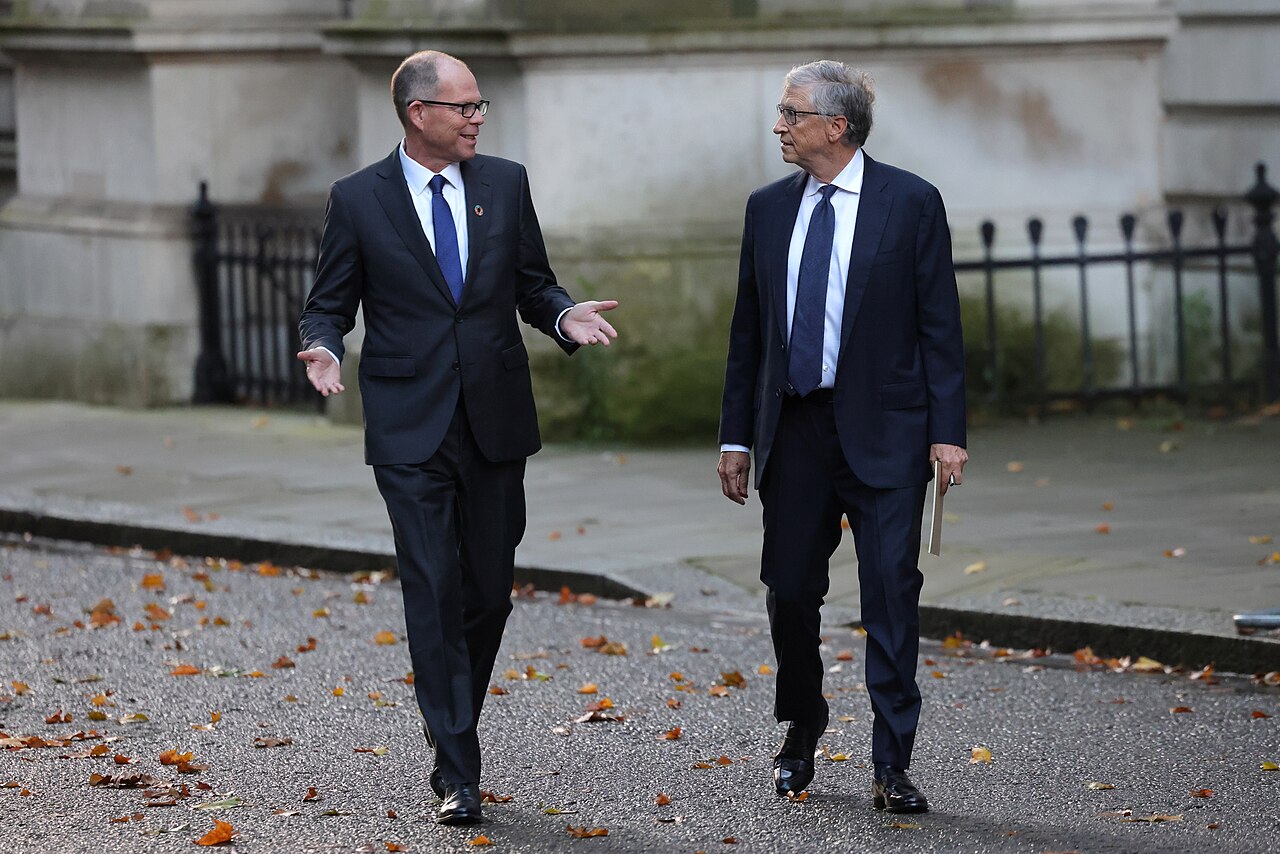
Header image: Bill Gates speaking on an AI panel with Aza Raskin and Tristan Harris at the 2026 Telluride Film Festival, via Wikimedia Commons, licensed under CC BY-SA 4.0. In-body photograph of Bill Gates with Gates Foundation CEO Mark Suzman outside 10 Downing Street, London, on 17 October 2024, via Wikimedia Commons, licensed under the Open Government Licence v3.0. Neither photograph depicts the September 2026 pledge announcement itself.