On August 12, 2026, Foxconn, formally Hon Hai Precision Industry, reported second-quarter results that mark a genuine turning point rather than just a good quarter. Net profit reached a record NT$59.97 billion, roughly US$1.86 billion, up 35 percent from a year earlier and ahead of analyst expectations. The number that matters more than the profit, though, is a mix shift: for the first time, the company's cloud-and-networking segment, dominated by AI servers, accounted for 51 percent of total revenue.
That single percentage point over half is a milestone with weight. The company that built its empire assembling iPhones now earns more, by revenue, from AI servers than from iPhones and all its other consumer electronics combined. A business synonymous with consumer hardware for two decades has, by its own numbers, become an AI infrastructure company. Understanding how that happened, and what it exposes the company to, is more instructive than the headline profit beat.
The mix shift is the story
Foxconn's transformation did not happen in one quarter, but this quarter is where the line was crossed. The cloud-and-networking segment rose from 48 percent of revenue in the first quarter of 2026 to 51 percent in the second, passing the halfway mark for the first time in the company's history.
AI servers cross half of revenue for the first time
Foxconn's cloud-and-networking segment, which is dominated by AI servers, as a share of total revenue. It passed 50% in Q2 2026, overtaking the consumer electronics that built the company. Data from The Next Web.
For the first time in the company's history, Foxconn earned more from AI servers than from iPhones and all other consumer electronics combined.
The mechanics behind that shift are the AI buildout the whole industry has been financing. Foxconn assembles the server racks that hyperscalers and AI labs are buying in enormous volume, and the value of an AI server rack dwarfs the value of a smartphone. As orders for these systems scaled through 2025 and 2026, the revenue mix tilted mechanically toward the segment that builds them. The company reported that AI rack shipments are growing several-fold in 2026, and that Vera Rubin rack systems, the next generation of Nvidia-based infrastructure, enter mass-production preparation in the third quarter with shipments expected to begin in the fourth.
A record second quarter, driven by AI demand
The headline numbers behind the milestone. The profit growth is real, though it rides on a hardware cycle whose ceiling Foxconn itself has started to name.
Vera Rubin rack systems enter mass-production preparation in Q3 2026, with shipments expected to begin in Q4 2026.
The profit growth is real and the beat against the consensus estimate is real. But it is worth being precise about what kind of growth this is. Assembling servers is a lower-margin business than designing chips or selling models, and Foxconn's role sits at the manufacturing layer of the AI stack, where the money is large in absolute terms but the margin per dollar of revenue is thinner than further up the chain. The record profit reflects enormous volume more than it reflects a high-margin business. That distinction matters for how durable the earnings are.
 NVIDIA
 Apple
AppleThe concentration risk underneath
A milestone framed as triumph is also worth reading as exposure. Foxconn has traded one concentration for another. For years its fortunes were tied heavily to Apple and the iPhone cycle, a dependency analysts long flagged as a risk. The AI-server business reduces that specific dependency, but it introduces a new one: a heavy reliance on a small number of AI-infrastructure buyers and, above them, on the continued pace of AI capital spending.
Foxconn has traded one concentration for another: from the iPhone cycle to the AI-capex cycle. The dependency is different, not gone.
On the milestone's hidden exposure
That reliance cuts both ways. As long as hyperscalers and AI labs keep ordering server racks at the current pace, Foxconn's AI-server revenue compounds. If that spending slows, whether from a digestion period, tighter financing, or a reassessment of returns on AI infrastructure, the segment now carrying more than half of Foxconn's revenue would feel it directly. The company's own management has begun naming the constraints: Foxconn's chief executive pointed to advanced chip packaging capacity as a ceiling on how many AI servers the industry can build in 2027. When the manufacturer at the center of the supply chain starts talking about ceilings, it is a signal that the current pace is not automatically permanent.
What Foxconn's results say about the wider cycle
Because Foxconn sits at the physical center of the AI supply chain, its numbers are a useful read on the health of the buildout as a whole. A manufacturer this large does not post a record AI-server quarter unless the orders behind it are genuine, so the results are hard evidence that AI infrastructure demand remained strong through the middle of 2026. The several-fold growth in rack shipments and the ramp toward next-generation Vera Rubin systems both point to a buildout still accelerating, not cooling.
At the same time, the packaging-capacity ceiling and the thin-margin nature of assembly are reminders that the physical layer of AI has real limits and real economics. The demand is not infinite, the capacity is not instantly expandable, and the profits at the manufacturing layer are volume-driven rather than structurally rich. Foxconn's quarter is simultaneously the strongest possible confirmation that the AI buildout is real and a quiet catalogue of the constraints that will eventually shape its pace.
The read-through
The lasting significance of these results is what they say about where AI value is being created and captured. The compute buildout is now large enough to reshape the revenue base of one of the world's biggest manufacturers, which tells you how much capital is flowing into the physical foundation of AI. But the manufacturer earns thin margins on that flow, while the higher-margin value accrues to the chip designers above it and, ultimately, to the software and model layers that turn all this compute into useful work.
For companies building at that software layer, Foxconn's quarter is a reminder that the infrastructure underneath is a fast-moving, capital-intensive commodity being produced at massive scale, and that the durable advantage lies in what gets built on top of it rather than in any single generation of hardware. Keeping software portable across the shifting hardware and model landscape underneath, the design principle behind a model-agnostic platform like Metir AI, is one way to stay insulated from the churn in the layers below. Foxconn becoming an AI-server company by revenue is a striking marker of the buildout's scale; the more important question for most businesses is what they do with all that compute, not who assembled it.
Sources:
- Foxconn: AI servers now pass half of revenue | The Next Web
- Taiwan's Foxconn reports 35% rise in Q2 profit on AI demand, beats forecast | Business Standard
- Foxconn sees AI rack shipments grow multiple-fold in 2026 after 2Q operating profit rises 68% | DigiTimes
- Foxconn CEO Names CoWoS Packaging as 2027 AI Server Ceiling After Record Q2 Earnings | Tech Times
Image credits
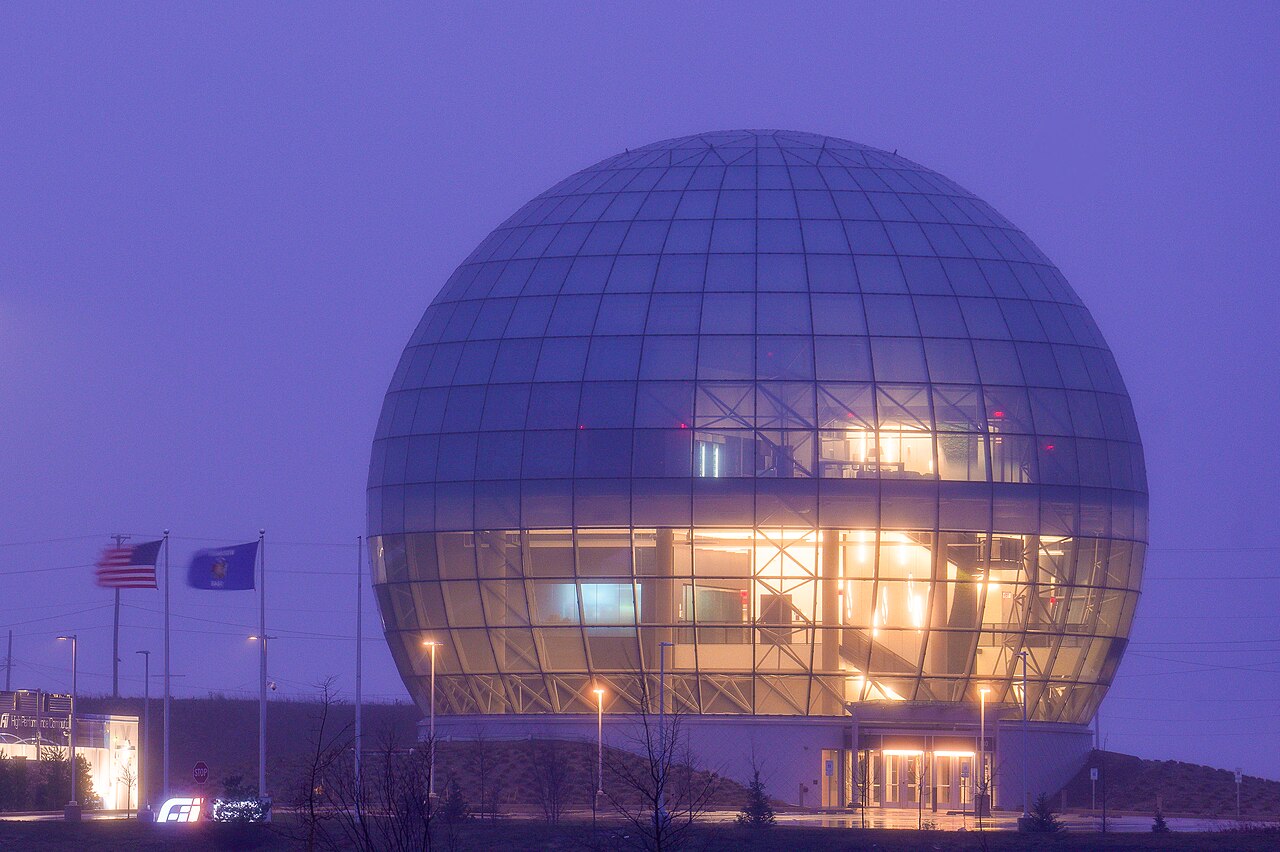
Header image: Foxconn's globe building at its Mount Pleasant, Wisconsin campus. By Chad Davis via Wikimedia Commons, licensed under CC BY 2.0.