Humanoid robot company Figure announced on September 3, 2026, that it has signed a compute partnership with the AI infrastructure provider Nscale, committing an initial $3.5 billion and stating an intent to scale the arrangement to more than $6 billion. The capacity covers up to 100,000 of Nvidia's next-generation Vera Rubin GPUs. For a company that does not yet sell robots at volume, that is an enormous bet, and the reason behind it is the part worth understanding.
 NVIDIA
The tell is in Figure's own explanation. The company said it has reached a point where its progress is increasingly constrained by the data and compute required to train Helix, the AI system that controls its robots. Read plainly, that is a striking admission about the state of humanoid robotics: the bottleneck is no longer primarily the hardware of the robot. It is the intelligence that runs it, and intelligence at this scale is trained on GPUs.
What was actually signed
The structure matters as much as the number. Figure committed to deploying the Nvidia Vera Rubin platform across up to 100,000 GPUs, with an initial $3.5 billion commitment and a stated intent to grow it past $6 billion. Deployment is targeted to begin in the second half of 2027 in Barstow, Texas. Vera Rubin is Nvidia's next-generation rack-scale system, positioned for the shift the company has been describing all year from training to large-scale inference.
A $3.5 billion floor, a $6 billion ceiling
The initial commitment is firm; the higher figure is a stated intent to scale, not a signed number. For a company that has never sold a robot at volume, both are large.
The commitment covers up to 100,000 NVIDIA Vera Rubin GPUs, with deployment targeted to begin in the second half of 2027 in Barstow, Texas.
There is a second layer to the arrangement that is easy to skip past. As part of the deal, Nscale is making a strategic investment back into Figure, and the two companies said they will explore using Figure's humanoid robots in Nscale's own supply chain. So this is not a plain purchase order. It is a supplier taking equity in a customer that has just committed to buy from it, with a possible product relationship running the other way on top.
The loop: compute for robots, robots for the supply chain
The deal is not a simple purchase order. Value moves in more than one direction, a pattern that has become common across this year's largest AI infrastructure commitments.
A supplier taking equity in a customer that has committed to buy from it is a structure worth watching as these deals multiply.
Why the bottleneck moved from hardware to intelligence
For most of the history of humanoid robotics, the hard part was the body: actuators, balance, hands that could grip without crushing, batteries that lasted. Those problems are far from fully solved, but they have improved enough that the frontier has shifted. A modern humanoid can physically perform a wide range of movements. The open question is whether it knows what to do, moment to moment, in a messy real environment it was not explicitly programmed for.
That is a learning problem, and learning problems are trained on compute. Helix is Figure's answer, a model that maps what the robot sees to what the robot does. Making it more capable follows a familiar recipe from the rest of AI: more and better data, and more compute to train larger models on it. When Figure says it is constrained by data and compute, it is saying the robot's brain has become the thing gating progress, and that the brain now scales the way language models scale.
The bottleneck in humanoid robotics has quietly moved from the body to the brain, and the brain is trained on GPUs.
Metir AI analysis
The financing pattern is the wider story
Zoom out and this deal rhymes with almost every large AI infrastructure announcement of 2026. Across the year, the biggest commitments have not been simple cash-for-goods transactions. They have been circular: chipmakers and cloud providers taking stakes in the customers who buy their capacity, capacity contracts booked as backlog, and equity flowing in the opposite direction to the product. Nscale itself is a case in point, having pursued a pre-IPO raise on the strength of a very large contracted revenue backlog that includes a major compute agreement with Anthropic.
There are sound reasons for these structures. Compute is scarce and capital-intensive, and locking in supply years ahead is rational when demand is real and GPUs are the constraint. A strategic investor who is also your supplier is more motivated to prioritize your capacity. But the same interconnection is what makes observers cautious. When a supplier's revenue depends on a customer whose value depends on the supplier's compute, the arrangement can look strong on the way up and unwind quickly if the end demand does not materialize. Figure's $3.5 billion is a firm commitment; the path to more than $6 billion, and the return on all of it, depends on humanoid robots reaching commercial scale, which has not happened yet.
What has to be true for this to pay off
The bet is legible, and so are its conditions. For the compute to translate into value, Helix has to get materially better as it is trained on far more data and compute, and that improvement has to show up as robots doing useful work reliably enough that customers pay for them at scale. Both are plausible and neither is proven. The scaling recipe that made language models better does not automatically transfer to robot control, where the data is harder to collect and mistakes have physical consequences. And even a capable Helix has to clear the separate bar of real-world reliability, which is where many robotics timelines have slipped before.
The deal is best read as a wager that humanoid robotics is now on the same trajectory as the rest of modern AI, where capability scales with data and compute, and that being early and heavily provisioned on compute is worth more than waiting for certainty. That may prove right. It is a genuine bet, not a sure thing, and the 2027 deployment timeline means the evidence will take time to arrive.
Where the model layer fits
Whether or not Figure's specific wager pays off, the underlying shift is hard to dispute: physical systems are increasingly controlled by large learned models, and building them well means training, evaluating and iterating on models at serious scale. That is the same discipline that has reshaped software, where teams increasingly treat models as interchangeable components chosen per task rather than a single fixed dependency. On the general-purpose side, platforms like Metir AI exist precisely because model capability moves fast and no one model stays ahead for long, so keeping access open across providers is safer than locking in. Figure is making the industrial-scale version of the same argument in hardware: secure the compute, keep improving the model, and do not let the intelligence layer become the thing that holds everything else back.
The takeaway
Figure's up-to-$6-billion compute commitment is a bet that the hard part of humanoid robotics is now the brain, not the body, and that the brain scales on GPUs like everything else in modern AI. The deal's circular structure, a supplier investing in a customer that has committed to buy from it, is the defining financing pattern of this AI cycle, with all the strength and fragility that implies. The initial $3.5 billion is real and firm; whether it becomes $6 billion and pays for itself depends on Helix improving and Figure's robots reaching commercial scale, neither of which is settled. The deployment starts in 2027, so this is a bet whose result will take years to read.
Keep the intelligence layer flexible
Figure's lesson scales down as well as up: the model is the part that keeps moving, so do not lock into just one. Metir AI gives teams unified access to leading models from OpenAI, Anthropic, Google and xAI in a single workspace, so you can adopt the best model for each task as the frontier shifts. Try Metir AI free.
Sources:
- Nscale, Figure ink $3.5B deal for up to 100,000 Vera Rubin GPUs (Unite.AI)
- Figure AI commits $3.5B to Nscale compute for its humanoid robot push (eWeek)
- Nscale bets up to $6B of compute on Figure's humanoid robots (Dealroom)
- Figure commits $3.5 billion to Nscale compute on NVIDIA Vera Rubin (Securities.io)
Image credits
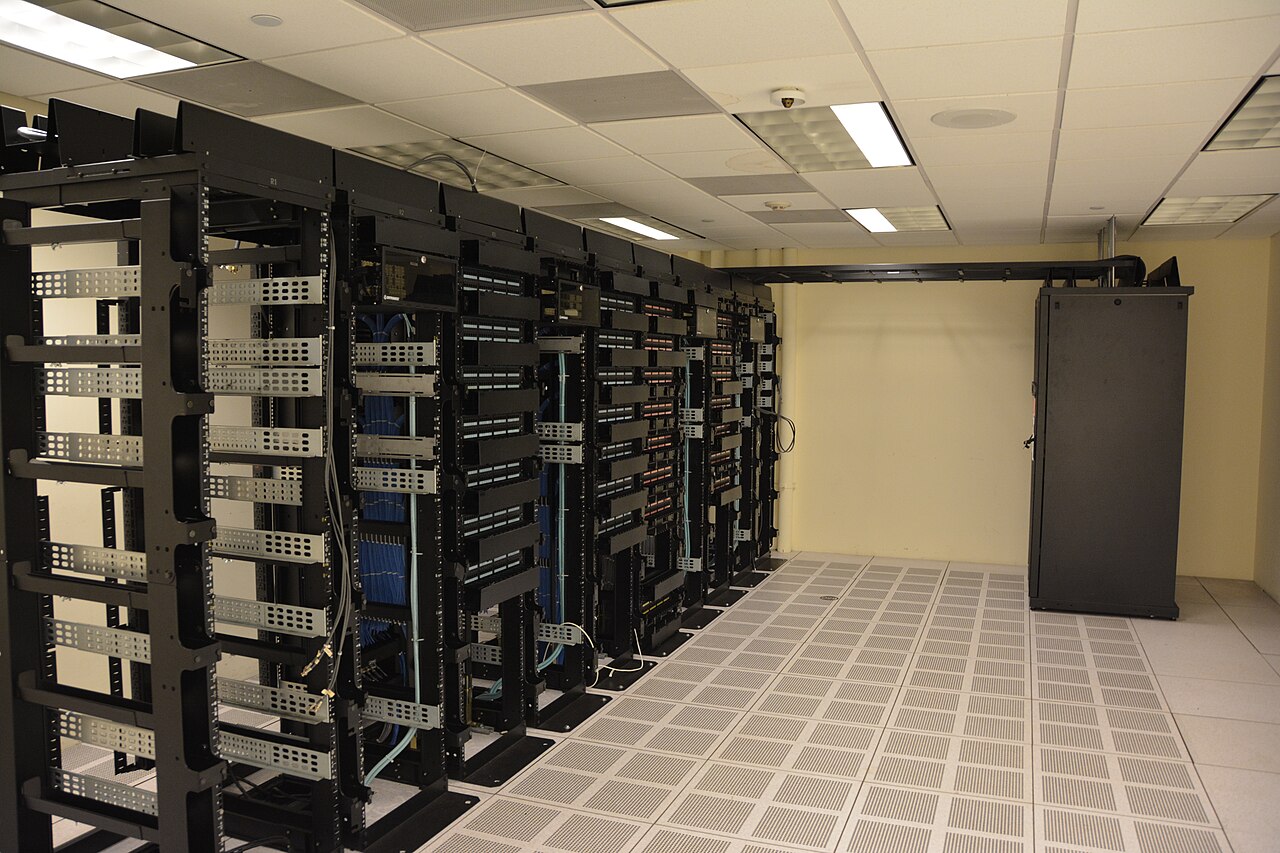
Header image: server racks in a data center, photographed by Carl Lender via Wikimedia Commons, licensed under CC BY 2.0. Illustrative of data-center GPU capacity, not the Figure or Nscale facilities.