On August 18, 2026, AI chip startup Etched said it had raised $700 million in a round led by trading firm Jane Street, at a valuation of about $21 billion. The figure is roughly double the $10.3 billion mark the company set in late July, and it caps a run from around $5 billion in December 2025. Two doublings inside a single year is unusual even by the standards of the current AI hardware boom.
The number will draw the headlines. The more interesting parts are what Etched is actually selling, who bought into the round, and the specific bet the whole company is built on.
The company and the bet
Etched was founded in 2022 by three young engineers, Gavin Uberti, Chris Zhu and Robert Wachen, two of whom left Harvard to build it. Its single product is a chip called Sohu, and the word single is doing real work in that sentence. Sohu is an application-specific integrated circuit, or ASIC, built to run one kind of AI model: the transformer, the architecture behind almost every large language model in wide use today.
A general-purpose GPU, the kind Nvidia sells, can run a transformer, a convolutional vision model, a recommender system or a physics simulation. That flexibility has a cost. A large share of the silicon and the power budget goes to the machinery that lets the chip do many things well rather than one thing perfectly. Etched's wager is that transformers now dominate demand so thoroughly that it is worth hardwiring the transformer computation directly into the chip and giving up everything else.
A four-fold re-mark in about eight months
Etched's reported private valuation at three points. The August 2026 round of about $21 billion is roughly double the late-July figure and more than four times the December 2025 mark.
Private-market valuations are negotiated marks, not audited figures. Figures as reported by TechCrunch and Bloomberg.
The design choices follow from that. Etched has described splitting the two phases of running a model: the prefill phase, where the model reads the prompt, runs on a low-voltage chip that can pack in more transistors without overheating, while the decode phase, where the model writes its answer token by token, draws on a shared low-latency memory pool the company calls Cluster Scale Memory. The details matter less than the principle. When you commit to one architecture, you can optimize the whole system around its exact bottlenecks.
A specialized chip is a leveraged bet on the model architecture staying still. If transformers reign, that focus is an edge. If the frontier moves, the same focus is a liability.
The specialization trade-off
Why a trading firm is the tell
The most informative fact in the announcement is not the valuation. It is that Jane Street led the round and is also a paying customer. According to reporting on the deal, the firm deployed an Etched inference cluster in its own data center and ran live workloads through it before writing the check.
That combination is worth pausing on. A quantitative trading firm evaluates hardware the way it evaluates everything else, by measuring whether it makes money, and it has no incentive to flatter a vendor. When such a customer becomes the lead investor, it is a signal that the chips did something useful under a real load, not just in a benchmark deck. Signed contracts that the company puts above $1 billion point the same direction. Revenue commitments are a firmer form of validation than a marketing claim about tokens per second.
Etched has also staffed up in a telling way, drawing roughly 400 people including engineers from Nvidia, Broadcom, Google's TPU team and SK Hynix. Building competitive silicon is as much about accumulated hardware expertise as about a clever idea, and hiring from the incumbents is how a startup buys that expertise quickly.
The incumbent it is aiming at
The backdrop to all of this is Nvidia's dominance. The company holds an estimated 80 percent share of the market for AI accelerators, and its general-purpose GPUs are the default substrate for training and running frontier models. That share is exactly what draws challengers, and Etched is one of several. Hyperscalers have their own custom silicon programs, and other startups are pursuing different specialized designs.
 NVIDIA
 AMD
AMD Google
 AWS
AWSIt helps to separate two markets that often get discussed as one. Training a model from scratch is a flexible, research-heavy workload where general-purpose hardware has clear advantages. Inference, running a finished model to serve users, is more repetitive and more predictable, which is exactly the kind of workload a fixed-function chip can attack. Etched, like several of its peers, is aiming primarily at inference, where the economics of specialization are strongest and where the sheer volume of usage is growing fastest.
The risk sits inside the strength
The clean way to read Etched is that its greatest strength and its greatest risk are the same property. A transformer-only chip is a leveraged bet that the transformer stays central. For now that looks safe: transformers underpin the models most organizations actually deploy. But the research frontier is not static. State-space models, diffusion approaches for language, mixture-of-experts routing and other ideas are all active areas, and a chip with the transformer etched into its logic cannot simply be reprogrammed for a design that arrives in 2028.
There is also a timing question that applies to the whole category. Valuations in AI silicon have moved faster than deployed revenue, and a private mark is a negotiated figure between a company and its investors, not an audited value. The signal from a customer-led round is genuinely stronger than a typical venture markup, but it does not repeal the risk that the market is pricing a future that has to arrive on schedule.
Why the architecture question matters downstream
For the teams that build on top of AI rather than fabricate it, the lesson is less about any one chip and more about avoiding hard commitments too early. The hardware layer is fragmenting into general-purpose GPUs, hyperscaler ASICs and specialized startups like Etched, and each is optimized for a different slice of the workload. The models on top are moving too, with new families and new architectures shipping on a near-monthly cadence.
That is the case for staying portable. An application whose logic is welded to one model or one vendor inherits every bet that vendor makes, including the architecture its silicon assumes. Infrastructure that treats models as swappable components, which is the approach platforms like Metir take by keeping their tooling model-agnostic, keeps that optionality open. It lets a team route work to whatever is fastest or cheapest this quarter without rewriting the product, whether the winning chip underneath ends up being a GPU, a hyperscaler ASIC or a transformer-only design like Sohu.
The bottom line
Etched's raise is a real data point, not just a headline number, because a demanding customer validated the chips before leading the round and the company is pointing to over a billion dollars in signed contracts. It is genuine evidence that specialized inference silicon can work commercially. It is also a concentrated bet on a single architecture, priced for a future that has to hold. Both readings are true at once, and the honest position is to hold them together rather than pick the one that makes a cleaner story.
Sources:
- Etched's valuation doubles to $21B in a month, TechCrunch
- $21 billion AI chip startup Etched takes on Nvidia, poaches its engineers and lands Jane Street, Tech Startups
- Etched doubles to $21B in $700M round led by Jane Street, AI Weekly
- Etched raises $700M led by Jane Street, doubling to $21B, Tech Funding News
- Etched ships first rack to Jane Street, valuation doubles to $21B, TechTimes
Image credits
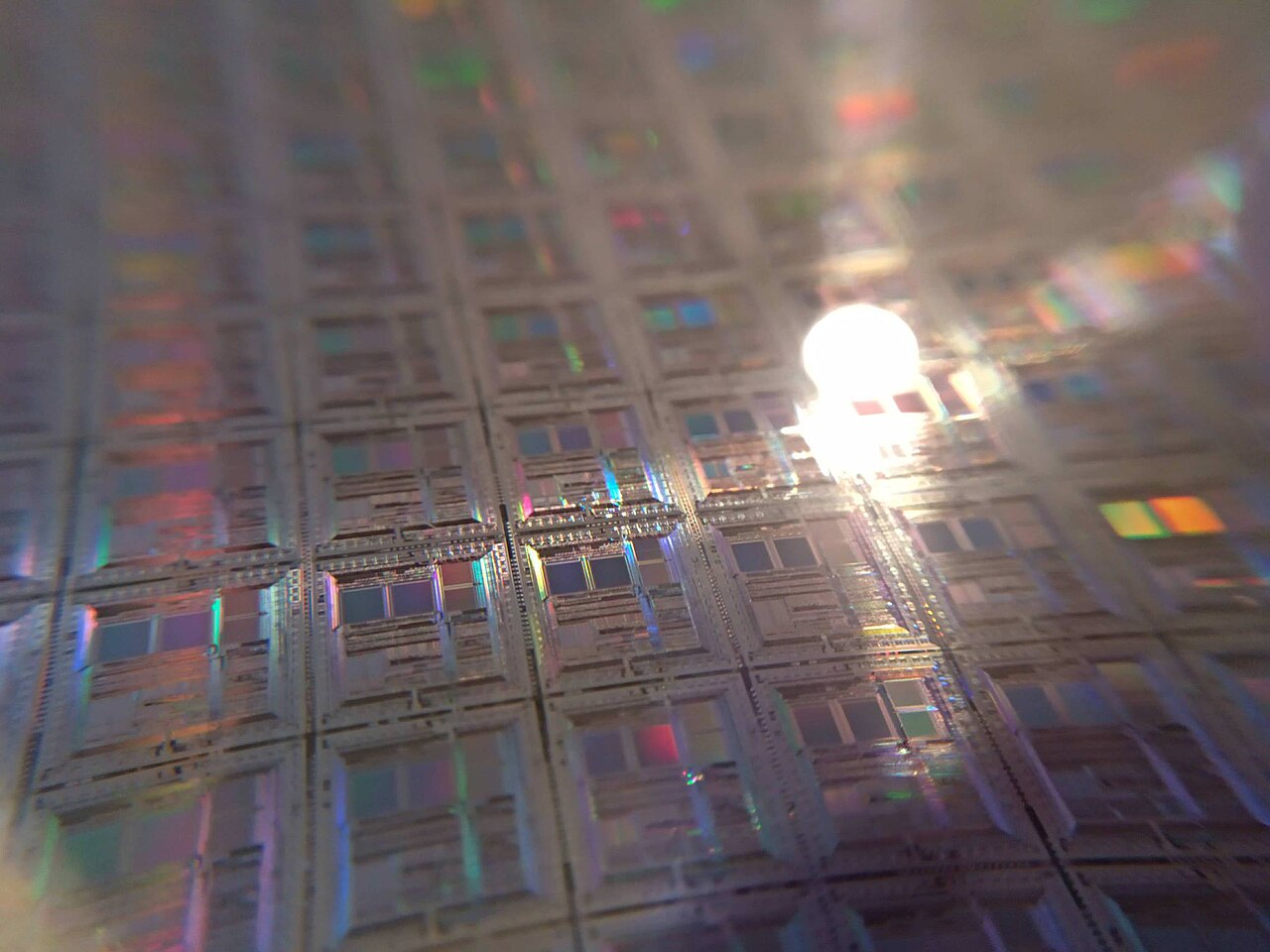
- Hero: close view of a silicon wafer showing integrated-circuit dies. Wikimedia Commons, File:Silicon wafer close view.jpg, licensed CC BY 4.0.