Enveda Biotherapeutics, a Boulder, Colorado biotech that uses AI to find drugs already present in plants and microbes, closed a $311 million Series E on September 23, 2026, led by Catalio Capital Management. The round roughly doubles the company's valuation from about $1 billion a year ago to close to $2 billion, and it brings Enveda's total capital raised since its 2019 founding to more than $845 million. The timing is not incidental: it follows two positive early clinical readouts in 2026 for medicines the company says its AI platform, PRISM, discovered, which is precisely the kind of evidence that has been scarce across the AI drug discovery field so far.
What PRISM actually does
Founder and CEO Viswa Colluru, a former early employee at Recursion Pharmaceuticals, started Enveda in 2019 on a specific bet: that the fastest way to find safe, effective drugs is not to invent new molecules from scratch, but to read the chemistry that plants and microbes have already spent billions of years refining. PRISM, Enveda's AI platform, is a foundation model trained on roughly 1.2 billion mass-spectrometry spectra drawn from public repositories and the company's own data. Rather than generating novel chemical structures the way generative-chemistry platforms do, PRISM works in the other direction: it predicts the molecular structure of a compound from its mass-spec signature, flags which of those naturally occurring molecules look biologically active, guides which ones get tested in the wet lab, and ranks the survivors by therapeutic potential.
That distinction matters. A generative-chemistry platform, the kind used by labs like Insilico Medicine, invents candidate molecules algorithmically and then has to prove each one is safe, synthesizable, and biologically active from a standing start. Enveda's bet is that nature has already done the hard part of the search, evolving molecules that are active in living systems, and that AI's job is identification and prioritization rather than invention. It is a narrower, more constrained design space, which is also its main appeal: less has to be discovered from nothing.
Two early readouts, read carefully
The proceeds are earmarked to push Enveda's three clinical-stage candidates further and to widen the pipeline behind them. ENV-294, aimed at atopic dermatitis and asthma, reported an average 85% improvement in eczema severity after 42 days in a Phase 1b study with no serious adverse events, and has moved into Phase 2. ENV-308, aimed at preserving metabolic health and preventing weight regain after patients stop GLP-1 drugs, mimics a naturally occurring molecule called Lac-Phe and completed a Phase 1 study in 88 healthy volunteers with a strong gastrointestinal safety profile and reduced circulating leptin. A third candidate, ENV-6946, targeting inflammatory bowel disease, is in Phase 1. Enveda says all 3 clinical candidates were drawn from a set of 17 development candidates the platform has produced since 2019.
From 17 candidates to two clinical readouts
Enveda’s reported drug-discovery funnel since the company’s 2019 founding.
Source: Enveda Series E announcement, September 23, 2026. Funnel widths are illustrative; labels contain the reported counts. A positive early readout is not a completed trial or an FDA approval.
It is worth being precise about what these readouts are and are not. Phase 1 and Phase 1b studies are primarily designed to test safety and tolerability in small groups, not to prove a drug works. An 85% improvement figure from an open-label, small-cohort study is an encouraging early signal, not confirmatory evidence of efficacy, which is normally established in larger, controlled Phase 2 and Phase 3 trials. Both are true at once: these are genuinely positive early results, and they are also several trial phases away from telling investors, physicians, or patients whether either drug ultimately works.
Why the industry is watching for proof, not promises
Enveda's raise lands inside a field still waiting for its first unambiguous win. As of mid-2026, no drug discovered or designed by AI has received full FDA approval, and projections for the first one have slipped for several consecutive years. An analysis presented at the American Society of Clinical Oncology in 2026 tracked 117 AI-enabled therapeutic assets across 63 companies that had entered human trials: 60, or about 51%, had completed Phase 1, but only 8, roughly 7%, had completed Phase 2. That pattern lines up with a broader, AI-independent reality of drug development: only around 10% of drugs that enter Phase 1 historically go on to reach approval, and some recent analyses put the odds for a new Phase 1 molecule closer to 7%. Phase 2, where a drug has to prove it actually works rather than merely that it is safe, is consistently where most programs die, AI-discovered or not.
AI-discovered molecules do appear to clear Phase 1 safety hurdles at meaningfully higher rates than historical averages. That advantage largely disappears in Phase 2, where efficacy, not safety, is the primary hurdle.
IntuitionLabs analysis of AI-enabled clinical assets, 2026
That is the honest frame for a raise like Enveda's. The furthest-advanced AI-discovered molecule in the industry, Insilico Medicine's rentosertib for idiopathic pulmonary fibrosis, only entered Phase 3 in July 2026, seven years after that company's own platform first flagged the target. AI has genuinely compressed the front end of drug discovery, the search for candidate molecules and the prediction of their structure and activity, from years to months in some cases. It has not yet compressed, and arguably cannot compress, the back end: the multi-year, multi-thousand-patient trials that establish whether a drug is both safe and effective across a real population, and which remain exactly as slow and expensive as they were before any AI model was involved.
Seen that way, Enveda's doubled valuation is less a bet that AI has cracked drug discovery and more a bet on two narrower things: that its platform can keep producing candidates that clear the earliest, cheapest hurdle at a good rate (3 of 17 into human trials, with reasonably clean early safety data), and that a nature-derived search strategy is a durable way to keep doing that. Investors including Durable Capital Partners, ICONIQ, Lightspeed, Surveyor Capital, accounts advised by T. Rowe Price Investment Management, Digitalis Ventures, an unnamed sovereign wealth fund and Alderline Group joined existing backers Baillie Gifford, Premji Invest, and Lux Capital in making that bet, alongside Catalio's George Petrocheilos, who is joining Enveda's board.
None of this determines whether ENV-294 or ENV-308 will eventually reach patients. It does suggest that the more useful question to ask about any AI drug discovery story in 2026, including Enveda's, is not whether the AI found something interesting, but which phase of the long clinical gauntlet the resulting molecule is actually in. The same discipline applies more broadly to picking AI tools for a specific job rather than a general promise: platforms like PRISM are built narrowly for one layer of one hard problem, and Metir AI is built around the same idea for everyday AI use, routing a task to whichever model actually fits it instead of asking one system to be good at everything.
Sources:
- Enveda Raises $311 Million From Leading AI and Biotech Investors to Bring Pharma Into the 21st Century | BioSpace
- Enveda secures $311M to bring more nature-derived AI drugs into clinical trials | TechCrunch
- Enveda Raises $311M Series E Led by Catalio Capital to Advance Drug Pipeline | citybiz
- Enveda Reports Positive Phase 1 Results for ENV-308, the First Pill Designed From the Chemistry of Exercise | Enveda
- Enveda's $311m Series E to fund AI-driven drug discovery | bioxconomy
- Enveda Raises $311M as AI Drug Discovery Startup Hits $2B Valuation | Channel Insider
- AI-Discovered Drugs in Clinical Trials 2026: Full Pipeline | IntuitionLabs
- AI Drug Discovery FDA Approvals: The 2026 Reality Check | IntuitionLabs
- Estimation of clinical trial success rates and related parameters | Biostatistics / PMC
Image credits
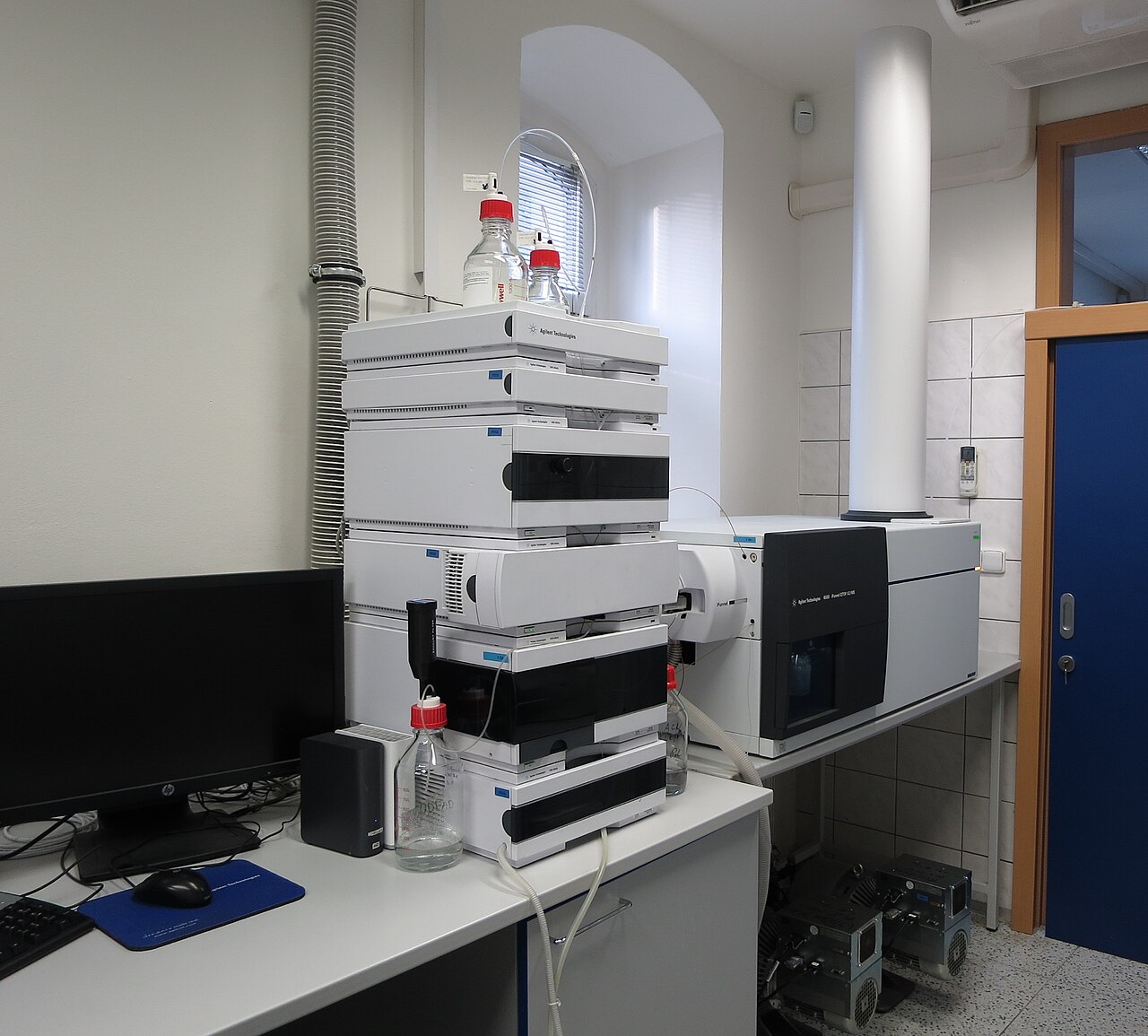
Hero image: "Liquid chromatograph with a mass spectrometer operating on the principle of flight time in combination with a quadrupole analyzer (qTOF), in CAFIA laboratory, Czech Republic," by CAFIA, licensed under CC BY-SA 4.0. Source: Wikimedia Commons. Reviewed before publication; shows a modern benchtop LC-MS/qTOF instrument, the class of equipment that produces the mass-spectrometry data PRISM is trained on, not a photo of Enveda's own laboratory.
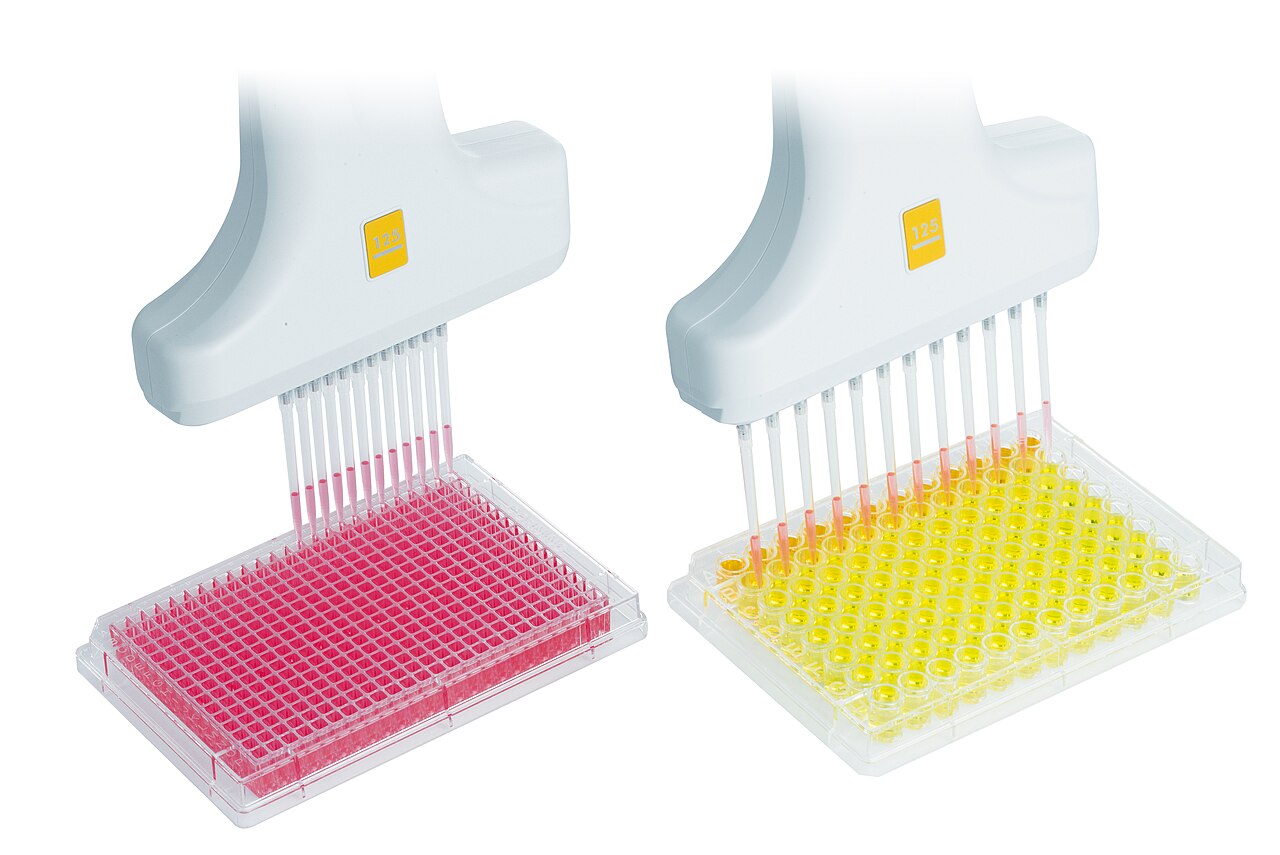
In-body figure: "VOYAGER adjustable tip spacing pipette," by INTEGRA Biosciences, licensed under CC BY-SA 4.0. Source: Wikimedia Commons. Reviewed before publication; shows an automated multichannel pipette dispensing into laboratory microwell plates, illustrative of the high-throughput liquid-handling equipment used in wet-lab candidate validation, not a photo of Enveda's own laboratory.