On September 10, 2026, DeepSeek released V4.1-Flash, a 552 billion-parameter open-weight model built on a new design the company calls a "Causal Encoder-Decoder." The headline number is not the parameter count. It is that the model activates a different number of those parameters depending on whether it is reading a prompt or writing a reply, 8 billion for input and 16 billion for output, an asymmetry that most large language model architectures do not have.
DeepSeek says V4.1-Flash beats its own former flagship, V4-Pro, on performance, cost, speed and total completion time. Starting at 04:00 UTC on September 14, 2026, every request sent to V4-Pro will be automatically rerouted to V4.1-Flash and billed at Flash's lower rates, effectively retiring the Pro tier until a V4.1-Pro model arrives.
 DeepSeek
 OpenAI
 Z.ai
Z.ai Anthropic
What shipped
V4.1-Flash is a Mixture-of-Experts model with a 552 billion-parameter backbone, pre-trained on 45 trillion tokens, supporting up to 1 million tokens of context and processing images natively as a multimodal reasoning model. DeepSeek ships it under an MIT license on Hugging Face, and the older model names "deepseek-v4-flash" and "deepseek-v4-flash-vision-exp" now route to it automatically, alongside the coming retirement of V4-Pro traffic.
The architectural change is the real story. A conventional decoder-only transformer activates the same slice of its parameters for every token, whether that token is part of the prompt or part of the answer. DeepSeek's Causal Encoder-Decoder (CED) splits the 40-layer transformer into a 20-layer causal encoder and a 20-layer decoder, and the decoder's key-value cache is projected from the encoder's final hidden states rather than computed independently in every decoder layer. That structural choice is what lets input tokens activate only 8 billion parameters while output tokens activate 16 billion.
Causal Encoder-Decoder: two different active-parameter counts, one model
A conventional decoder-only LLM activates the same parameter count for every token. V4.1-Flash's 552B-parameter backbone splits the work instead, so reading and writing cost different amounts of compute per token.
Processes the prompt, tool definitions, retrieved documents and conversation history: usually the bulk of the tokens in an agentic turn.
Generates each new token. Its KV cache is projected from the encoder's final hidden states rather than recomputed per layer, which is also what shrinks total cache size.
Total backbone size is 552B parameters (Mixture-of-Experts, MIT licensed). The 8B and 16B figures are how many of those parameters activate per token, depending on whether the model is reading or writing at that moment.
Why asymmetric active parameters change inference economics
Most agentic workloads are input-heavy. A long-running coding agent or research assistant re-reads system prompts, tool definitions, retrieved documents and prior conversation turns on nearly every step, and generates comparatively few new tokens in return. In a standard decoder-only model, all of that re-reading costs the same per-token compute as generation does. In V4.1-Flash's CED design, the prefill pass, the stage where the model reads everything before it starts writing, runs through the lighter 8B-active encoder rather than the heavier 16B-active decoder, so the token-heavy part of an agentic turn is also the cheaper part per token.
That is a deliberate trade against decode cost, not a free lunch. Output tokens, the ones the decoder actually has to generate, get more expensive per token in exchange, at 16B active parameters instead of a single uniform figure. The bet is that this trade nets out in the model's favor for the workloads DeepSeek is targeting, since agentic sessions are dominated by re-read context rather than by freshly written tokens. It is the same logic behind why DeepSeek is pushing V4.1-Flash as an agent-first release rather than a general chat upgrade.
Benchmarks: strong on coding and security, weaker on hard reasoning
CyberGym: the one benchmark DeepSeek leads outright
Launch-day scores on CyberGym, a cybersecurity capability benchmark. Higher is better. Self-reported by DeepSeek, not independently audited.
DeepSeek V4.1-Flash scores 88.1 on CyberGym, ahead of GPT-5.6 Sol and GLM 5.3, which tie at 84.5.
On CyberGym, a cybersecurity capability benchmark, V4.1-Flash scores 88.1, ahead of both GPT-5.6 Sol and GLM 5.3, which tie at 84.5. On DeepSWE v1.1, an agentic coding benchmark, it scores 74.2, essentially matching Claude Opus 5 at 74.0. The pattern breaks on Humanity's Last Exam, a demanding, tool-free reasoning test, where V4.1-Flash scores 36.8 against Opus 5's 56.3, a gap of nearly 20 points.
Near parity on coding, a wide gap on hard reasoning
Launch-day scores for DeepSeek V4.1-Flash against Claude Opus 5. Higher is better. Self-reported, not independently audited.
On agentic coding the two models are essentially tied. On a demanding, tool-free reasoning exam, Opus 5 leads by a wide margin.
V4.1-Flash rivals frontier models on coding and cybersecurity tasks, but trails meaningfully on reasoning that requires no tools at all.
On the shape of V4.1-Flash's benchmark spread
Every one of these figures is vendor-published and self-reported at launch. None of them have been independently replicated yet, and independent numbers on comparable harnesses have historically landed lower than launch-day claims across the industry, not just for DeepSeek. Treat the spread as a shape worth watching rather than a settled ranking: a model built for tool-using, agentic work looks strong exactly where that framing predicts it should, and weaker exactly where it does not.
Retiring a "Pro" tier for a cheaper "Flash" is the notable part
Pricing confirms the direction. According to DeepSeek's own API pricing page, V4.1-Flash charges $0.60 per million output tokens off-peak (double at peak hours), against V4-Pro's $1.98, a cut of roughly 70%. Cached input tokens fall from $0.022 to $0.003 per million off-peak, a steeper cut still. Peak hours run 01:00 to 04:00 and 06:00 to 10:00 UTC on weekdays, with off-peak pricing applying the rest of the time.
What makes this notable is not the discount itself but the decision it represents. DeepSeek is not just cutting the price of its flagship, it is discontinuing the flagship tier and routing its traffic to the cheaper model instead, at the cheaper model's rates. That is a different move than a price cut applied evenly across a product line: it removes the higher-priced option from the menu entirely, at least until a V4.1-Pro exists to replace it. In a market where every open-weight lab is competing partly on capability and partly on cost per token, retiring the expensive tier in favor of the cheap one that claims to beat it is a stronger signal about where the economics are heading than a rate card change alone would be.
The broader 2026 open-weight landscape
DeepSeek QwenZ.ai
 Moonshot AI
 MiniMax
V4.1-Flash lands inside a crowded field. Alibaba's Qwen family, Z.ai's GLM series and Moonshot AI's Kimi models have each shipped open-weight releases through 2026 that compete on a similar mix of agentic coding ability, long context and aggressive pricing, and MiniMax has pushed on cost-efficient inference from the same region. The common thread across this group is architectural experimentation aimed squarely at inference cost, not just headline benchmark scores, because open-weight labs compete on what it costs a developer to actually run the model at scale, not only on what it can do in a demo. DeepSeek's CED design, and the asymmetric active-parameter trade it makes, is best read as one lab's specific answer to that same pressure.
For teams evaluating models, the practical takeaway is that no single release settles which model is the right default. V4.1-Flash's strengths in coding and security sit next to a real gap on hard reasoning, and every number here is a vendor's own claim about its own system. That is the case for keeping model choice portable rather than betting on one lab's release cycle. DeepSeek's models sit alongside GPT, Claude and Gemini models in the same Metir workspace, so a task like an agentic coding session or a reasoning-heavy research question can be routed to whichever model actually performs best on it, without switching tools or subscriptions to test a new release.
Sources:
- DeepSeek API changelog: V4.1-Flash release
- DeepSeek API pricing
- DeepSeek launches V4.1-Flash, V4-Pro retired, price cut - TheNextWeb
- DeepSeek launches V4.1 Flash multimodal reasoning model - Neowin
- DeepSeek V4.1-Flash benchmarks and pricing - OfficeChai
- DeepSeek formally launches V4.1 Flash, routes V4 Pro requests to Flash - TechNode
- deepseek-ai/DeepSeek-V4.1-Flash model card - Hugging Face
- DeepSeek V4.1-Flash model page - BenchLM
Image credits
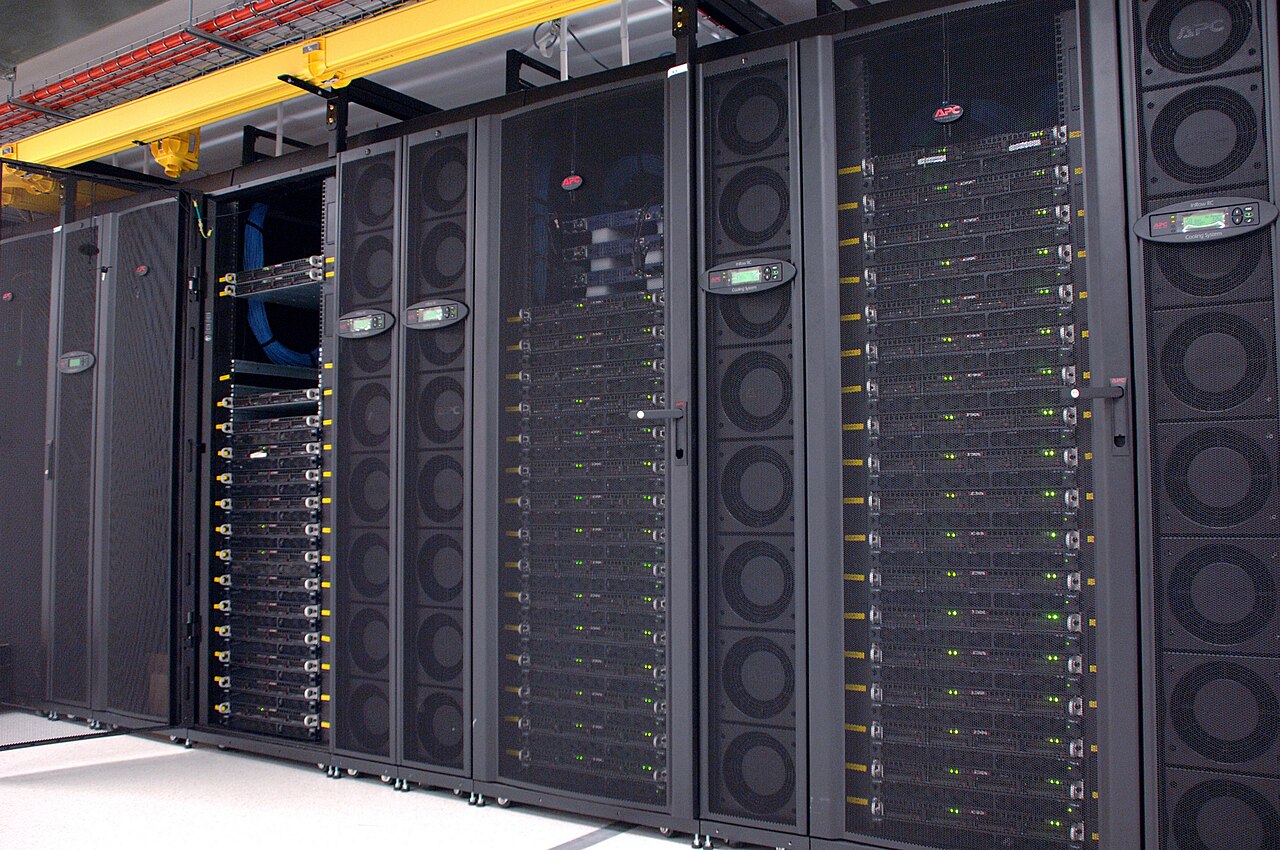
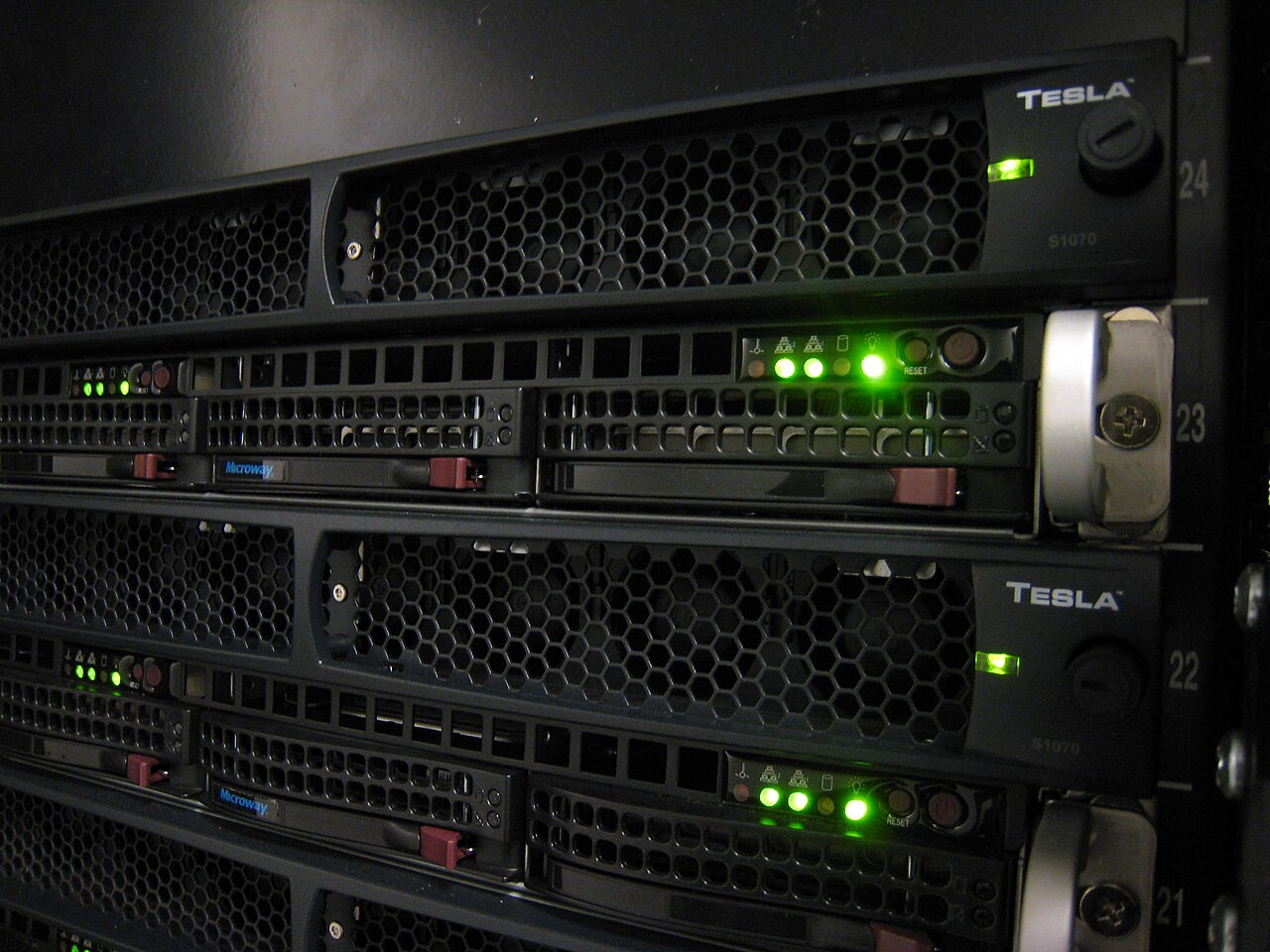
Header image: a GPU compute cluster inside a data centre, photographed by CSIRO (Australia's national science agency), via Wikimedia Commons, licensed under CC BY 3.0. This photo illustrates the class of accelerator hardware large language models run on and does not depict DeepSeek's own infrastructure. In-body photo of a rack-mounted NVIDIA Tesla GPU compute cluster by ChrisDag via Wikimedia Commons, licensed under CC BY 2.0.