On August 6, 2026, Bloomberg reported that DeepSeek, the Hangzhou-based AI lab, has reopened its second funding round and is seeking close to $8 billion at a valuation near 500 billion yuan, roughly $74 billion. The round had been paused, according to the reporting, after frustration over leaked remarks from the company's founder to investors, and it is now moving again, with Monolith Management said to be in talks to join a syndicate that already includes China's national AI fund and a set of strategic and financial backers. Signing is expected to complete late in August.
DeepSeek has not publicly confirmed the round, and the figures come from reporting rather than an official announcement, so they are best read as a well-sourced target rather than a closed deal. With that caveat in place, the raise is a useful lens on how China's most internationally recognized AI lab is institutionalizing, and on how differently the capital behind it is structured compared with its American counterparts.
What is reportedly on the table
The structure, as reported, is a large primary round: close to $8 billion in new capital at a valuation near $74 billion. The named participants span three categories. There is state-linked money in the form of China's national AI fund, a government-backed vehicle whose presence signals that DeepSeek is treated as a national-champion asset. There are strategic corporate investors, with NetEase and JD.com, both large Chinese technology companies with their own AI and cloud interests, in the syndicate. And there are financial investors already committed, including IDG Capital, Loyal Valley Capital and Shixiang Capital. Monolith Management, a backer of rival Chinese lab Moonshot, is reported to be negotiating to join.
Who is reported to be backing DeepSeek's round
A target of close to $8 billion at a valuation near $74 billion (roughly 500 billion yuan), drawn from state-linked, strategic and financial investors. As reported by Bloomberg; DeepSeek has not publicly confirmed the round.
The mix of state-linked and strategic Chinese capital is a different funding base than the venture and sovereign money behind leading U.S. labs.
The path to this point was not smooth. The round was paused before it was reopened, with the reported trigger being investor frustration over leaked comments from DeepSeek's founder, Liang Wenfeng, made to investors. That a stalled round could restart at this scale, and draw in an outside backer like Monolith, is itself a demand signal: the pause was about process and perception, not about a collapse in interest.
How the round got here
A raise that stalled and restarted, as pieced together from public reporting.
Why DeepSeek matters enough to fund at this scale
DeepSeek is not a typical startup raising its way from obscurity. It became globally known in January 2025, when its R1 reasoning model demonstrated frontier-level performance at a fraction of the training cost the market assumed was necessary, and the resulting reappraisal of AI economics contributed to a sharp, widely reported sell-off in AI-exposed equities. That episode, often called the "DeepSeek moment," established the lab's central identity: high capability delivered with unusual efficiency, and model weights published openly rather than kept behind a closed API.
The company's roots explain some of that efficiency focus. DeepSeek grew out of High-Flyer, a quantitative hedge fund, and inherited both a research culture oriented toward getting more out of less compute and a founder, Liang Wenfeng, with a background in systematic, cost-sensitive engineering. For most of its life the lab ran lean, without the mega-rounds that defined its US peers. A raise approaching $8 billion is a departure from that posture, and it reflects the reality that staying at the frontier, even efficiently, now requires capital for compute, talent, and the infrastructure to serve models at scale.
The pause was about process and perception, not a collapse in interest. A stalled round restarting at this scale is itself a demand signal.
On the round's reopening
A $74 billion valuation, in context
The number that will draw the most attention is the $74 billion valuation, and it is worth reading in two directions at once. In absolute terms it is very large, placing DeepSeek among the most valuable AI companies in the world and by some distance the most valuable Chinese one. In relative terms, it is a fraction of where the leading US labs are marked, which are valued in the hundreds of billions. The gap is not a simple statement that DeepSeek is worth proportionally less as a technology. It reflects several forces at once: an open-weight business model that monetizes differently than a closed, per-token API; a capital environment in China that is more constrained and more state-directed than the US venture and sovereign-fund ecosystem; and the geopolitical reality that a Chinese lab's addressable market and access to the most advanced chips are shaped by export controls and cross-border trust in ways a US lab's are not.
None of those factors is a verdict on model quality. They are structural features of where and how DeepSeek operates, and they are exactly why a valuation comparison across the US-China line has to be made carefully rather than treated as a straight ranking.
The open-weight strategy the money is buying into
What investors are funding is a specific strategy, not just a model. DeepSeek publishes the weights of its frontier models, which means anyone can download, run, fine-tune, and build on them without paying DeepSeek per query. That openness is part of why the lab's influence outruns its revenue: its models propagate into products, research, and other companies' infrastructure far more widely than a closed model with the same benchmark scores would.
The strategic logic of funding an open-weight lab is different from funding a closed one. A closed lab's value is tied fairly directly to the API revenue it can capture. An open-weight lab's value is more diffuse, resting on ecosystem gravity, on being the default open model that developers reach for, on services and enterprise offerings built around the open core, and, in DeepSeek's case, on national strategic importance. Reporting has also placed this round in the context of an eventual planned IPO, which would give the open-weight thesis a public-market test it has not yet had.
For the buyers of AI rather than the builders of it, DeepSeek's openness has a practical consequence. Its models are among the ones an organization can run on cost-efficient infrastructure, weighed against closed frontier models on a task-by-task basis. That is only an advantage if your systems are built to use different models interchangeably. A platform designed to be model-agnostic, as Metir AI is, can route a given task to an open model like DeepSeek's or to a closed frontier model depending on cost and quality, rather than committing to one provider's economics. The value of an open-weight frontier lab is highest for those who can actually pick it up and put it down as needed.
The risks and open questions
A neutral read holds several uncertainties. The most immediate is that the round is not closed. The figures are reported, DeepSeek has not confirmed them, and a raise that already paused once could shift in size, valuation, or timing before signing. Treating the $74 billion mark as settled would be premature.
Beyond the deal itself, DeepSeek faces the structural constraints of a leading Chinese AI lab. Access to the most advanced AI chips is shaped by export controls, which affects how it trains and serves models. Its international footprint is complicated by data-governance concerns that have led some governments and organizations to restrict use of its consumer app, a separate matter from the quality of its open models but a real factor in its addressable market. And the presence of state-linked capital, while a source of strength domestically, can add scrutiny abroad. These are not predictions of failure; they are the specific reasons a Chinese frontier lab's trajectory cannot be modeled as a straight-line extrapolation of a US one.
The read-through
DeepSeek's reopened round captures a broader shift. The lab that made its name proving frontier AI could be built more cheaply, and shared openly, is now raising at a scale that puts it firmly among the world's most valuable AI companies, backed by a distinctly Chinese mix of state, strategic, and financial capital, and reportedly pointed toward an eventual public listing. That is a maturation story: an efficiency-first, open-weight lab institutionalizing into a national AI champion with the balance sheet to match.
For everyone downstream, the durable takeaway is that the frontier is not a single-country, single-model phenomenon. Capable models are emerging from multiple labs under different business models and different funding structures, and open-weight options from labs like DeepSeek are a permanent part of that landscape rather than a passing disruption. The organizations best positioned to benefit are the ones that treat model choice as a variable to optimize rather than a vendor to marry. Whether DeepSeek closes this round at $74 billion is a question for late August. That it can command the attempt is already the more telling fact.
Sources:
- DeepSeek's $8 Billion Fundraising Reopens, Valuation Nears $74 Billion | Bloomberg
- DeepSeek Resumes Funding Round to Raise $8 Billion | PYMNTS
- DeepSeek resumes funding round seeking nearly $8 billion, Bloomberg News reports | Zawya
- DeepSeek eyes $74 billion valuation in new funding round ahead of planned IPO | Tech Startups
Image credits
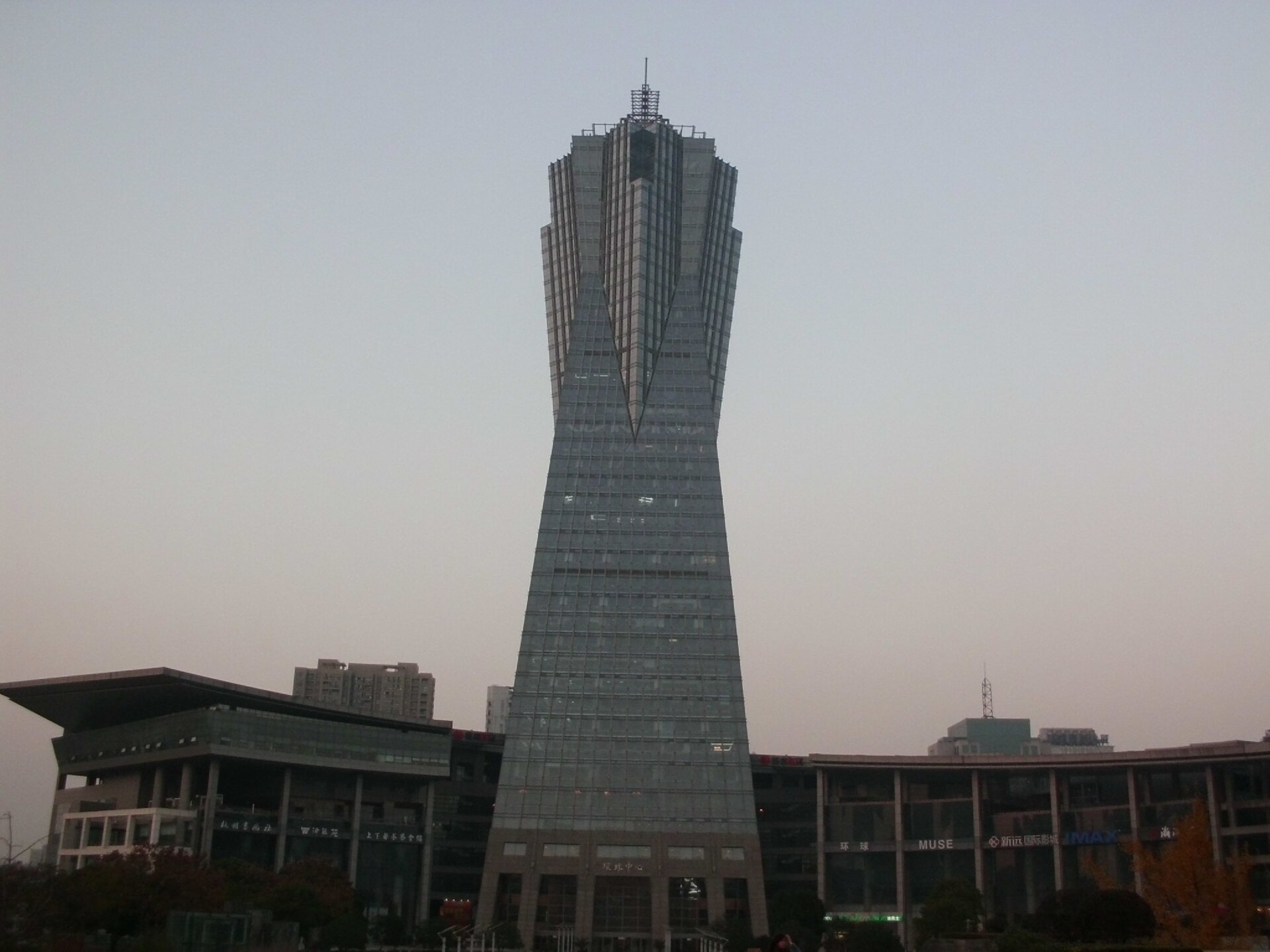
Header image: a commercial high-rise in Hangzhou, the city where DeepSeek is headquartered, shown to illustrate the company's home city rather than any DeepSeek facility. By Huandy618 via Wikimedia Commons, licensed under CC BY-SA 3.0.