On 8 September 2026, Google DeepMind released AlphaGenome Atlas, a dataset containing predicted molecular effects for all 9 billion possible single-letter changes to the human genome. It is roughly a petabyte of data, which DeepMind says is more than 30 times the size of the AlphaFold Database it opened in 2022, and it arrives with a new variant-ranking score and a technical paper. The release is a useful moment to explain a kind of AI that gets far less attention than chatbots but may end up mattering more: specialized scientific models that turn biology into something you can look up.
 Google DeepMind
Where the number 9 billion comes from
The human genome is a sequence of about 3 billion DNA letters, drawn from an alphabet of four: A, C, G, and T. At any single position, a mutation can change the existing letter into one of the other three. Three billion positions times three possible substitutions gives roughly 9 billion possible single-letter variants. AlphaGenome Atlas has a prediction for every one of them. That completeness is the point: instead of studying the handful of mutations a given lab happens to be interested in, a researcher can now query any position in the genome and get a predicted answer immediately.
Where 9 billion variants comes from
Every position in the genome can change to one of three other DNA letters. Atlas stores a predicted molecular effect for all of them.
Precomputing every prediction turns a model experts had to run into a table a biologist can query from a laptop.
The shift from running a model to reading a table
The technical move behind Atlas is subtle and worth understanding, because it represents a pattern that will recur across AI for science. DeepMind already had AlphaGenome, a sequence-to-function model that predicts what a stretch of DNA does. A model like that normally runs on demand: you give it a variant, it computes a prediction, and that computation needs specialized hardware and expertise. Atlas instead precomputes the model's prediction for every possible variant in advance and stores the results.
Atlas turns a model that experts had to run into a table that anyone can read. That is what democratizing a capability actually looks like.
On precomputed scientific datasets
The consequence is a change in who can use the capability. Precomputing everything turns a model that required GPUs and machine-learning skills into a static resource a biologist can query from a laptop. It democratizes access at the cost of flexibility: the predictions are frozen at one model version, and improving them means recomputing the whole atlas. This is the same trade every precomputed dataset makes, and for a resource meant to be a shared reference for the whole research community, freezing a known version is a feature rather than a bug.
Why non-coding DNA is the hard part
The headline capability of AlphaGenome is not just scoring mutations in genes. Only about 2 percent of the human genome codes for proteins directly. The other 98 percent was once dismissed as junk, but much of it regulates when and how genes switch on and off, and a large share of disease-associated variants sit in these non-coding regions. Predicting the effect of a change in a gene is comparatively tractable; predicting the effect of a change in a regulatory region that acts at a distance on other genes is much harder, and it is where earlier tools were weakest.
Atlas introduces the AlphaGenome Variant Impact score, or AVI, which combines predictions across both coding and non-coding regions into a single ranking. The practical value is triage. A researcher studying a disease might have thousands of candidate variants and no way to know which to investigate first. A unified score lets them prioritize the most likely culprits and ignore the rest, compressing what used to be months of narrowing down into a first-pass filter. The score does not explain the biology; it points at where to look.
The caveat DeepMind put in writing
The most important part of the release is the disclaimer, and it deserves to be read as carefully as the capability. DeepMind states plainly that Atlas and AVI are research tools that can form only part of the evidence chain leading to a clinical diagnosis, not sufficient evidence on their own, and that AlphaGenome has not been validated or approved for any clinical use. That is not legal boilerplate. It is the correct scientific posture, and it is where a lot of AI-for-medicine coverage goes wrong.
A prediction is a hypothesis about biology, generated by a model trained on existing data, and it inherits both the strengths and the blind spots of that data. Used well, it accelerates research by telling scientists where to spend their experimental effort. Used badly, treated as a verdict rather than a lead, it would launder a statistical guess into a clinical claim. The honest framing, and the one DeepMind chose, is that Atlas makes the search faster without making the confirmation optional. The wet-lab experiment that validates a prediction is still required; what changes is how quickly you find the prediction worth testing.
A different shape of AI
For readers whose picture of AI is a chat window, AlphaGenome is a useful corrective. It is not a general-purpose language model, it does not converse, and its value is not fluency. It is a narrow, deeply specialized system that does one scientific task and turns the result into shared infrastructure. The frontier of AI is not one model getting better at everything; it is a widening portfolio of very different models, general and specialized, each suited to a different job.
That plurality is quietly the operative point for anyone building on top of AI. The most useful systems increasingly draw on whichever model fits the task rather than committing to a single one, and staying able to reach the right model for each problem, general reasoning here, a specialized scientific or coding model there, is what keeps that plurality an advantage. Platforms like Metir that stay model-agnostic reflect the same reality Atlas illustrates from the research side: the field is getting broader, not just deeper, and access to the right tool for each job is the thing worth preserving.
The measured read on AlphaGenome Atlas is that it is a genuine expansion of what genomics researchers can do cheaply and fast, delivered with unusually honest limits. It does not diagnose disease, it does not replace the laboratory, and it does not claim to. What it does is turn one of biology's largest search problems into a lookup, which is exactly the kind of unglamorous, foundational contribution that tends to matter more over time than the demonstrations that trend.
Sources:
- AlphaGenome Atlas: Molecular predictions for 9 Billion human DNA variants | Google DeepMind
- AlphaGenome Atlas Predicts Effects of All 9 Billion Human DNA Variants | Unite.AI
- Google DeepMind Releases AlphaGenome Atlas With Precomputed Molecular Effect Predictions and AVI Scores | MarkTechPost
- AlphaGenome Atlas Maps 9 Billion DNA Variants | StartupHub.ai
Image credits
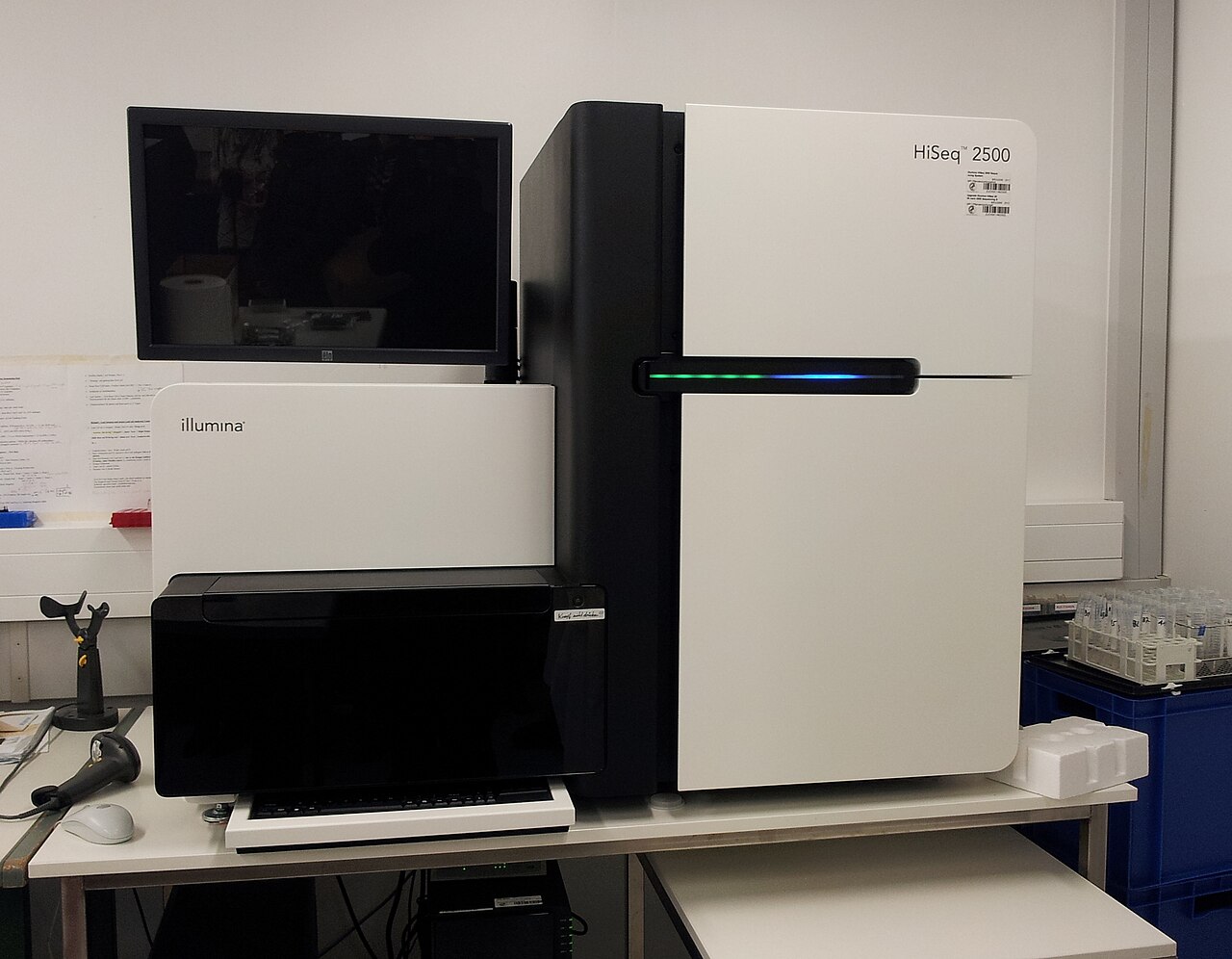
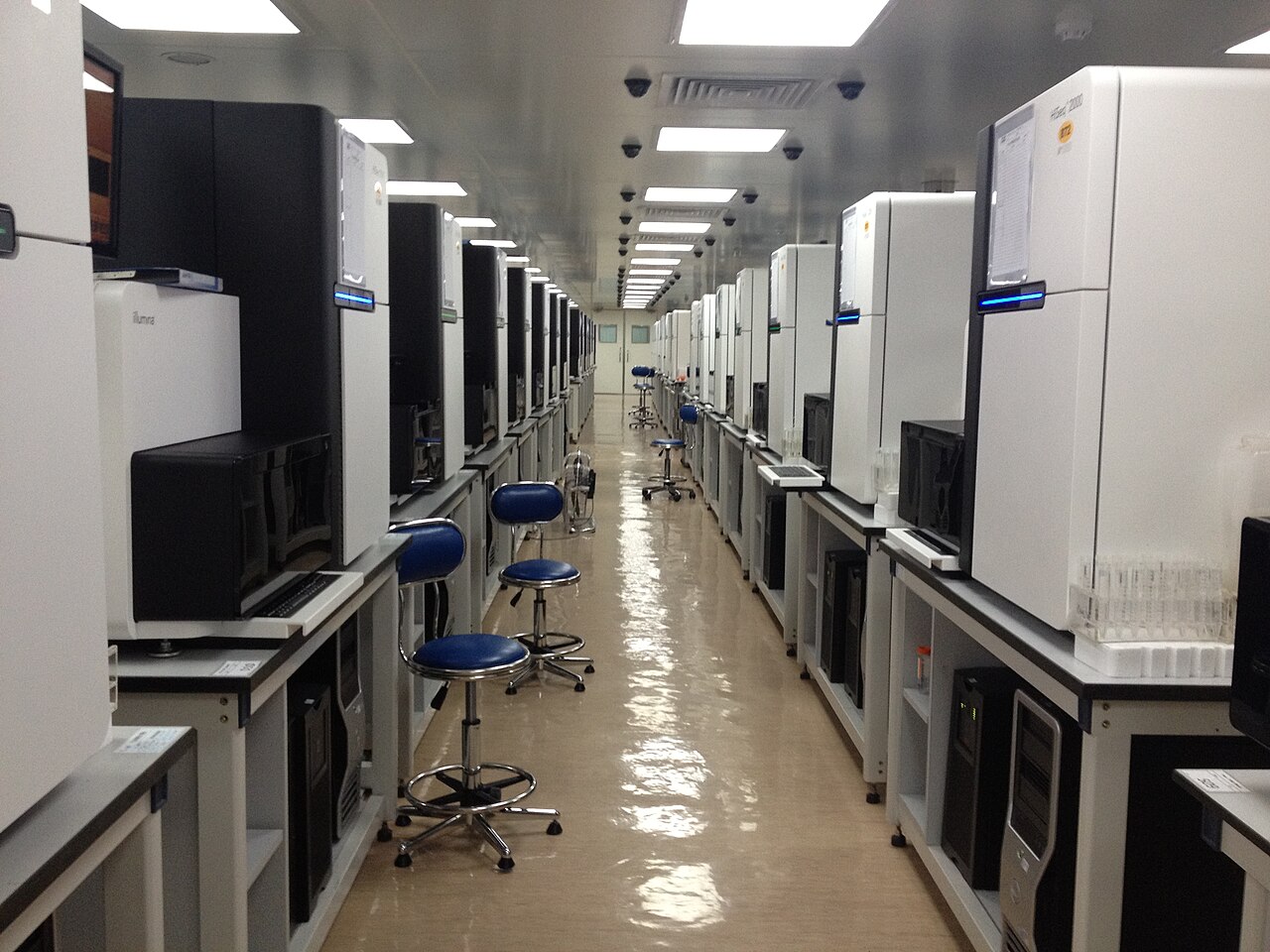
Hero image: an Illumina HiSeq 2500 DNA sequencer, via Wikimedia Commons, released under CC0 1.0. In-body photograph: Illumina sequencing machines in a laboratory, via Wikimedia Commons, licensed under CC BY 3.0. The photographs illustrate DNA sequencing generally and do not depict DeepMind's work.