
On July 20, 2026, the Cambridge, UK startup CuspAI announced a $450 million Series B at a $2.6 billion valuation, led by Kleiner Perkins and NEA with Jeff Bezos' Bezos Expeditions co-leading, and a supporting cast that includes AMD Ventures, Britain's sovereign AI fund and the Netherlands' Invest-NL. Alongside the money it launched a coalition it calls the AI Materials Foundry, with more than 45 industrial and technology partners including Nvidia and Meta. The raise is a useful lens on a broader shift: after years of AI attention concentrated on chatbots and code, serious capital is now flowing into using AI to discover physical things. This piece explains what CuspAI is trying to do, why it is attracting this kind of backing, and where the honest limits sit.
What "AI for materials" actually means
To see why investors are interested, it helps to understand the problem CuspAI is attacking. Almost every hard technology challenge eventually becomes a materials problem. Better batteries need better electrode and electrolyte materials. Carbon capture needs sorbents that grab carbon dioxide cheaply and release it easily. Faster chips need better substrates and packaging. For a century, finding those materials has been slow, expensive laboratory work: hypothesize a compound, synthesize it, test it, repeat. The space of possible materials is astronomically large, and human intuition can only sample a sliver of it.
The bet behind AI materials discovery is that a model can search that space far faster than trial and error. Instead of physically making thousands of candidates, a system proposes promising structures computationally, predicts their properties, and ranks them, so that scientists only synthesize the handful most likely to work. It compresses the search.
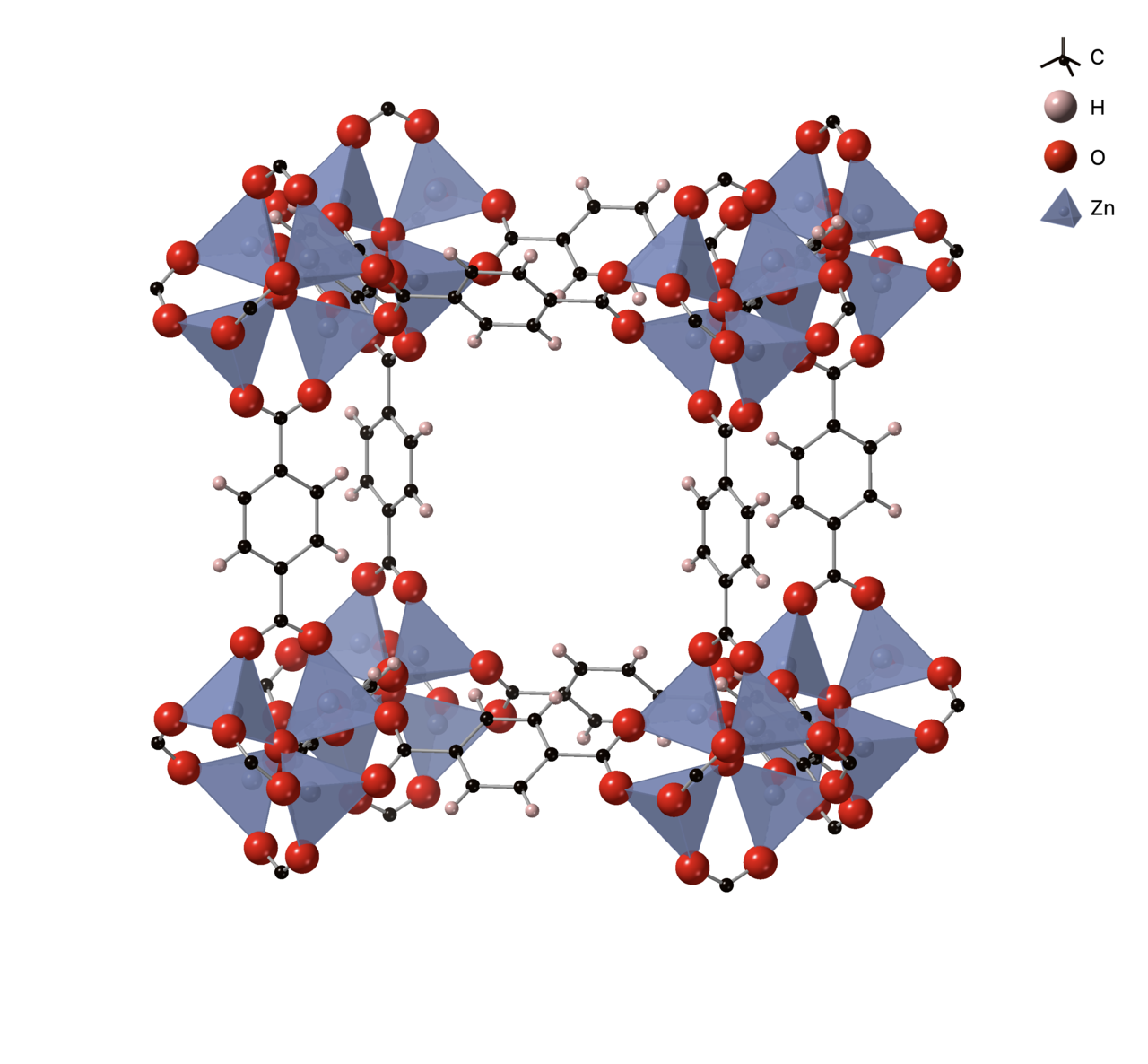
CuspAI focuses on precisely this kind of structured, porous material, with early emphasis on capturing carbon dioxide, and more broadly on materials for semiconductors, energy and climate technology. The pitch is not a general-purpose chatbot; it is a specialized engine pointed at a specific and economically enormous search problem.
Why the valuation moved so fast
The most striking number in the announcement is not the $450 million; it is the speed of the mark-up. CuspAI's valuation rose from roughly $520 million to $2.6 billion in about nine months, close to a five-fold increase.
A five-fold mark-up in about nine months
CuspAI's post-money valuation from its Series A to its July 2026 Series B. The company has now raised more than $650 million in total.
The $450 million Series B was led by Kleiner Perkins and NEA with Bezos Expeditions co-leading, valuing the Cambridge, UK company at $2.6 billion.
Two forces explain that. The first is the pattern across all of AI in 2026: private valuations for anything credible at the frontier are compounding at a pace that would have looked absurd two years ago. The second is more specific. Materials discovery is one of the few AI applications where success would produce a tangible, defensible, physical asset, a new compound with real-world value, rather than a software feature that a competitor can replicate. Investors are paying for the possibility of durable, hard-to-copy output.
Materials discovery is one of the few AI applications where success produces a physical asset a competitor cannot simply copy.
The investor list reinforces the read. When a personal fund like Bezos Expeditions co-leads and chipmakers such as Nvidia and AMD participate through their venture arms, the interest is strategic as much as financial. Better materials feed directly back into the semiconductor and energy supply chains those companies depend on. Meta and others joining the AI Materials Foundry signals the same thing: the people building large-scale AI infrastructure have a direct stake in the materials that make chips, cooling and power more efficient.
 Nvidia
 Meta
MetaThe Foundry model: compute plus chemistry
The AI Materials Foundry is worth a closer look, because it hints at how this field is likely to be structured. Rather than a single company owning every step, CuspAI is assembling a coalition: partners that supply compute, partners that supply industrial demand and validation, and CuspAI in the middle running the discovery engine. It resembles the way modern AI itself is built, with model developers, chip makers and cloud providers each owning a layer.
That structure exists because no one link is sufficient on its own. A brilliant model that proposes a material is worthless without the compute to run the search, the chemistry expertise to synthesize the candidate, and an industrial partner willing to test it at scale. The Foundry is an attempt to line up all of those at once, which is also why the raise and the coalition were announced together.
The part that deserves skepticism
A neutral account has to state the limits plainly. AI materials discovery has produced genuine, peer-reviewed advances, but the gap between a promising computational candidate and a manufactured, certified, commercially deployed material is wide and often years long. A model can rank a compound as promising; it cannot guarantee the compound is stable, safe, manufacturable at cost, or better than the incumbent once real-world constraints are applied. The history of computational chemistry is full of candidates that looked excellent in silico and failed in the flask.
So the right way to hold this news is as a well-funded, credible bet on a hard problem, not as a solved one. The $2.6 billion valuation prices in success that has not yet been proven at commercial scale. That is not a criticism; it is the nature of frontier deep-tech investing. But it means the meaningful milestones to watch are not funding rounds. They are validated materials moving from prediction into pilot production, and eventually into products.
What it signals about where AI is heading
Step back and the CuspAI round fits a pattern visible across 2026. The first wave of the AI boom monetized language: writing, coding, answering. The emerging wave is pointing the same underlying techniques at the physical and scientific world, drug discovery, protein design, robotics, and now materials. These problems are harder to fake and slower to validate, but the payoff, if it lands, is more durable than a chat feature.
There is also a tooling lesson in it for everyone else. Specialized scientific AI still sits on top of general model infrastructure, and the teams doing this work tend to keep their options open across models and compute providers rather than betting the company on one. That instinct, staying model-agnostic so you can route work to whatever performs best, is the same discipline that serves ordinary teams using AI day to day. A flexible workspace such as Metir AI applies it to everyday work, but the principle is identical: the value is in the problem you solve, not the vendor you happen to start with.
The bigger picture
CuspAI's $450 million is a small figure next to the tens of billions flowing into frontier language models, but it is a meaningful marker. It shows that the most sophisticated investors now believe AI's next returns may come from the physical world as much as the digital one. Whether that belief is vindicated depends on something no funding round can shortcut: turning a model's confident prediction into a material you can actually hold, make and sell. The money says the search is worth accelerating. The proof is still in the lab.
Sources:
- Launching our AI Materials Foundry and $450 million Series B | CuspAI
- CuspAI raises $450 million Series B for AI materials discovery | Yahoo Finance
- From $520M to $2.6B in 9 months: Bezos Expeditions co-leads CuspAI's $450M Series B | TechFundingNews
- UK government, Bezos back CuspAI's $450 million round | Global Banking and Finance Review
- CuspAI Raises $450 Million Series B At $2.6 Billion Valuation | Pulse 2.0
Image credits
Header image: a research scientist working in a chemistry laboratory, National Center for Advancing Translational Sciences, via Wikimedia Commons, licensed under CC BY 2.0. In-body diagram of the crystal structure of the metal-organic framework MOF-5 via Wikimedia Commons, licensed under CC BY-SA 4.0.