
On August 6 and 7, 2026, Cloudflare introduced Kitesurf, a cloud-hosted web browser built specifically for AI agents instead of human users. The announcement ran first as a developer changelog post, then spread through TechCrunch, MarkTechPost, TheNextWeb, and TechRepublic. Kitesurf is available free during a beta through Cloudflare's "Browser Run," and it is the clearest signal yet that internet infrastructure providers are starting to design products for machine visitors as a category distinct from human ones.
The pitch is narrow and specific. Kitesurf is not a faster Chrome or a new consumer browser. It is a browser stripped down to the operations an autonomous agent actually performs: load a page, read its structure, take a screenshot, extract text, click and type. Everything a browser builds for a person watching a screen, tabs, extensions, themes, pixel-perfect rendering, smooth scrolling, is gone. What is left is designed to run at the scale and unpredictability of agent workloads, which look nothing like human browsing sessions.
What Kitesurf actually is
According to Cloudflare's developer changelog, Kitesurf runs entirely on Cloudflare Workers, the company's edge compute platform built on V8 isolates rather than full virtual machines or containers. It is stateless: each session spins up fresh rather than persisting a long-lived browser process waiting for the next request. That design matches how agents tend to browse in practice. A human keeps a handful of tabs open for hours; an agent might spin up a session, complete one narrow task, and tear the session down seconds later, doing this thousands of times in short bursts that spike and disappear.
Cloudflare's own framing draws a direct line between what it removed and who the product is for. Tabs, extensions, themes, and 60-frames-per-second scrolling all exist to serve a person's eyes and hands. An agent does not have either. It needs the DOM, the rendered text, a screenshot when a screenshot is the fastest way to answer a question, and reliable input events for clicking and typing. Every capability outside that list is surface area Cloudflare chose not to build, which is also surface area it does not have to secure, patch, or pay to run.
Reporting across the coverage is consistent on the headline efficiency number: for common agentic tasks like taking a screenshot or extracting page HTML, Cloudflare says Kitesurf uses roughly 3 to 7 times less CPU and memory than a full Chromium instance doing the same job. Cloudflare also says the product was built in about 12 weeks, a detail worth treating as a Cloudflare-reported figure rather than an independently verified one, but one that fits a pattern this piece returns to below: a narrowly scoped product is faster to build precisely because most of a browser's engineering effort goes into features Kitesurf chose to skip.
CPU and memory per browsing session, indexed to Chromium
For common agentic tasks like taking a screenshot or extracting page HTML, Cloudflare reports Kitesurf using roughly 3 to 7 times less CPU and memory than a full Chromium instance. Lower is cheaper and allows more concurrent agent sessions per unit of compute.
Figures are Cloudflare's own reported range for common agentic tasks, not an independent benchmark. Actual savings vary by workload.
The economics of an agent session
The efficiency claim is not a side note. It is the entire reason Kitesurf exists as a separate product rather than "run headless Chrome, but faster." Every AI agent that browses the web needs a browser instance behind it somewhere, and that instance consumes CPU and memory for as long as the session runs. Multiply a single session's resource footprint by the number of agents a platform wants to run concurrently, and the footprint becomes the limiting factor on how many agents can operate at once for a given budget.
This is a familiar shape of constraint from adjacent parts of AI infrastructure. Just as GPU memory gates how large a model a given accelerator can serve, and grid power gates how many accelerators a data center can run, per-session CPU and memory gates how many autonomous browsing agents a given compute footprint can support at a time. A platform running one browser session per agent request pays a fixed resource cost whether that agent is doing something valuable or idling on a slow page load. Cut that per-session cost by a factor of three to seven, and the same hardware budget supports several times as many concurrent agents, or the same number of agents at a fraction of the cost. That is the commercial logic behind building a browser that throws away everything a human does not need an agent to have.
A browser built for machines does not need to look good doing its job. It only needs to finish it, cheaply, at a scale no human ever browses at.
Cloudflare's dual role: gatekeeper and enabler
Kitesurf sits in an interesting position relative to the rest of Cloudflare's business. Cloudflare has spent years building tools to detect and block automated traffic on behalf of the sites it protects, from bot-management scoring to, more recently, a pay-per-crawl mechanism that lets publishers charge AI crawlers for access to their content. That is Cloudflare acting as gatekeeper, standing between websites and the automated traffic hitting them.
Kitesurf is Cloudflare acting as enabler, building infrastructure that makes it easier and cheaper to run the very kind of automated traffic its other products are built to manage. The two roles are not necessarily in conflict. A company that understands bot traffic well enough to detect it at scale is also well positioned to build tooling that helps legitimate automated agents run efficiently, and Cloudflare's business model rewards it for sitting in the middle of both flows regardless of which side of the interaction it is optimizing at any given moment. But the juxtaposition is real: the company that has spent years telling sites how to keep bots out is now also selling the infrastructure that helps a new generation of bots, in the form of AI agents, get more done per dollar.
 OpenAI
 Anthropic
 Google
 xAI
xAIA different threat model: prompt injection
A browser driven by an autonomous agent carries a security posture that a browser driven by a person does not. When a human browses a suspicious page, the person is the last line of defense; they can recognize a phishing attempt or ignore a manipulative pop-up. An agent has no equivalent instinct. It reads whatever text a page contains and, depending on how it is built, may treat that text as part of its working context alongside its actual instructions. If a page contains text engineered to look like a command, an agent that is not carefully guarded can follow it. This is prompt injection, and it is a threat model specific to agents that read and act on untrusted web content rather than simply displaying it to a person who filters it themselves.
The agent browsing stack, and where prompt injection enters
An agent browser sits between an autonomous agent and the open web. Whatever a page contains, including text designed to look like instructions, flows back up into the agent's context.
Decides what to browse, issues actions, and reads back whatever the browser returns.
Runs on a model of the developer’s choosing, separate from the browser itself.
A cloud-hosted, stateless browser built for agent workloads, not human ones.
Runs entirely on Cloudflare Workers (V8 isolates). No tabs, extensions, themes, or 60fps rendering to maintain.
Untrusted content the agent did not write and cannot fully vet before it is read.
Page text, scripts, and hidden instructions all arrive in the same channel as the content the agent is there to extract.
The same channel carries both the content an agent wants and any adversarial instructions a page author has planted in it, which is the core of the prompt-injection risk unique to agent-driven browsers.
Building an agent browser does not remove this risk; if anything, it concentrates it. A stateless, high-throughput browser designed to run thousands of agent sessions is, by construction, reading thousands of arbitrary pages on the open web that nobody has vetted in advance. The reporting on Kitesurf is candid that agent browsers inherit this exposure along with the more familiar problems of managing context windows, controlling token costs, and scaling performance. None of the coverage claims Kitesurf has solved prompt injection; the honest reading is that it is infrastructure optimized for a workload that carries this risk by nature, not a security product that neutralizes it.
What it means for teams building agents
For teams building products on top of AI agents, Kitesurf is a useful data point rather than a mandate. It confirms that browsing is becoming a first-class agent capability serious enough for a major infrastructure provider to build dedicated tooling around it, and it puts a concrete number on how much cheaper that capability can get when a browser is purpose-built instead of repurposed. It also underscores that adopting agent browsing means adopting its threat model: any pipeline that feeds page content back into a model's context needs the same scrutiny given to any other untrusted input, regardless of which browser fetches it.
It is also a reminder that the tooling underneath an agent, the browser it drives, the model that reasons over what the browser returns, and the runtime that orchestrates both, are separable choices. A model-agnostic agent platform like Metir AI is built on that same premise: the value sits in how an agent reasons and acts, not in being locked to one specific model or one specific piece of infrastructure underneath it, so teams can adopt tools like a purpose-built agent browser without re-architecting everything above it.
The bigger picture
Kitesurf is a small, specific product, a browser with fewer features running on one company's edge compute platform. But it is evidence of a broader shift: the infrastructure layer of the internet is starting to build distinct products for AI agents rather than assuming agents will simply reuse tools built for people. A browser is one of the most human-shaped pieces of software there is, built around a screen, a mouse, and eyes reading a page. Stripping that shape away and rebuilding around what a machine actually needs is a small but telling move toward an internet with two kinds of visitors, human and agentic, each served by infrastructure tuned to how it actually behaves.
Sources:
- Cloudflare launches Kitesurf, a browser built for AI agents | TechCrunch
- Kitesurf: a browser for the agentic era | Cloudflare Developer Changelog
- Cloudflare Introduces Kitesurf: An Agent-First Web Browser That Runs Entirely in V8 Isolates on Cloudflare Workers | MarkTechPost
- Cloudflare's Kitesurf browser is built for AI agents | TheNextWeb
- Cloudflare's new Kitesurf browser targets AI agents | TechRepublic
Image credits
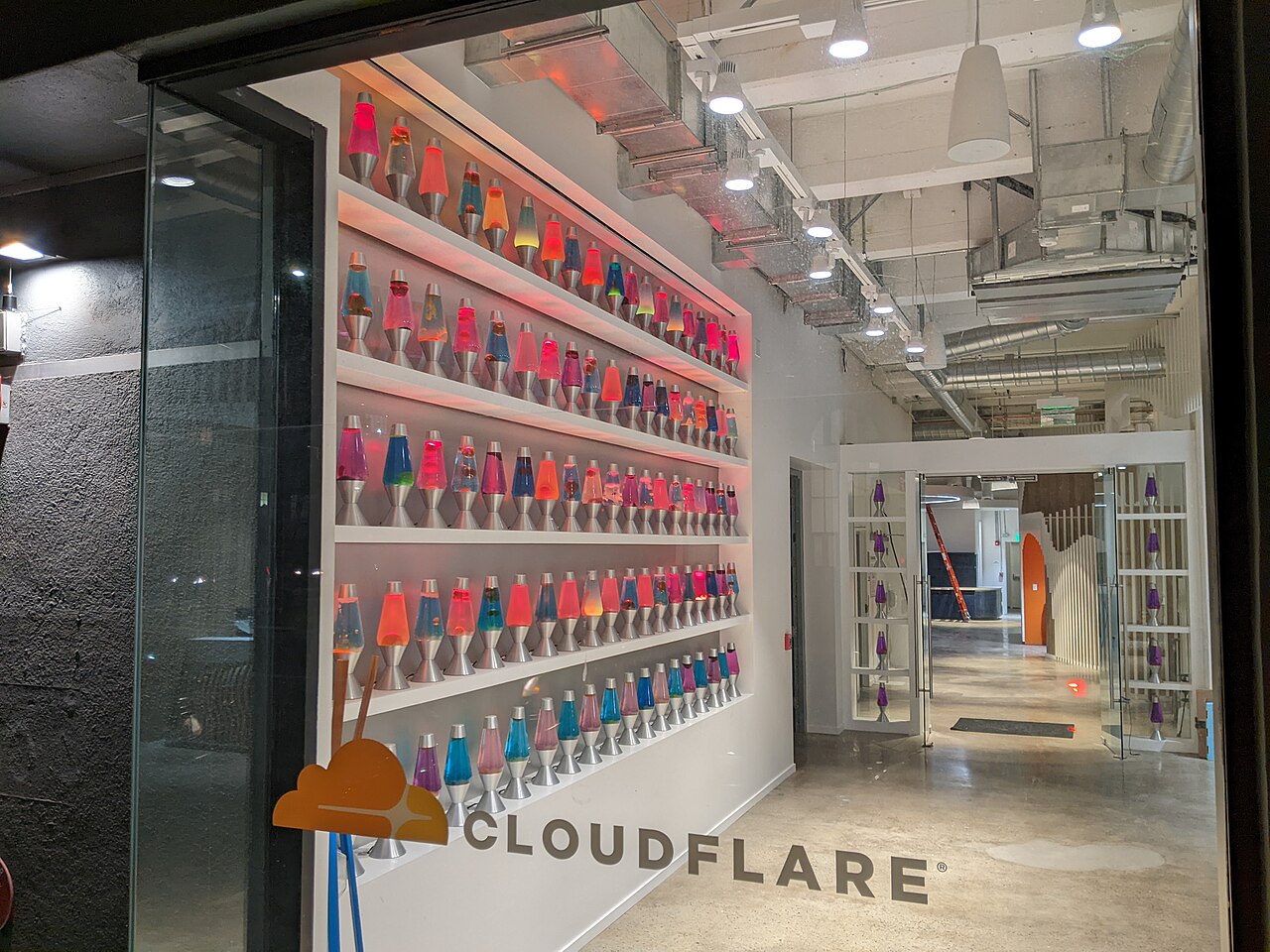
Header image: the entrance area of Cloudflare's offices at 101 Townsend Street, San Francisco, showing the illuminated Cloudflare logo, by HaeB via Wikimedia Commons, licensed under CC BY-SA 4.0. In-body photograph of Cloudflare's wall of lava lamps at the same San Francisco office, by HaeB via Wikimedia Commons, licensed under CC BY-SA 4.0.