On October 16, 2026, Anthropic published research in which Claude Mythos 5 designed quantum circuits for eight computational building blocks, and, according to the company, produced designs that use fewer qubits and fewer gates than the best previously published algorithms for all eight. Two results are quantified most prominently: a 17x gate reduction for elliptic-curve point addition, at the cost of 12% more qubits, and about a 12x gate reduction for a step of a Reed-Solomon decoder used in a quantum optimization algorithm. This article explains the setup, puts the numbers in context, and covers the caveats Anthropic itself lists.
 Anthropic
The setup
Per Anthropic's write-up, Claude received plain-language specifications for each circuit and wrote its designs as Python code. An automated evaluator checked correctness and scored each design by qubits multiplied by gates. Claude then revised its designs in a closed loop with no human input between rounds. The work was led by Andi Gu of the STEM Fellows Program, mentored by Alek Kemeny, with Susanne Yelin and Mikhail Lukin; the full paper is on arXiv as 2610.22367.
The eight tasks span chemistry, optimization, quantum simulation, number theory and numerical computing. The score, qubits times gates, is a proxy for runtime, a point the authors stress rather than hide.
The headline results
- Elliptic-curve point addition. Claude ran for 53 hours with minimal human input. One design uses 12% more qubits but 17 times fewer gates than the smallest previous design, and the designs together extend the qubit-versus-runtime Pareto frontier, with baselines from Schrottenloher 2026 and Luo et al. 2026.
- Reversible divsteps (modular inversion). Claude produced what Anthropic describes as the first reversible divsteps implementation that stores no branch history, recovering branch information by decoding number pairs. It was checked with large-scale numerical simulation and formalized in the Lean proof assistant. Simple decoding rules failed at 256-bit sizes.
- Reed-Solomon decoder for DQI. Claude switched from the extended Euclidean algorithm to Berlekamp-Massey and reconstructed most intermediate values instead of storing them. Gate count falls by a factor of 12 relative to Google's earlier construction (arXiv 2510.10967), described as "a little over an order of magnitude cheaper."
Qubits needed for the Reed-Solomon locator step
Qubit counts as reported by Anthropic. About one run in 10,000 needs more storage than Claude's circuit has and fails, which the task's error budget allows.
For the decoder step, a naive reversible version needs 840 qubits and a worst-case reserve would need 665, while Claude's circuit uses 19, enough to store one value. The trade-off is explicit: across 403 million sample decodings Claude measured exception rates, and about one run in 10,000 needs more storage and fails, which is within the task's allowed error rate. Put differently, the circuit is built around a probabilistic bet that the rare overflow can be tolerated.
Why the decoder step matters
Anthropic cites Google Quantum AI's estimate that one OPI problem would take about three months on the Frontier supercomputer, against roughly one hour on a future quantum computer running DQI, with most of that hour spent on Reed-Solomon decoding. Since decoding dominates the quantum runtime in that estimate, a roughly 12x reduction in the gate count of one decoding step addresses the dominant term. It does not, by itself, shorten the estimate by 12x, because the article does not say how much of the decoding time this step accounts for.
Qubits times gates is a proxy for runtime, not a direct measure.
Anthropic's own caveat
Caveats from Anthropic's own account
- Credit for earlier progress. The 150,000-fold FeMoco reduction, from about 50 trillion to 340 million Toffoli gates for the same 54-orbital model, came from many research groups over eight years, not from Claude. The 2017 estimate is from Reiher et al.
- Search behavior. Claude was conservative and often re-checked results that were already sound, and it tended to favor well-known approaches. The team required parallel, qualitatively different approaches and occasionally prompted a broader search.
- Scope. The work covers circuit design only. Error correction, decoders and hardware control were not addressed, although the authors suggest AI could eventually optimize these jointly.
- Illustrative figures. The code and values in the paper's Figure 1 are described as illustrative.
What the result suggests, and what it does not
The structure of the task is what makes it tractable for a model: a precise, machine-checkable score, a fast evaluator and a design space where a closed loop can iterate for hours. The 53-hour run is notable mainly as a data point on how long a model can keep working on a verifiable objective without human steering. It does not show that the same approach transfers to problems without an automatic scorer, and the caveat about favoring familiar approaches is a reminder that search diversity had to be engineered in.
For readers following capability reports across labs, similar verifiable-task patterns appear in recent automation tests from Epoch and in Anthropic's account of Claude tracing the NIST curve seeds. Because capabilities like this arrive from several providers at different times, teams that route work across models through tools such as Metir AI can test new releases on their own verifiable tasks as they appear.
Sources:
- Designing efficient quantum circuits with Claude | Anthropic
- AI News Today, October 19: Top Stories | AI Weekly
Image credits
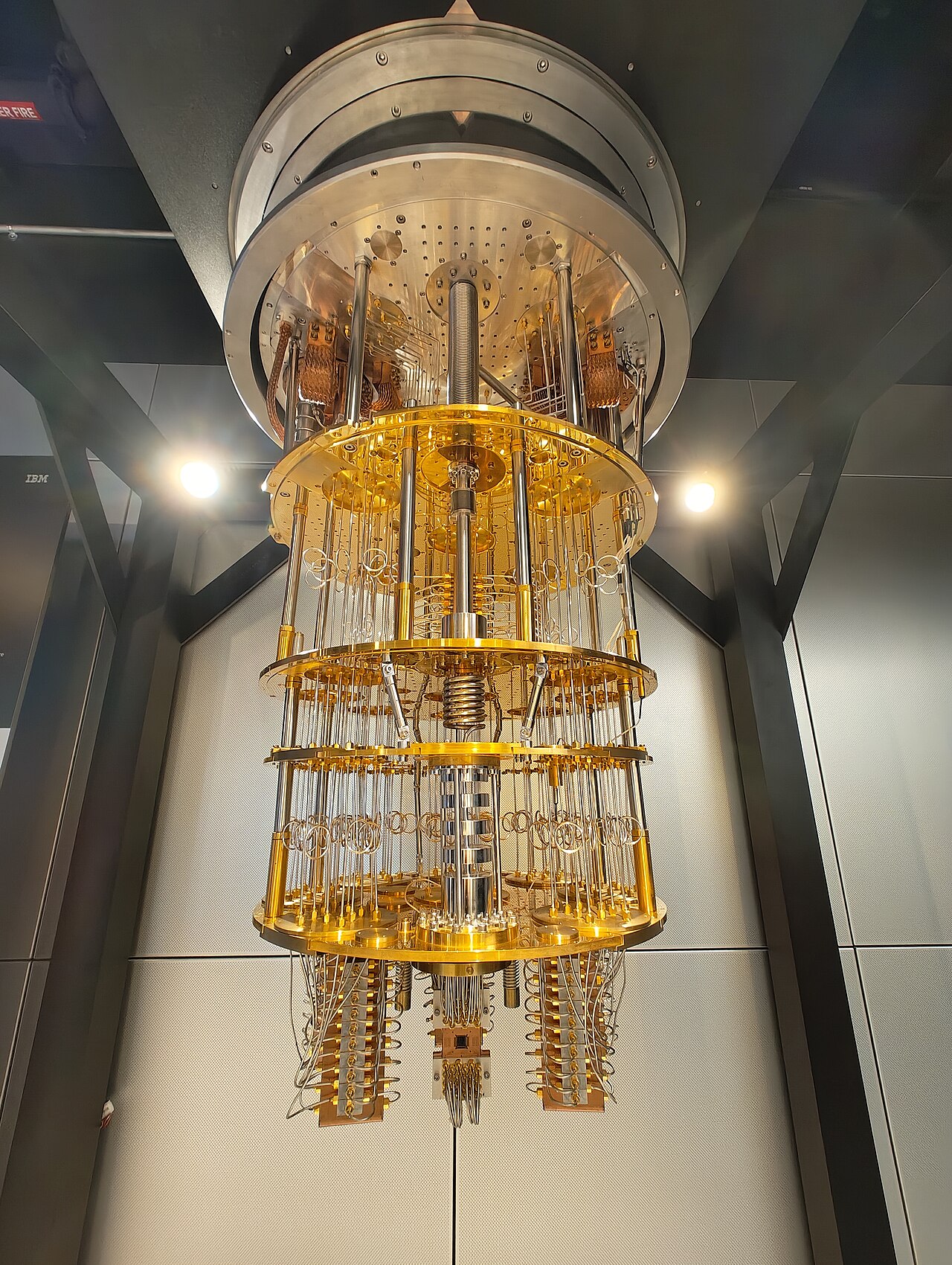
Header and in-body image: IBM Quantum System One at the ThinkLab of IBM's TJ Watson Research Center, Yorktown Heights, New York, photographed 2024-05-22 by OJB Quantum, via Wikimedia Commons, licensed CC BY 4.0. Illustrative only; it does not depict Anthropic's work.