
Every week since February 8, 2026, Chinese-origin AI models have accounted for more than 30% of the tokens US companies process through OpenRouter, an AI model routing platform that gives a rare, granular window into which models enterprises actually run in production. At its peak in April, that share touched 46%. A year earlier, in the first half of 2025, Chinese models were drawing an average of roughly 4.5% of that same traffic. The shift from a rounding error to nearly half of enterprise token volume in about twelve months is the kind of move that would normally take years, and it has arrived just as Washington has started pushing, in July 2026, to get Chinese AI out of corporate America.
This piece lays out what the OpenRouter data actually shows, why price is doing most of the work, and why the open-weight nature of these models complicates any attempt to restrict them. The goal is to describe the trade-offs enterprises are weighing, not to argue a side.
What the OpenRouter data shows
OpenRouter sits between enterprise developers and dozens of model providers, so its aggregate token counts function as a proxy for what companies are actually choosing to run, as opposed to what they say in surveys. Two numbers stand out in the platform-wide view: in June 2025, models from Google, OpenAI, and Anthropic combined for roughly 70% of all tokens routed through the platform. By June and July 2026, that combined US share had fallen to roughly 30%.
Where the tokens actually go
Approximate share of OpenRouter token volume by leading provider, mid-2026. Chinese-origin providers in emerald, US providers in gray.
Approximate OpenRouter token-share readings for July 2026. Individually, DeepSeek and Qwen each roughly match or exceed Claude and OpenAI on volume, and together account for close to a third of tokens routed on the platform. Figures are rounded and vary slightly by source and week.
The provider-level breakdown explains where that share went. DeepSeek is now the single largest provider on OpenRouter by token volume, at roughly 16 to 17% of all traffic on the platform, having overtaken established US labs. Qwen, Alibaba's open-weight model family, sits close behind at around 13.9%. Reporting from mid-2026 counts six Chinese models now ranking above Anthropic's Claude by token volume, including DeepSeek's newest release, GLM-5.2 from Z.ai, Qwen, Kimi K2.6 from Moonshot AI, and MiniMax-M3. That is not a niche experiment. It is a broad-based shift across a handful of Chinese labs simultaneously.
 DeepSeek
 Qwen
Qwen OpenAI
 Anthropic
 Google
Price is doing most of the explaining
The single clearest driver in the reporting is cost. Chinese open-weight models are running roughly 60% to 90% cheaper than US frontier models on output tokens, which is the pricing dimension that dominates the bill for any high-volume production workload, chat interfaces, coding agents, batch summarization, anything that generates a lot of text rather than just reading a little.
That gap matters more than it would have a year ago because the capability difference has narrowed. When a Chinese open-weight model was clearly behind on quality, the cost advantage was a rounding error against the risk of shipping a worse product. As models like DeepSeek and Qwen closed that gap on many production tasks, the calculus flipped: for a large share of enterprise workloads, the cheaper model is now good enough, and "good enough at a fraction of the cost" is a very different pitch than "good enough."
For a large share of enterprise workloads, the cheaper model is now good enough, and that changes the calculus entirely.
Companies that have said publicly they are running Chinese open-weight models in production include Airbnb and Uber, alongside many others that have not been named. That two large, consumer-facing US companies are willing to be identified with this shift suggests it is no longer confined to cost-sensitive startups experimenting at the margins.
Why "open weight" changes the policy problem
Washington's push in July 2026 is aimed at reducing Chinese AI's footprint inside US corporate infrastructure, largely on data-governance and provenance grounds: concerns about where prompts and outputs might flow, what a foreign-controlled model was trained to prioritize, and whether enterprises can fully audit a system they did not build. Those are legitimate categories of concern, and they are the same categories regulators raise about any foreign-controlled software supply chain.
The complication is structural. A closed, API-only model is easy to restrict: block the endpoint, and the model is unreachable. An open-weight model is a set of downloadable files. Once DeepSeek or Qwen weights are on a company's own servers, running entirely inside infrastructure the enterprise controls, there is no ongoing network call to a Chinese-operated service to intercept. The enforcement target moves from a single reachable endpoint to an unbounded number of already-downloaded files sitting on hardware the policy has no jurisdiction over. This is a genuine, non-partisan observation about the mechanics of open-weight distribution, not a comment on whether restriction is the right policy goal.
That same openness is also the strongest counterargument enterprises raise to the governance concern. Because the weights can be self-hosted, a company can run the model in its own cloud account or on its own hardware, with no data ever leaving its environment and no dependency on a Chinese-operated API. The provenance question, what the model was trained on and how it behaves, does not disappear, but the data-in-transit question that usually drives the loudest objections can be substantially addressed by self-hosting.
What enterprises are actually weighing
Reading the reporting even-handedly, the decision enterprises face has at least four variables, and reasonable teams can land in different places:
- Cost. A 60% to 90% reduction in output-token pricing is large enough to change unit economics for high-volume products, not just to trim a line item.
- Capability. The gap to frontier US models has narrowed enough that many workloads no longer require the most expensive option, though it has not disappeared, and some tasks still favor the leading closed models.
- Governance and provenance. Self-hosting mitigates data-transit risk but does not fully resolve questions about training data, model behavior, or long-term supply dependence on a small number of foreign labs.
- Supportability. Open-weight models require in-house infrastructure and expertise to run well, a cost that a pure API call does not carry, even if the token price is lower.
None of these cleanly dominates the others, which is why the same set of facts is producing genuinely different decisions across companies, some embracing Chinese open-weight models for cost reasons, others avoiding them entirely on governance grounds, and many, like Airbnb and Uber by their own account, choosing a middle path of adopting them for specific workloads rather than wholesale.
The portability angle
One practical implication of this much movement in provider share within twelve months is that betting an entire stack on any single model, of any origin, is a riskier position than it used to be. A workspace that routes across both open and closed models lets a team capture the cost advantage where an open-weight model is genuinely good enough, without a hard commitment to any one lab, and gives room to shift quickly if governance rules or pricing change again. That is the underlying logic behind model-agnostic tools like Metir AI, which let users move between providers inside one interface rather than re-platforming every time the underlying economics shift. Try Metir AI to see the range of models available in one place.
The takeaway
The OpenRouter data describes a market that moved fast: US models held about 70% of platform token share a year ago and hold roughly 30% today, with Chinese open-weight models like DeepSeek and Qwen accounting for most of the difference, driven overwhelmingly by a large and durable price gap. Washington's July 2026 effort to restrict Chinese AI in US corporations runs into the basic mechanics of open weights, that a downloaded model is far harder to block than a hosted API. Enterprises are left balancing real savings against real governance questions, and the honest position is that neither the cost case nor the caution case fully wins the argument on its own.
Sources:
- Washington Wants Chinese AI Out Of Corporate America. Open Weights Block A Ban | TechTimes
- DeepSeek V4 Adoption | OpenRouter
- Chinese AI Models Now Capture Roughly a Third of US Enterprise Traffic | Yahoo Finance
- Chinese AI Models Surpass 30% of US Developer Traffic on OpenRouter as Cost Gap Over OpenAI Widens | MLQ.ai
- Share of US Models Being Used on OpenRouter Has Collapsed From 70% to 30% Over the Past Year | OfficeChai
Image credits
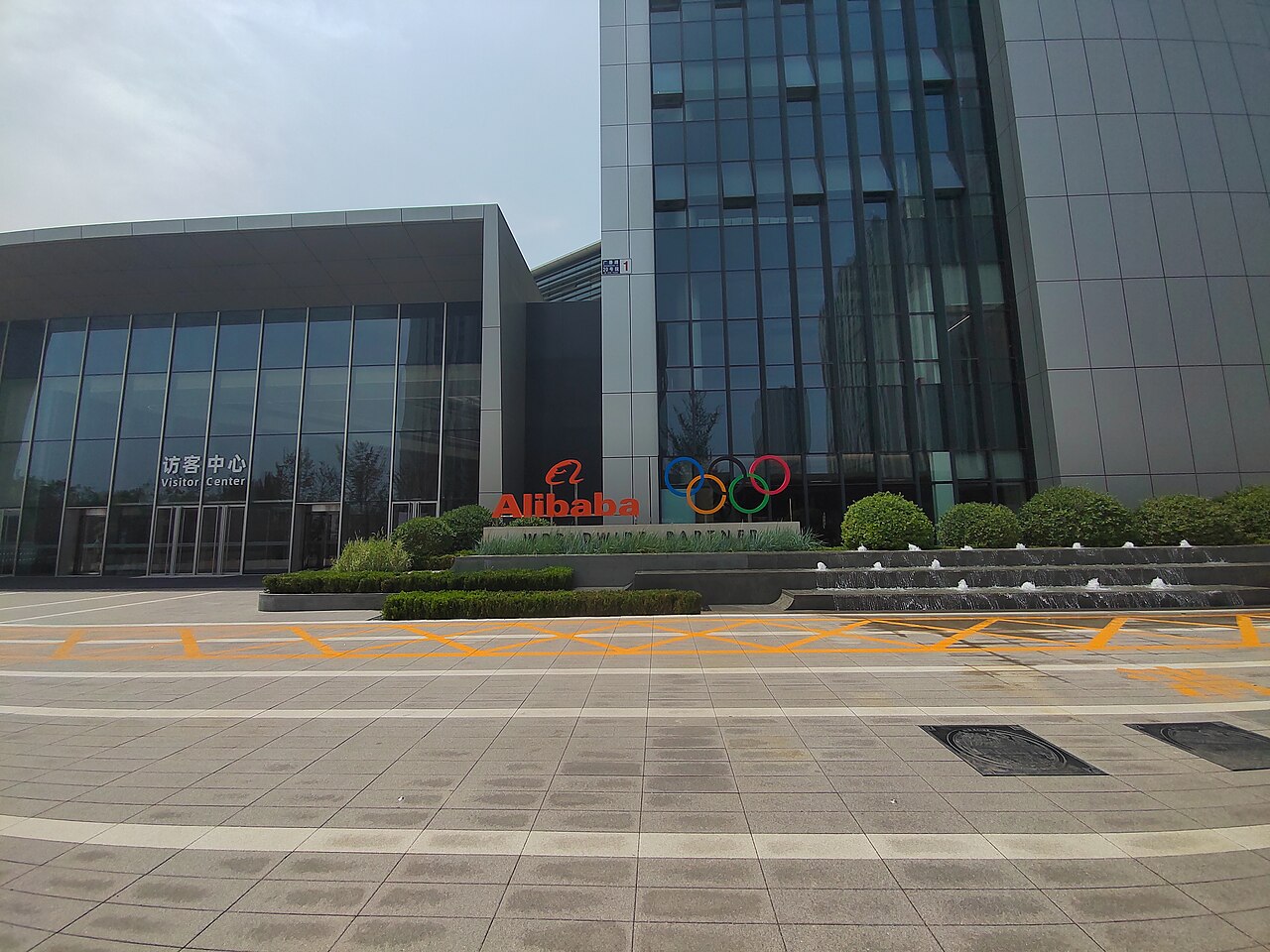
Header image: Alibaba Group headquarters in Hangzhou, by Thomas LOMBARD via Wikimedia Commons, licensed under CC BY-SA 3.0. In-body photograph of Alibaba's Chaoyang Technology Park in Beijing by HoweyYuan via Wikimedia Commons, licensed under CC BY-SA 4.0.