China has widened its overseas-travel curbs on AI and semiconductor talent to cover their families. According to a Bloomberg report dated September 28, 2026, spouses and children of leading AI and chip executives at private Chinese firms, including Alibaba and DeepSeek, must now obtain government approval before leaving the country, even for a short trip. The AI travel curbs are the latest step in a sequence that began at a single lab earlier this year.
 Alibaba
 DeepSeek
 NVIDIA
What Bloomberg reported about the AI travel curbs
Bloomberg reports that the new requirement applies to relatives of executives in roles Beijing treats as vital to state security in AI and chips. The reported stated aim is to prevent key know-how and information from flowing to the US. Outlets citing Bloomberg, including The Next Web and Winbuzzer, add that the requirement covers brief trips as well as long stays.
It is a pre-approval regime, not an outright ban. Permission is required before travel, and the reporting says it is still unclear which office decides applications, exactly which executives qualify, and what the application procedure looks like. Those gaps matter, because the practical effect of any approval system depends on how often approval is granted and how long it takes.
The escalation ladder
The measure did not arrive alone. Reporting places it at the end of a sequence:
- March 2026: DeepSeek staff reportedly began surrendering passports, the first publicly reported case.
- May 2026: Bloomberg reported that top AI professionals at private firms such as Alibaba and DeepSeek needed approval from relevant authorities before foreign travel.
- September 15, 2026: A State Council regulation took effect allowing commerce and other departments to bar citizens from leaving where export-control or technology violations are judged to endanger industrial or technological security.
- Late September 2026: Approval requirements reach spouses and children.
Four steps, widening scope
Each reported step moves the control from one firm, to a sector, to a legal basis, to the household.
A pre-approval requirement, not an outright ban. Details come from Bloomberg and outlets citing it.
Read as a ladder, each step changes the unit being controlled: first one company, then a class of individuals across companies, then a legal basis that applies more widely, and finally the household. Earlier reporting cited by Winbuzzer notes that university researchers and executives at state-owned companies already faced similar family-travel restrictions, so the September step extends to private firms a logic that existed in the public sector.
The unit being controlled has moved from the lab, to the individual, to the household.
Analysis of the reported sequence
Why treat talent as a strategic resource
The strategic logic is straightforward. In frontier AI and chip design, much of the decisive knowledge is tacit: training recipes, data pipelines, yield tuning and system design that do not fit in a patent or a file. Tacit knowledge lives in people, and it moves when they move. A state that regards AI capability as a national-security asset may therefore treat the people who hold it the way it treats other controlled inputs.
Family members are a natural next lever in that logic, because a relocated household is a common route to a permanent departure. Controlling the family changes the cost of leaving, which is the same effect exit controls on the individual were meant to have.
Precedents and the talent firewall
Restricting the movement of strategic-sector personnel is not new, and it is not unique to one country. The most cited example runs the other direction: the rocket scientist Qian Xuesen was stripped of his US security clearance in 1950 and spent about five years under partial house arrest and surveillance before leaving the United States in 1955, as Britannica and other histories record. The parallel is limited, since that case involved suspicion of an individual rather than a standing regime, but it shows that states have long tried to keep critical scientists in place.
The current moment adds a second wall. US export controls on advanced chips and chipmaking equipment restrict the flow of hardware toward China, while Beijing's measures restrict the flow of people and know-how outward. Analysts sometimes describe this as a talent firewall on both sides: each government limits what crosses the border in the direction it considers sensitive. The two sets of rules were adopted for different stated reasons, but they reinforce the same outcome, a less porous technology border.
Effects on hiring, retention and morale
The consequences are uncertain and cut in more than one direction, so it is worth separating what is known from what is inference.
- Global hiring: Firms that recruit internationally, or send staff to conferences, joint research and customer sites abroad, face added friction. Candidates weighing an offer may also factor in constraints on their families.
- Retention: Restricting exits can keep know-how in place in the short run. It can also change how attractive a role is to the very people it targets, which is a retention question as much as a security one.
- Morale and recruiting at home: Personal-travel constraints on relatives may weigh on how workers view their roles. No data yet shows whether that translates into attrition, so this remains an open question.
- Research openness: Frontier AI progress has depended heavily on open conferences and cross-border collaboration. Less travel means fewer informal exchanges in both directions.
Context also matters. A Carnegie study cited by The Next Web indicates more elite AI researchers now work in China than in the US, which suggests the domestic talent base is a strength Beijing may be seeking to protect rather than a gap it is trying to fill. The same report links the broader environment to Beijing ordering Meta's roughly $2 billion acquisition of Manus to be unwound and to tighter limits on US investment in sensitive technology.
What to watch
Three things will determine how far this goes: whether the approval process is published or stays informal, how many approvals are granted and how quickly, and whether other countries respond with their own talent-related measures. For now the record is a set of reports rather than a public rulebook, so conclusions should stay tentative. What the sequence does show is a policy direction: AI talent is being managed as a strategic resource, and the border is becoming a control point for people as well as for chips.
Sources:
- Bloomberg: China Limits Overseas Travel for AI Talent at DeepSeek, Alibaba (May 26, 2026)
- The Next Web: China travel curbs and families of AI executives, citing Bloomberg
- The Next Web: China extends AI travel curbs from DeepSeek to other private firms
- Japan Times: Beijing broadens travel curbs to encompass family of top AI talent (Sep 29, 2026)
- Winbuzzer: China travel approval for AI and chip executives' families (Sep 28, 2026)
- Britannica: Qian Xuesen
Image credits
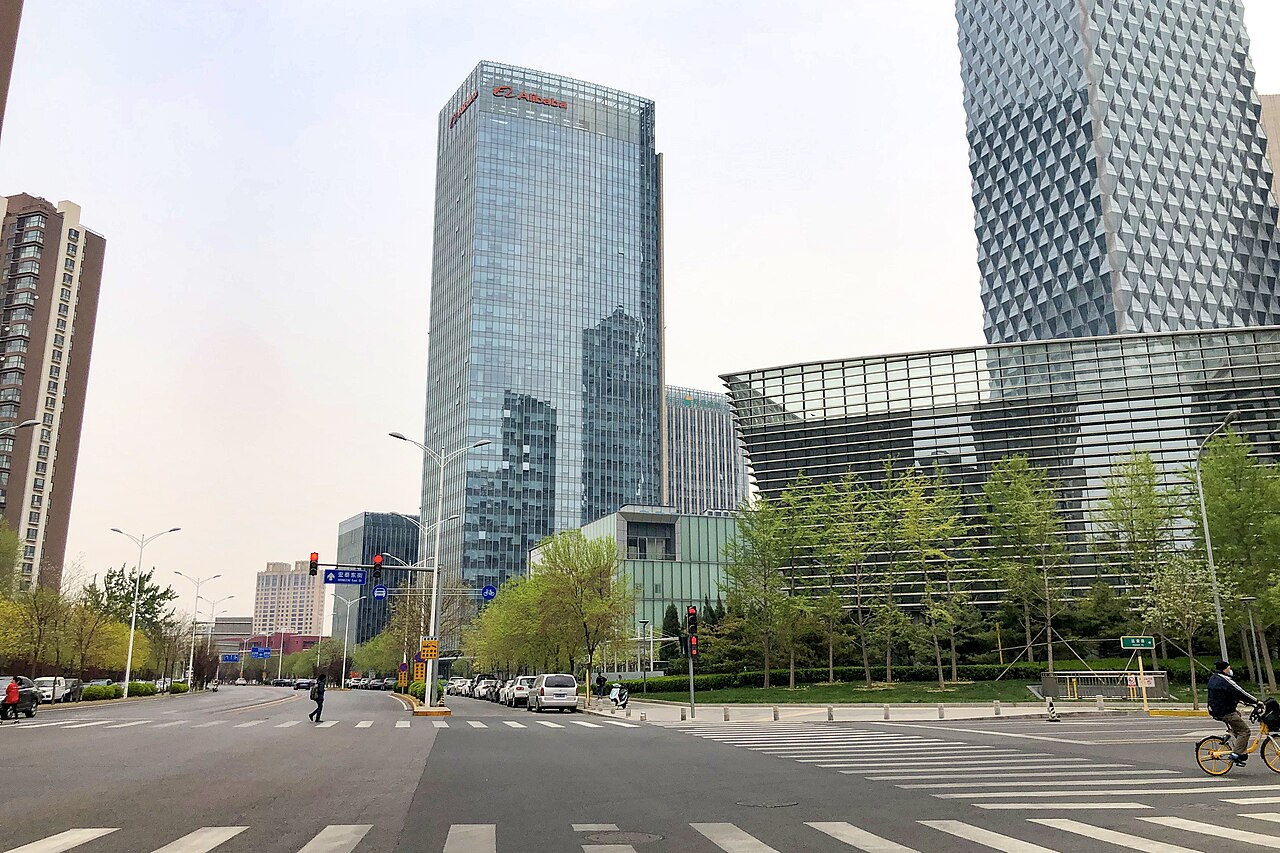
- Hero: Alibaba Group's Beijing headquarters at Greenland Center, Wangjing, photographed April 2021. Author N509FZ, Wikimedia Commons, CC BY-SA 4.0.
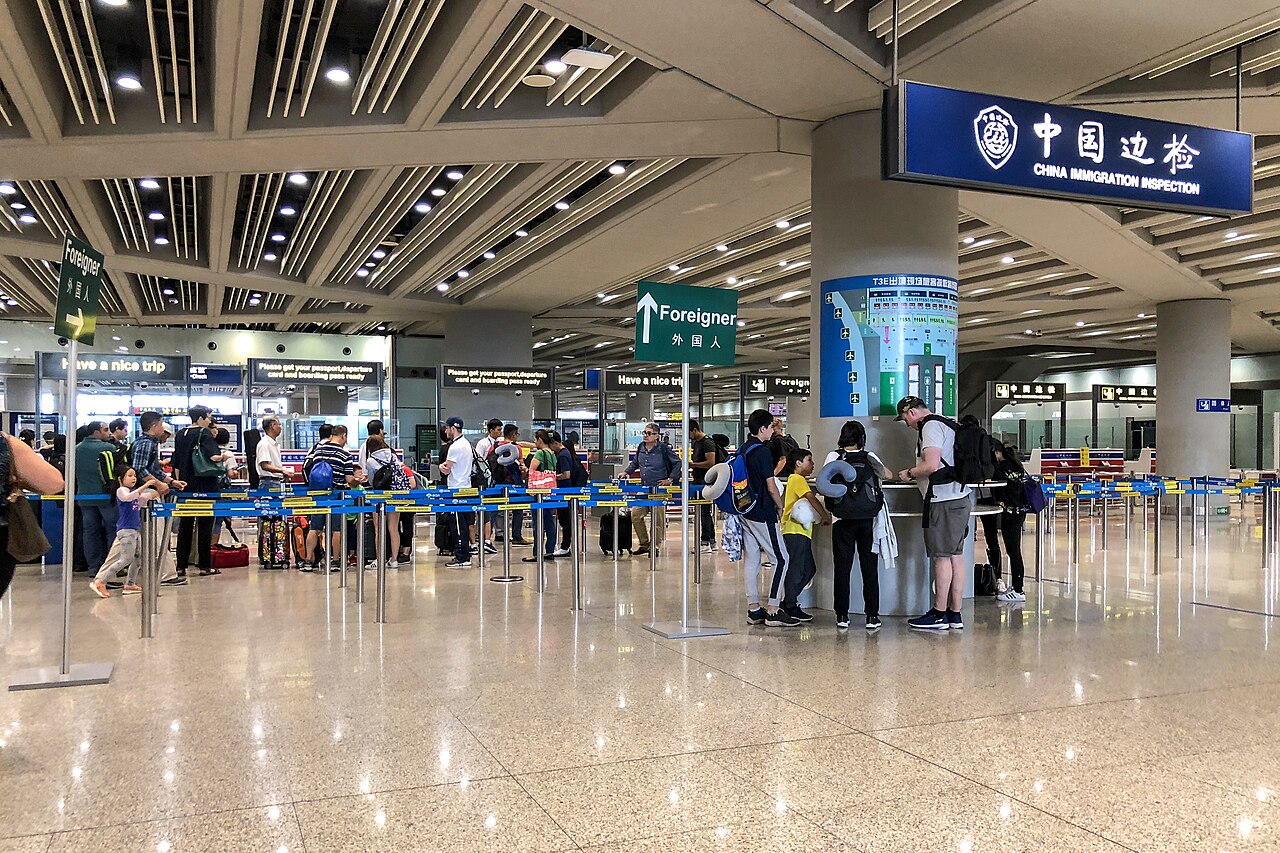
- In-body: China Immigration Inspection at Beijing Capital International Airport T3E departures, August 2018. Author N509FZ, Wikimedia Commons, CC BY-SA 4.0.