Two companies in very different businesses disclosed large workforce changes within a day of each other. Canva, the Sydney-based design platform, told staff that 1,271 roles, about 22% of its workforce, are affected in its first redundancy round. Fiserv, the payments and banking technology provider, reported third-quarter results on November 3 in which it raised its Project Elevate savings target to $1 billion, and PYMNTS reported that it has cut 3,000 employee and contractor positions since its CEO took over.
Both stories have been widely framed around AI. The disclosures are more specific, and in one case more cautious, than that framing, which is the useful part to examine.
What Canva said
Per Bloomberg, about 1,271 people, or 22% of Canva's staff, will lose their jobs, change roles or relocate to central hubs. HRD America describes it as the first redundancy round in the company's 13-year history and notes that Canva has not said how many roles will be made redundant outright, so the figure is a mix of exits, role changes and relocations.
People Matters reports that Canva employs more than 5,700 people in 37 countries. That is consistent with the reported ratio: 1,271 divided by 0.22 is about 5,800 (our arithmetic).
This is without doubt the hardest moment in our thirteen-year history.
Melanie Perkins, in a message to staff, as reported by HRD America
Reported details of the restructuring:
- Product, growth and platform teams merge into a single product organisation, and management layers are reduced.
- Sydney becomes the primary base for more product teams, and most hybrid staff are expected in the office two to three days a week from January.
- Departing staff receive at least six months' salary, 12 months of healthcare where Canva provides it, and removal of the one-year equity vesting cliff.
- Growth slowed this year for the first time in a decade, and Canva cut its 2026 revenue growth forecast from 30% to 20%, per People Matters and HRD America.
Did Canva attribute the cuts to AI?
Not explicitly. Both HRD America and People Matters report that Canva's CEO, Melanie Perkins, did not cite AI as the reason, and HRD America states the cuts are not described as caused by AI. Her stated reasoning was structural: "We're simplifying layers, consolidating overlapping responsibilities," and "small changes won't be enough."
The AI link comes from context and commentary. HRD America notes investor concern that AI could undercut software businesses and that Blackbird cut its valuation of Canva by 17% to US$34.9 billion in August 2026. People Matters links the restructuring to competition from AI-powered image-generation and design tools. Bloomberg's framing, per its headline, is that growth is slowing for the first time. Those are readings of the situation by outlets, not company statements about substitution.
What Fiserv said
Fiserv's third-quarter earnings release filed with the SEC reports:
| Item | Q3 2026 |
|---|---|
| GAAP revenue | $5.20 billion, down 1% |
| Organic revenue growth | Flat (Merchant Solutions down 2%, Financial Solutions up 2%) |
| Goodwill impairment (non-cash) | $6.45 billion |
| Adjusted EPS | $1.75, versus $2.04 a year earlier |
| Project Elevate savings target | Raised to $1 billion from $500 million after a portfolio review |
| Severance costs | $83 million in Q3, $196 million for nine months |
| 2026 outlook | Affirmed: organic revenue (1%) to 0%, adjusted EPS $7.20 to $7.40 |
The release itself gives no headcount figures. The 3,000 number comes from PYMNTS' coverage of the call, which reports that Fiserv has cut 3,000 employee and contractor positions since CEO Takis Georgakopoulos took over, including a reduction of more than 10% in senior management. We could not find a second source for the 3,000 figure, and it is a cumulative count, not a single announcement. PYMNTS does not give it as a percentage of the workforce, so we do not either.
Canva and Fiserv: the disclosed numbers, side by side
The two counts are not like for like. Canva's 1,271 includes people who change roles or relocate. Fiserv's 3,000 covers employee and contractor positions cut since its CEO took over.
People and positions
Fiserv Project Elevate savings target (US$ millions)
Sources: Bloomberg and HRD America on Canva; PYMNTS and Fiserv's Q3 2026 earnings release (SEC Form 8-K) on Fiserv.
Where AI appears in Fiserv's account
Per PYMNTS, management described AI being used to automate fraud reviews, customer service and software development, and Georgakopoulos spoke of "increasing confidence that we can drive greater efficiency" while simplifying the organisation with an "AI-everywhere mindset." The one quantified example: AI agents in Clover's risk-hold process cut decision times by two-thirds and lowered false positives by more than 40%, according to management. PYMNTS notes these are operational indicators, not proof of company-wide savings.
The wider restructuring is not only about AI. PYMNTS describes consolidating merchant services through Commerce Hub, replacing more than a dozen legacy gateways and switches, a Core Modularity initiative to move core banking systems toward shared components, and plans to exit or transition away from more than a dozen smaller products. Organic revenue was flat and the company recorded a goodwill impairment tied, in the release's words, to sustained declines in its share price and market capitalization.
Comparing the two disclosures
| Question | Canva | Fiserv |
|---|---|---|
| Headline number | 1,271 roles affected (about 22%) | 3,000 positions cut since CEO change (PYMNTS) |
| Counts redundancies only? | No: includes role changes and relocations | Employee and contractor positions, cumulative |
| AI named by the company as the reason? | Not explicitly, per HRD America and People Matters | Named as part of efficiency plan ("AI-everywhere mindset") |
| Other stated drivers | Layers, overlapping responsibilities, slower growth | Portfolio review, platform consolidation, product exits, flat organic revenue |
| Financial backdrop | 2026 growth forecast cut from 30% to 20% | Revenue down 1%, $6.45 billion impairment |
Taking only the stated information, the two cases sit at different points on a spectrum. Fiserv ties its efficiency programme to AI in its own words, alongside several non-AI levers. Canva ties its cuts to structure and growth, and the AI connection is supplied by observers.
How to read "AI restructuring" claims
- Separate the statement from the inference. A company saying it wants an AI-first organisation is different from saying a specific role has been automated. Neither company disclosed role-level automation in the sources reviewed.
- Check the denominator. Canva's figure includes people who stay in changed roles. Fiserv's is cumulative over a period. Comparing 1,271 with 3,000 directly would mislead.
- Look for the financial pressure. Both companies are dealing with slowing or flat growth. Cost reduction under that pressure has historically occurred with or without new technology, so the presence of AI in the narrative does not isolate its causal weight.
- Watch the evidence of productivity. Fiserv's Clover figures are a first measurable example. Company-wide evidence, such as revenue or cost per employee over coming quarters, would test the thesis.
What to watch next
- Canva's all-hands on November 10, reported by People Matters, and any later breakdown of how many roles end versus change.
- Fiserv's Project Elevate delivery against the $1 billion target, and whether the severance run rate ($196 million over nine months) continues.
- Other cases. HRD America also cites Atlassian's 1,600 cuts in March 2026 and WiseTech's 1,700 as other AI-linked reductions, which we have not independently verified. Whether each states AI as the cause or as context is the same question applied again.
For teams planning their own automation, the practical takeaway is to attach AI claims to a measured workflow, as Fiserv's risk-hold example does, and to keep tooling portable across models so a workflow is not tied to one vendor's roadmap, an approach platforms such as Metir are built around.
Sources:
- Canva Cuts Jobs, Restructures Workforce as Growth Slows for First Time, Bloomberg
- Canva job cuts affect 1,271 roles in first redundancy round, HRD America
- Canva layoffs: 22% employees to exit, company offers six months' salary, People Matters
- Fiserv Q3 2026 earnings release, SEC Form 8-K
- Fiserv wants AI to fix what decades of payments growth made expensive, PYMNTS
Image credits
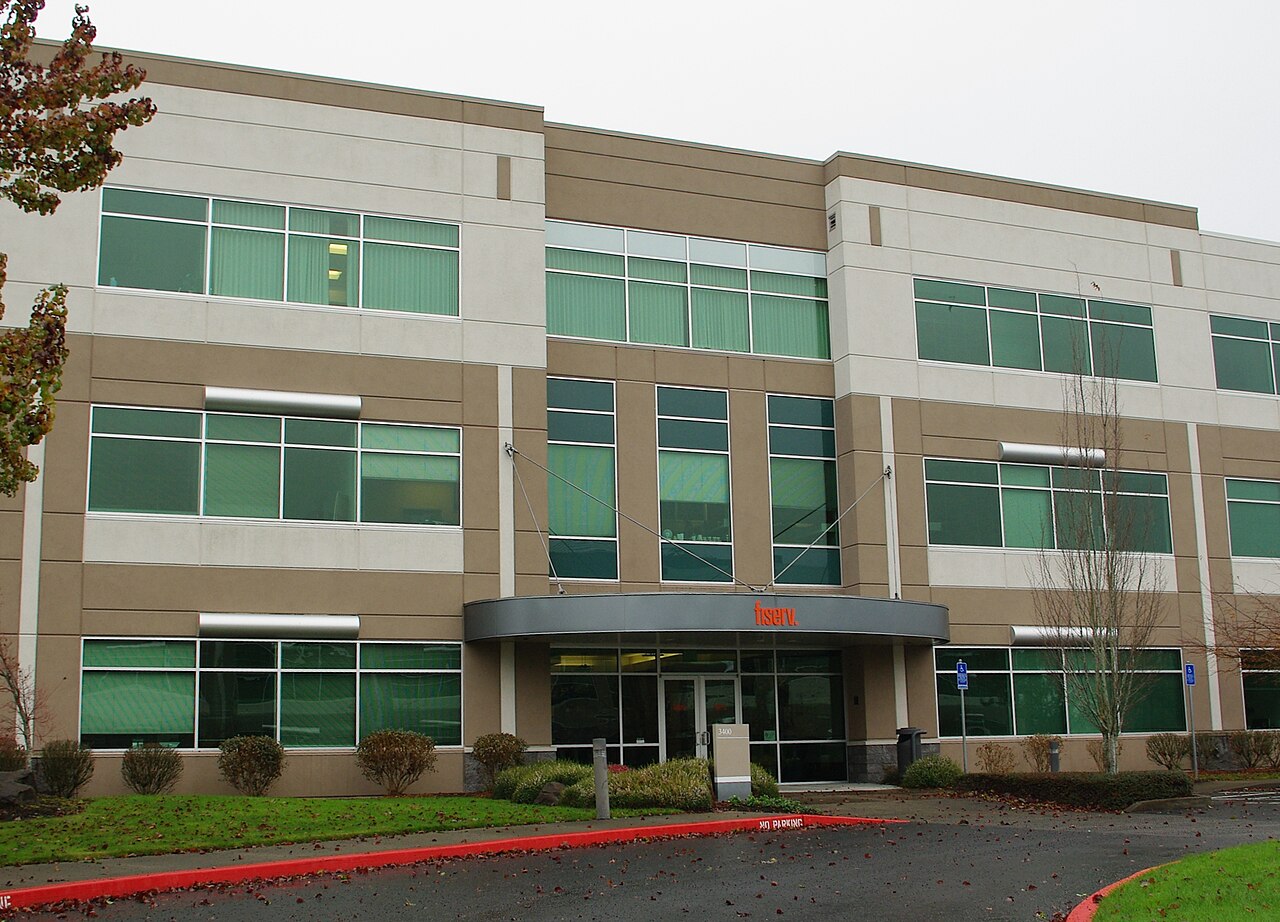
- Header and in-body image: "Fiserv offices - Hillsboro, Oregon.JPG" by M.O. Stevens via Wikimedia Commons, licensed CC BY-SA 3.0. It shows a Fiserv office building (photographed in 2010) and does not depict any staff or the announcements.