
Most coverage of the AI infrastructure boom stops at chips and power. The layer in between, the network that lets thousands of GPUs behave like one machine, rarely makes headlines. Arista Networks is the company that turns that layer into an income statement, and on August 4, 2026, it reported a quarter that showed just how large the opportunity has become. Revenue rose 38% year over year to $3.06 billion, results beat the company's own guidance, and management raised its full-year outlook by about 10%.
Why networking is a bottleneck, not a detail
Training a frontier model is not one chip working hard. It is tens of thousands of accelerators exchanging enormous volumes of data on every step of training. If the network between them is slow or congested, the expensive GPUs sit idle waiting for data, and the effective return on a multi-billion-dollar cluster falls. The network is therefore not a supporting cost; it is a determinant of how much useful work the whole cluster can do.
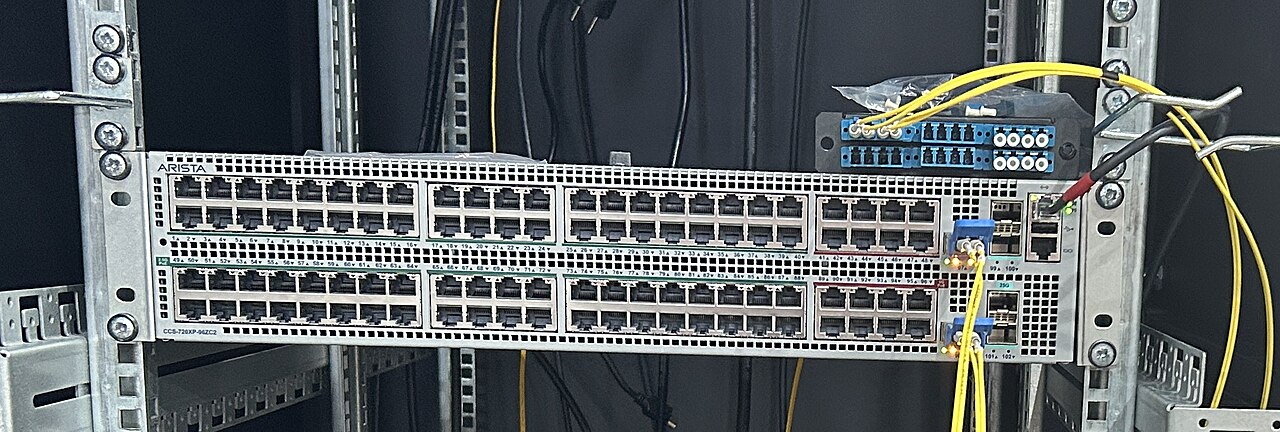
Arista sells the high-speed Ethernet switches that carry that traffic, along with the software to run them. Its pitch to hyperscalers is that merchant-silicon Ethernet, built on open standards, can match the performance of proprietary interconnects while being easier to operate at scale. That argument has moved from theory to revenue.
The three networks inside an AI cluster
Arista frames its AI opportunity across three tiers, and understanding them explains where the growth is coming from. There is scale-up, the very short links inside a single server or rack. There is scale-out, the network that connects racks into a full training cluster. And there is scale-across, the newest tier, which links entire data centers together as AI campuses grow beyond the walls of one building.
The three networks inside an AI cluster
Arista frames its AI opportunity across three tiers. The newest, scale-across, grows as AI campuses spill beyond one building.
The shortest, fastest links that tie a handful of accelerators into one tightly coupled unit.
The network that connects racks into a full training cluster of tens of thousands of GPUs.
Links that stitch entire AI sites into one logical system as campuses outgrow a single building.
About $1.2B of Arista 2026 AI revenue; expected to grow more than 60% annually through 2030.
A slow network leaves expensive GPUs idle, so each tier directly affects how much useful work a cluster delivers.
That third tier is the one to watch. Arista pegged its scale-across AI revenue, for connecting data centers to one another, at roughly $1.2 billion for 2026 and said it expects that market to grow at more than a 60% annualized rate through 2030. As individual AI sites hit the limits of local power and land, operators are stitching multiple sites into single logical systems, and each of those links is Arista's addressable market.
The guidance raise is the signal
Beating a quarter is common. Raising the full year by 10% after beating is the more meaningful action, because it tells investors the strength is expected to persist rather than pull forward. Arista lifted its 2026 revenue guidance to about $12.6 billion, up from roughly $11.5 billion, implying around 40% annual growth. For Q3 2026 it guided revenue to approximately $3.3 billion with non-GAAP operating margin of 48% to 49% and non-GAAP diluted earnings of $1.06 to $1.08 per share.
A 10% raise to the full-year outlook
Arista 2026 revenue guidance, before and after Q2 ($ billions). Raising the full year after beating the quarter signals the strength is expected to persist.
The raised guide implies roughly 40% annual growth. Q2 2026 revenue was $3.06 billion, up 38% year over year.
Beating a quarter is common. Raising the full year by 10% after beating is the more meaningful action.
On reading the guidance raise
Analysts framed part of the raise as supply-driven, meaning Arista is now able to ship more of the demand it already had visibility into. That is a subtle but important distinction. Supply-led upside suggests the constraint has been the ability to build and deliver, not the ability to find customers, which is a healthier problem to have in a boom.
The concentration risk underneath the growth
A neutral read cannot stop at the beat. Arista's largest customers are a small group of hyperscalers, and two of them have historically accounted for a large share of revenue. That concentration is the flip side of selling into the AI buildout: the same handful of companies driving unprecedented demand also hold unusual leverage, and any change in their capital spending plans lands directly on Arista's results. When a few buyers can each swing a vendor's year, forecasting becomes harder and the downside in a spending pause is sharper.
There is also live competition for the AI back-end network. Nvidia offers both InfiniBand and its own Spectrum-X Ethernet, and the broader debate over which interconnect wins the largest AI clusters is not settled. Arista's bet is that open, standards-based Ethernet becomes the default; the incumbent GPU vendor's bet is that a tightly integrated stack wins. Both can hold meaningful share, but the mix will shape Arista's long-term ceiling.
 Arista Networks
 NVIDIA
 Microsoft
 Meta
MetaWhat the quarter says about AI infrastructure
Arista's Q2 is a reminder that the AI buildout is a stack, and that value accrues at every layer of it, not only the chips that get the attention. The unglamorous plumbing, switches, optics, the software that keeps a hundred-thousand-GPU fabric coherent, is a multi-billion-dollar business precisely because it is load-bearing. The same principle applies further up the stack, where the systems that route and orchestrate work across many models, platforms like Metir among them, matter as much as any single model does. In AI, the connective layers are where a lot of the durable value quietly lives.
For infrastructure planners, the practical read is that networking has graduated from a line item to a strategic decision. The choice of interconnect now affects how much useful compute a cluster delivers, and Arista's raised guidance is evidence that buyers are treating it that way.
Sources:
- Arista Networks Q2 2026 earnings release, SEC EDGAR 8-K
- Arista earnings: supply upside drives a big raise to guidance, Morningstar
- The bull case for Arista Networks following raised 2026 guidance, Yahoo Finance
- Arista Networks (NYSE:ANET) issues Q3 2026 earnings guidance, MarketBeat
- What to expect from Arista Networks' Q2 2026 earnings report, Barchart
Image credits
- Hero: "Jayshree Ullal Arista CEO" licensed CC BY-SA 4.0, via Wikimedia Commons. Retrieved August 6, 2026, and visually reviewed before use. It shows Arista Networks CEO Jayshree Ullal.
- In-body: "Distro switch used under The Gathering 2025 (cropped, Arista switch)" by Jonas Bergsten, licensed CC BY-SA 4.0, via Wikimedia Commons. Retrieved August 6, 2026, and visually reviewed before use. It shows an Arista data-center switch in a rack.