On August 13, 2026, Applied Materials reported the largest quarter in its history. Revenue reached $9.12 billion, up 25 percent from a year earlier and up 15 percent from the prior quarter. Net income was $2.54 billion, or $3.17 per diluted share, with adjusted earnings of $3.50 per share. Both the top and bottom lines beat analyst expectations, which had sat around $8.99 billion in revenue and $3.40 in adjusted earnings. The company then guided the current quarter higher, to roughly $10.25 billion, and raised its full-year outlook for semiconductor-equipment growth to over 30 percent, up from an earlier estimate near 20 percent.
By almost any measure that is a strong report. Applied Materials sells the machines that fabricate and package chips, the deposition, etching, and inspection tools that sit upstream of every processor and memory die. When demand for AI silicon rises, the equipment makers are among the first to feel it and among the last to see it fade, because a fab ordered today takes years to fill. A record quarter here is a clean signal that the physical build-out behind the AI boom is still accelerating.
The picks-and-shovels position
Most AI coverage focuses on the model labs and the chip designers: OpenAI, Anthropic, Google, Nvidia, AMD. Applied Materials sits one layer deeper, in the part of the supply chain that gets less attention but is arguably more exposed to the raw pace of construction. It does not design the chip or train the model. It sells the tools that turn a wafer into a working device, and it sells them to the foundries and memory makers who are racing to add capacity.
AI demand is showing up in the chip-equipment layer
Revenue in USD billions. The Semiconductor Systems segment, the tools that build the chips, drove a record quarter, and guidance points higher still.
Applied Materials raised its 2026 semiconductor-equipment growth outlook to over 30%, up from an earlier estimate near 20%.
The Semiconductor Systems segment, the core equipment business, brought in $7.04 billion, up from $5.56 billion a year earlier. That is where the AI signal is clearest. Advanced logic for AI accelerators and the high-bandwidth memory that feeds them both require more process steps, more advanced packaging, and therefore more of Applied Materials' tools per unit of output. CEO Gary Dickerson tied the raised outlook directly to what he called unprecedented demand driven by the global adoption of AI.
Why the market shrugged
Here is the more interesting part. A record beat-and-raise from a bellwether supplier would, in an ordinary cycle, send the stock sharply higher. Instead the reaction was muted, and Applied Materials shares had been trading well below their earlier peak going into the print. That gap between excellent results and a cautious market is the analytically useful piece of this report.
A record beat-and-raise from a bellwether supplier, met with a shrug. The gap between the results and the reaction is the real story.
On the market response
Several forces sit behind the caution, and it is worth naming them without overstating any one. First, expectations were already very high: when a stock has run up on AI optimism, even a strong quarter can be priced in, and "record" is not the same as "above what the market already assumed." Second, equipment makers carry China exposure and live under export-control uncertainty, where a policy change can remove a slice of addressable demand with little warning. Third, there is a durable investor worry about the shape of the cycle: capital-equipment spending is famously lumpy, and a boom driven by a wave of data-center construction invites the question of what the order book looks like once that wave crests. None of these is a verdict on the quarter. They are reasons a good quarter does not automatically become a higher stock.
Reading it against the broader capex picture
Applied Materials' results fit a larger pattern visible across 2026: the money in AI is flowing heavily into physical infrastructure, chips, packaging, data centers, and power, and the companies supplying that infrastructure are posting real, cash-generating growth while the economics of the model layer itself remain more debated. The equipment maker booking record revenue is downstream of hyperscaler capital budgets that now run into the hundreds of billions of dollars a year, and upstream of the accelerators that get the headlines.
That position cuts both ways. It means Applied Materials benefits from the build-out regardless of which model or which chip designer ultimately wins, a genuinely diversified exposure to AI demand. It also means the company is tied to the sustainability of that build-out. If the capital-spending cycle that is filling fabs slows, the equipment layer feels it with a lag but feels it clearly. The raised outlook says the company sees no such slowdown yet. The market's caution says investors are not ready to assume it continues indefinitely.
The signal worth keeping
For anyone tracking the health of the AI infrastructure cycle rather than the drama of model releases, equipment-maker earnings are among the most honest indicators available. They are real revenue for real machines, ordered by customers making multi-year bets, and they are hard to inflate with narrative. Applied Materials' record quarter and raised guidance say the build-out is still expanding, and expanding faster than the company expected a few months ago.
The subtler lesson sits in the same place it always does when a boom matures: capability and demand are not the constraint right now, and the questions that decide outcomes move to cost, cycle timing, and durability. That is true for the fabs Applied Materials supplies, and it is true one layer up for the software built on the chips those fabs produce, where the winning approach increasingly favors flexibility, using the right model and the right hardware for each task rather than committing to a single stack. Tools like Metir AI are built on that model-agnostic premise for exactly the reason Applied Materials is diversified across customers: in a fast-moving cycle, exposure to the whole field beats a bet on any single part of it. Applied Materials' quarter is a reminder that the least glamorous layer of the AI stack is, for now, one of the most clearly profitable.
Sources:
- Applied Materials Q3 2026 earnings beat on AI demand | Yahoo Finance
- Applied Materials posts record Q3 revenue as AI demand boosts chip equipment sales | Investing.com
- Applied Materials Q3 2026 earnings beat on AI demand | Quartz
- Applied Materials revenue reaches $9.12 billion in Q3 | Grafa
- Applied Materials Q3 Earnings: Semiconductor Equipment, AI | TradingKey
Image credits
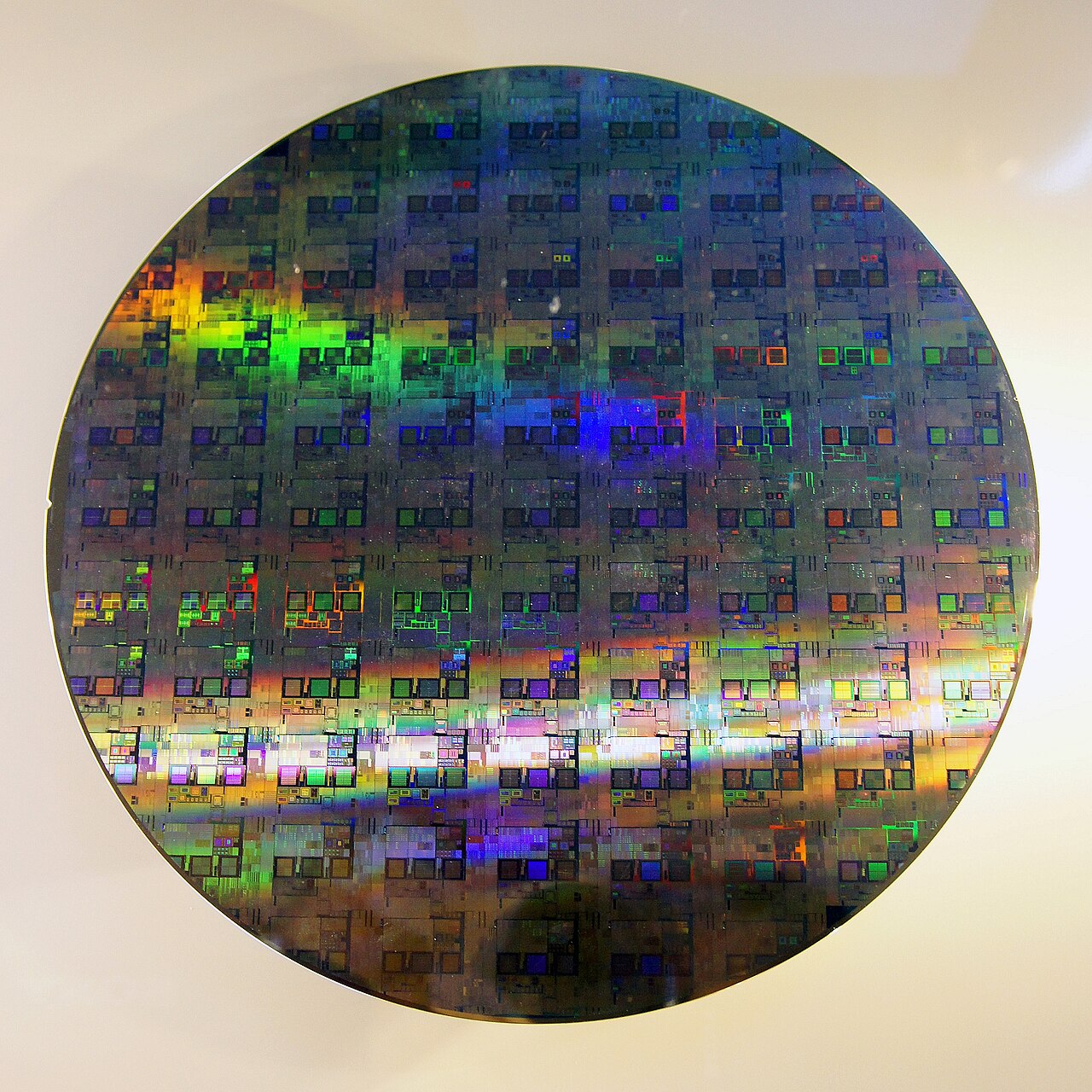
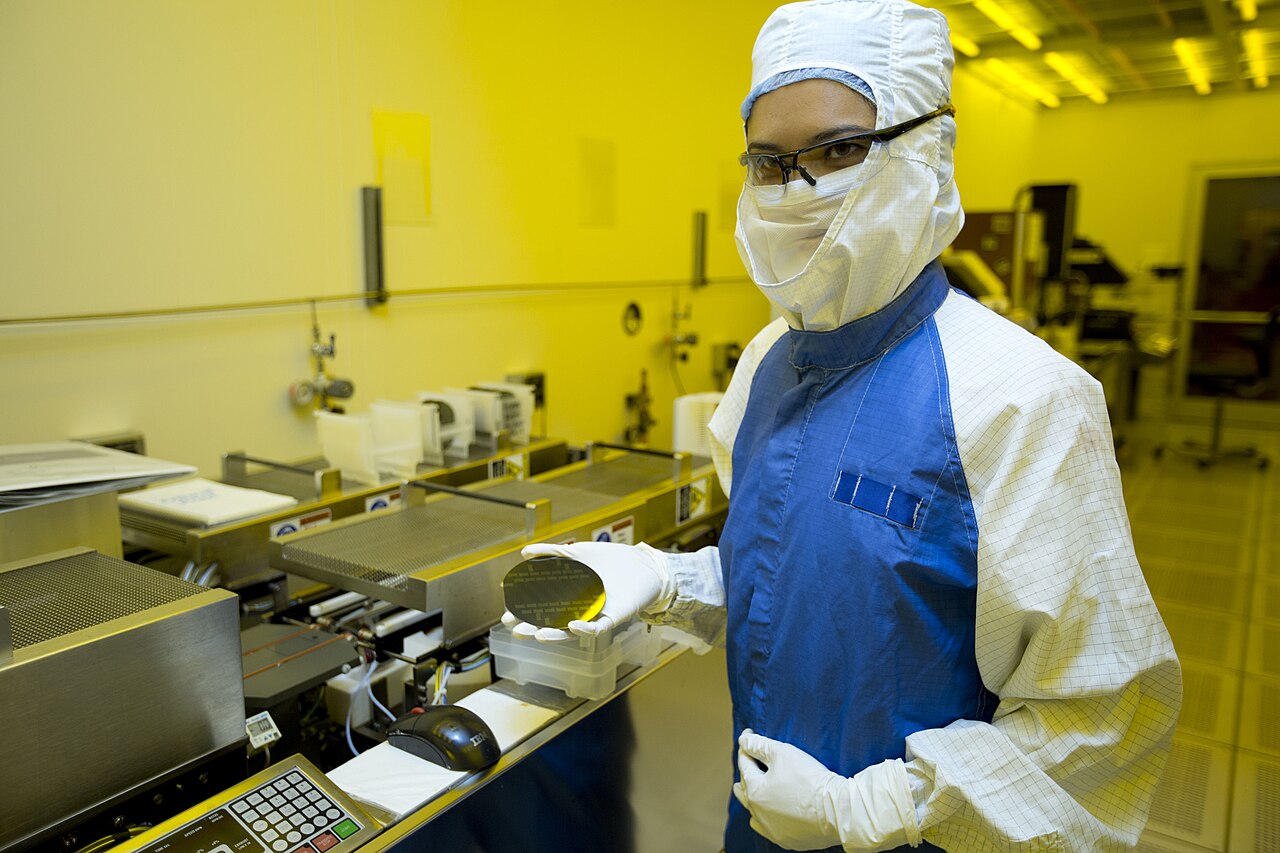
Header image: a 300mm (12-inch) silicon wafer patterned with completed dies, showing the iridescence of its microscopic features. By Peellden via Wikimedia Commons, licensed under CC BY-SA 3.0. In-body image: a technician holds a silicon wafer inside a cleanroom. By the U.S. Department of Energy via Wikimedia Commons, public domain.