Applied Compute, an AI infrastructure startup, raised $350 million at a $3.25 billion valuation, with the round announced on a Monday and reported on November 3, according to SiliconANGLE. Elad Gil led the round, and Nvidia, Shopify Ventures, HubSpot Ventures and more than a dozen other investors participated.
The company says its annualized recurring revenue has passed $100 million, less than 18 months after launch. Its customers include Microsoft and DoorDash.
What it sells
SiliconANGLE describes a cloud platform where developers train large language models and run inference, plus a research team of machine learning researchers who help customers with projects such as building quality evaluations for new models.
The three layers Applied Compute has shipped
The founders describe these as the first pieces of a larger stack.
Asynchronous reinforcement learning and self-distillation, with researchers embedded with the customer.
Autoscaling that follows traffic, plus an online reinforcement learning option that periodically updates weights from live prompts.
The Shift-1 router sends each request to the model that can handle it most cost-efficiently, aimed at coding agents.
Source: SiliconANGLE, November 3, 2026.
Technical features named in the report include asynchronous reinforcement learning, where data generation and weight adjustment run at the same time instead of waiting on each other, and self-distillation, which removes the need for teacher models. On the inference side, an autoscaling engine adjusts hardware to user traffic, and an "online RL" feature periodically fine-tunes the model's weights using the prompts it receives. The Shift-1 router sends each request to the model that can handle it most cost-efficiently and can split complex tasks across several models, and is aimed at coding agents.
The valuation, in context
A valuation of $3.25 billion against annualized recurring revenue of "more than $100 million" implies a multiple of at most 32.5 times, by our own arithmetic, since the revenue figure is a floor and the company gave no exact number. Whether that is high depends on the comparison set and on how durable the revenue is, neither of which the announcement discloses. The report does not say whether the valuation is pre- or post-money, so we avoid computing an ownership percentage.
Two features of the revenue base are worth separating. The first is that the customers are large technology buyers, which suggests spending from teams with their own training budgets. The second is that the product mixes software and services: embedded researchers are labor-intensive, and a mix of the two usually affects margins differently from pure software. The report does not give margins.
Why the stack matters
The founders wrote that "training, inference, and routing are the first pieces of a much larger stack," and that they are building infrastructure "every company will need to fully own their intelligence." The thesis is that companies will want models tuned to their own tasks and kept up to date from live usage, rather than relying only on a general model through an API.
The routing piece reflects a wider pattern. When several models of different cost and quality exist, a layer that chooses between them per request becomes a product in itself. Consumer and business tools that expose several models in one place, Metir among them, rely on the same idea at the user level: the best model for a task is not always the largest one.
 NVIDIA
 Microsoft
What to watch
- Revenue quality. Whether the next disclosure splits software from research services.
- Online RL in production. Updating weights from live prompts raises evaluation and safety questions that customers will need to answer for themselves.
- Competition. Larger cloud providers and model labs also offer training and routing, so the question is whether a specialist retains customers as those features spread.
Sources:
Image credits
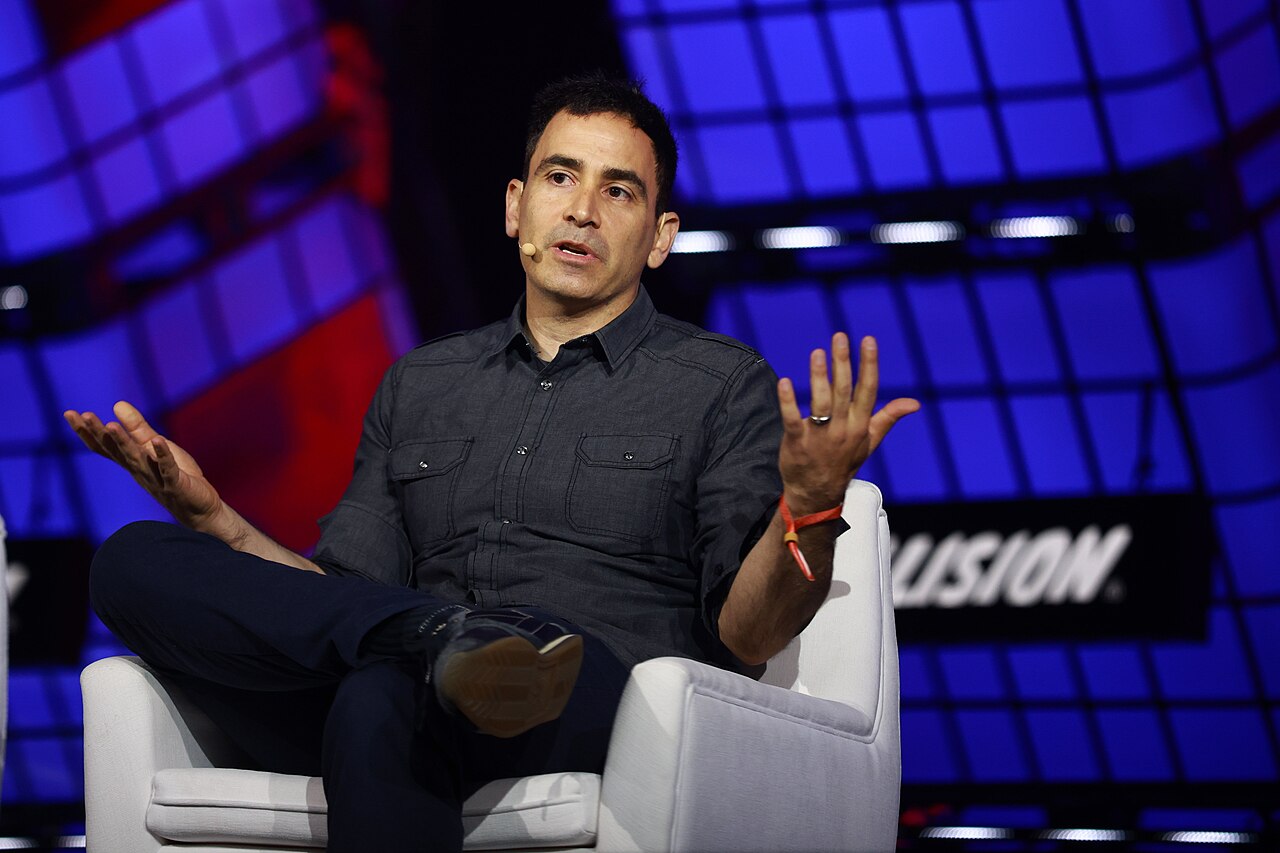
- Hero: "Elad Gil (53005956841)" by Collision Conf, licensed CC BY 2.0, via Wikimedia Commons. Retrieved November 2026 and visually reviewed. It shows investor Elad Gil on stage at Collision 2023 in Toronto; it is a 2023 file photo and does not depict the funding announcement.