On August 14, 2026, several outlets reported that Apple has trained its own China-specific artificial intelligence model, with engineering help from Alibaba, to power Apple Intelligence for iPhone users inside China. The reporting, led by Bloomberg and picked up by MacRumors, Benzinga, and others, framed it as a strategy shift: rather than lean entirely on a local partner's model, Apple has built a model of its own and paired it with Alibaba's Qwen family for the parts that Chinese rules require a licensed domestic provider to handle.
Two claims in that reporting are worth separating, because they point in different directions. The first is a control claim: Apple now owns more of the model layer in its second-largest market than it did a year ago. The second is a dependency claim: the piece of the system that must comply with Chinese content law still runs through a Chinese company. Both are true at once, and the interesting part is how Apple has arranged the pieces so that each holds.
What was actually reported
The core of the reporting is that Apple trained a model tuned specifically for the Chinese market, a first for the company, and that Alibaba assisted in that work. Alibaba's Qwen models are described as integrated into Apple Intelligence across Apple's operating systems for users in China. Apple has also been reported to be working with Baidu on some China features. The rollout is expected in the coming months, tied to a software update, after a regulatory process that reporting says concluded the prior month, when China's Cyberspace Administration registered Apple's generative AI service.
The reason this took so long is regulatory, not technical. Apple Intelligence shipped in most markets during 2024 and 2025 but was held back in mainland China, where generative AI services must be registered with the state and route sensitive functions through approved domestic systems. A foreign phone maker cannot simply switch on a US-hosted assistant for Chinese users. The registration step is the gate, and clearing it is what the August reporting says Apple has now done.

The architecture is the story
Apple Intelligence has always been more than one model. In most markets it combines a small model that runs on the device, a larger one that runs on Apple's own Private Cloud Compute servers, and an optional hand-off to a third-party chatbot, OpenAI's ChatGPT, for open-ended world knowledge that Apple's own models are not built to answer. A user in London or New York touches all three depending on the task.
Inside China, the shape is the same but the suppliers change on the outer layer. OpenAI's service is not available in the country, so the third-party knowledge layer cannot be ChatGPT. That slot, plus the compliance filtering that Chinese law requires, is where a licensed domestic provider has to sit, and that is the role Alibaba's Qwen fills. Apple keeps the on-device experience as its own work, now with a China-specific build, and delegates the externally supplied intelligence to a partner that already holds the necessary registrations.
Same product, a different supply chain inside China
The parts of Apple Intelligence that run on the device stay Apple's work in both markets. The externally supplied layer, the one that answers open-ended questions and must satisfy local content rules, is where the China version diverges.
Most markets
Apple models plus an opt-in partner chatbot
Apple, runs locally
Apple servers
OpenAI ChatGPT (opt-in)
China
Apple device model plus a locally licensed partner
Apple, China-specific build
Alibaba, Qwen family
No OpenAI; local provider
The orange layers mark where a Chinese regulatory requirement, not a technical one, changes who supplies the intelligence.
Read that way, the "first foreign company approved to run a proprietary model in China" framing and the "still dependent on Alibaba" framing stop being contradictory. Apple has increased its ownership of the layers it can control, the ones that live on the phone, while accepting a partner on the layer it cannot control, the one that must answer to Chinese regulators. It is a division of labor drawn along a legal line rather than an engineering one.
Apple increased its ownership of the layers it can control, and accepted a partner on the layer that must answer to Chinese regulators.
On the China split
Why Apple is doing this now
The commercial pressure is not subtle. Apple's position in China has been squeezed by domestic phone makers, and Huawei in particular has marketed on-device AI features as a differentiator. An iPhone that cannot offer the assistant features Apple advertises everywhere else is a harder sell in a market where those features are now table stakes. Getting Apple Intelligence live in China closes a gap that competitors have spent two years widening.
There is also a longer-term logic to owning the model. A China-specific build lets Apple tune behavior, language handling, and the boundaries of what the assistant will and will not do to the specific requirements of that market, without forcing those choices onto its global model. Building the model in-house, even with a partner's help, gives Apple more room to adjust as rules change, which in China they frequently do.
The pattern underneath
Strip away the geopolitics and Apple's arrangement is a clean example of something every company shipping AI across borders now runs into. The "right" model is not a single choice. It is a routing decision that depends on where the user sits, what the law requires, and which providers are even available in that jurisdiction. Apple answers ChatGPT in one region and Qwen in another, on top of its own models, because no single supplier can legally serve every market it operates in.
 Apple
Apple Qwen
Qwen OpenAI
That is the same structural reality that pushes many software teams toward model-agnostic designs, where the application talks to an abstraction and the specific model behind it can change by region, by task, or by cost without rewriting the product. Platforms built on that principle, such as Metir AI, treat the model as a swappable component precisely because the constraints Apple is navigating in China, availability, compliance, and cost, apply in softer forms almost everywhere. Apple has the scale to build its own model and negotiate its own partnerships. The lesson for smaller teams is the architecture, not the budget: assume the model layer will need to change, and design so that it can.
What is still unconfirmed
A few things are worth holding loosely. The details rest on reporting rather than an Apple announcement, and Apple has not published a technical description of the China model or the exact division of work with Alibaba. The precise mechanism of how queries are split between Apple's on-device model and Alibaba's cloud layer, and how content filtering is applied, is not public. The rollout timing is described as "coming months," which is not a fixed date. As with any pre-launch report, the shape is clear even where the specifics are not yet nailed down, and the specifics are what will determine how the feature actually behaves for users.
What is not in doubt is the direction. Apple has moved from waiting on the sidelines of the Chinese AI market to shipping a registered, partly self-built assistant into it. The way it got there, owning the device layer and partnering on the regulated layer, is likely to be the template other foreign technology companies study as they try to do the same thing.
Sources:
- Apple Trained Own AI Model for China Market With Help From Alibaba | MacRumors
- Apple Makes Major AI Strategy Shift in China, Trains Own LLM With Alibaba | Benzinga
- Apple Intelligence in China: Alibaba Backs a Custom AI Model | TechRepublic
- Apple trains China-specific AI model with Alibaba's help | Yahoo Finance
- Apple develops Chinese AI model with Alibaba | Mobile World Live
Image credits
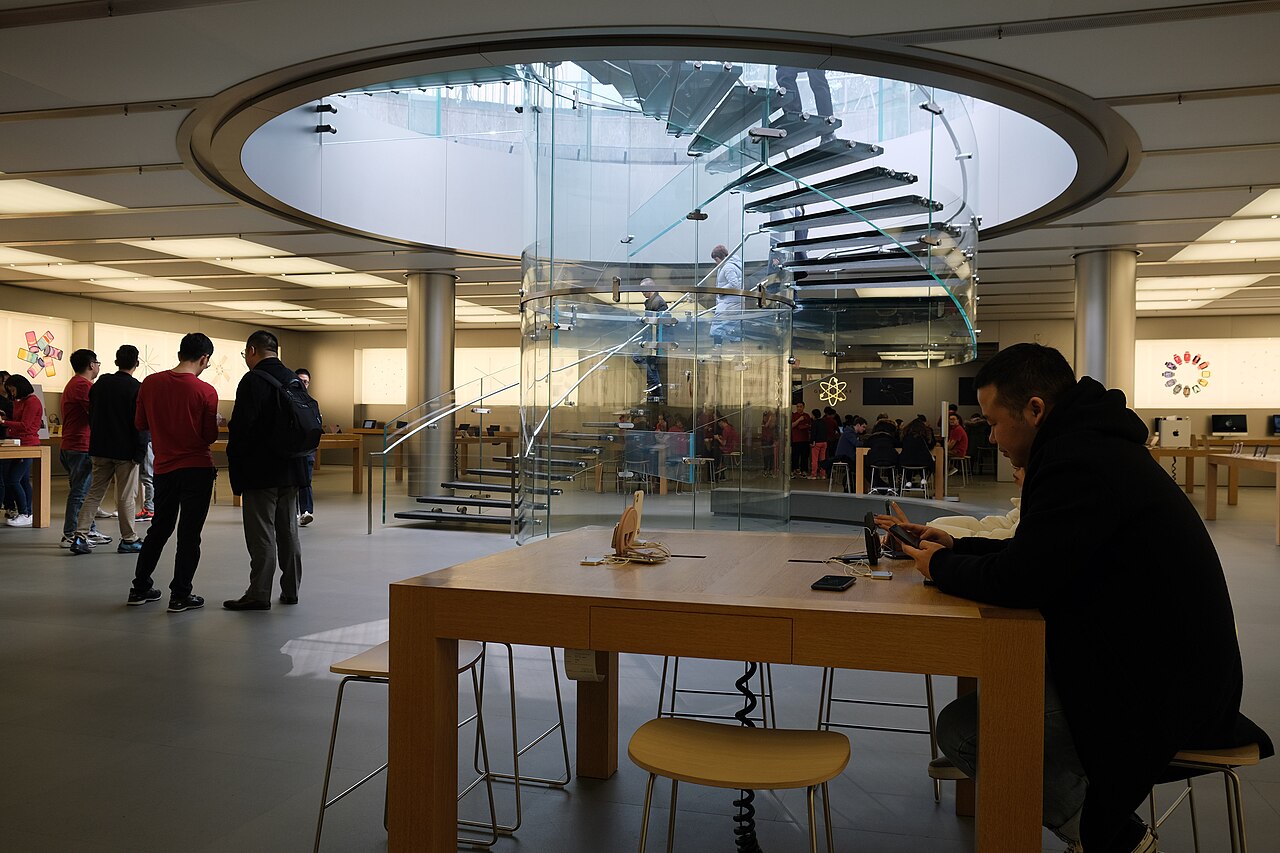
Header image: the interior of the Apple Pudong store in Shanghai, China, with its signature glass spiral staircase. By kallerna via Wikimedia Commons, licensed under CC BY-SA 4.0. In-body image: Alibaba Group headquarters, Hangzhou. By Thomas LOMBARD via Wikimedia Commons, licensed under CC BY-SA 3.0.