On November 2, 2026, Anthropic filed an amended registration statement (an S-1/A) that contains one of the more unusual sentences to appear in an IPO document. In the risk factors, the company says that its internal estimates and its expectations for future models "indicate that we may imminently meet our Responsible Scaling Policy's definition of 'dramatically accelerated progress attributable to AI.'" It adds that it has not designated any current model as exceeding that threshold and continues to assess the underlying data. TechCrunch's report framed this as Anthropic saying it is very close to recursive self-improvement; the filing itself uses more careful language. This post reads the filing text, the Responsible Scaling Policy (RSP) and the comparable frameworks at OpenAI and Google DeepMind side by side. It is separate from our earlier analysis of the S-1's training delay and sandbox incidents, which covers a different part of the risk factors.
 Anthropic
What the filing actually says
Three separate passages matter, and they say different things.
| Passage | What it says | What it does not say |
|---|---|---|
| Risk factor on AI-driven acceleration | Evidence of acceleration comes largely from lagging indicators; Anthropic has "in the past not identified, and may in the future not identify, a significant acceleration" until after it occurred | That acceleration has been confirmed |
| Same risk factor, the threshold sentence | Estimates and expectations about future models, not current ones, suggest the threshold may be met "imminently" | That any released model has crossed it |
| Business section, "closing the loop" | Claude is involved in running experiments, generating and processing training data, automating evaluations and safety audits, and writing and reviewing code; Anthropic does not anticipate being able to safely use Claude to fully autonomously design and build successive generations of frontier models without meaningful human supervision or understanding, and is considering RSP updates to keep humans in control | A specific RSP change or a date for one |
We have not designated any of our current models as exceeding this threshold, and we continue to assess the underlying data.
Anthropic S-1/A, risk factors
Two details are easy to miss. First, the filing ties the threshold to forward-looking expectations about models that are not yet released, so the statement is a forecast about the next generation rather than a description of the present one. Second, the same risk factor says Anthropic is "evaluating the implications of meeting the AI research and development capability threshold" and will publish further reports as the RSP provides, which signals that a formal process follows a determination.
The numbers Anthropic gives for its own loop
The business section supplies the filing's quantitative picture of how much Claude is used to build Claude. These are company-reported figures, based on internal benchmarks and internal data, and they are not independently audited.
What Anthropic says AI leverage looks like inside the company
Multiples versus an early-2025 or late-2024 baseline, as disclosed in the S-1/A. Headcount and code per engineer are stated as lower bounds ("over").
Baselines differ slightly by metric (see the S-1/A). Revenue is the three months to Sep 30, 2026 versus the three months to Dec 31, 2024.
| Disclosed metric | Figure in the S-1/A | Our derived reading (own calculation) |
|---|---|---|
| Success rate on hard, open-ended engineering problems | About 90% in September 2026, up about 50 percentage points in nine months | Implies a starting point near 40% about nine months earlier |
| Code contributed per engineer per day | Over 45 times the 2024 average (three months to Sep 30, 2026) | Lower bound, as stated |
| Share of codebase contributions written by Claude | Over 90% in September 2026 | Fortune reported over 80% in June 2026 from Anthropic's own post, so the share rose within roughly three months, though the two figures may be measured differently |
| Headcount, Dec 31, 2024 to Sep 30, 2026 | Grew over five times | Lower bound |
| Revenue, Q3 2026 vs Q4 2024 | 86 times | Revenue per employee up roughly 17 times at most (86 divided by 5), since headcount growth is a lower bound |
One caution on reading these. Code volume and revenue measure output, not the rate of capability progress, which is what the RSP threshold concerns. A company can write far more code without the pace of frontier model improvement doubling. The figures are context for why Anthropic takes the question seriously, not a measurement of the threshold itself.
What the RSP threshold definition means
The phrase in the filing, "dramatically accelerated progress attributable to AI," points to the Automated R&D capability threshold in the RSP. The version in force is 3.4, effective July 8, 2026. As extracted from the published policy PDF, the threshold is considered met if Anthropic determines that either of two conditions holds.
| Condition | Wording in the policy (paraphrased closely) | Practical test |
|---|---|---|
| (1) Full substitution | Models could fully substitute for the entire set of Research Scientists and Research Engineers at competitive costs, defined as within a factor of 5 | Cost-competitive replacement of a whole research function |
| (2) Dramatic acceleration | "Dramatic acceleration" of AI progress for reasons likely related to automation of AI R&D | See below |
For condition (2), the policy says it would consider this to have occurred where both of the following hold: (a) Anthropic observes or expects double the rate of progress in aggregate AI capabilities, compared both with the rate it would expect and with the fastest rate of extended progress (over at least three model generations) it has observed in the absence of significant AI contributions to AI R&D; and (b) it is plausible that the doubling is substantially attributable to automation of research or engineering, as opposed to other factors.
A footnote defines the doubling: "as much progress in one year as one would see in two years at baseline." Its worked example is a baseline of a 3x compute scaleup and a 3x algorithmic efficiency gain, a 9x effective scaleup, where doubling the rate of progress would mean something like an 81x effective scaleup. In other words, the test concerns the exponent of progress, not a doubling of output. The policy also states this is not the same as doubling researchers' productivity, because doubling inputs does not necessarily double the rate of progress. The RSP's version history also records that an earlier clarification (v3.1, April 2, 2026) addressed how this threshold is operationalized.
Why v3.4 matters for the "imminent" wording
The July 8, 2026 revision changed this threshold. According to the policy's change log, it addressed whether the threshold would count as crossed if overall AI progress were constant or slowing but dramatically faster than it would have been without advanced AI tools. Anthropic says it would not, because there could be a strong argument for expecting the trend to continue rather than accelerate. The change log describes the threshold as "intended to capture the onset of dramatic recursive self-improvement" and says it "has proven difficult to operationalize." Three analytical points follow:
- It is a measurement problem as much as a capability problem. The test needs a counterfactual baseline (the fastest extended progress without significant AI contributions), which cannot be observed directly.
- "Observe or expect" lets a forecast trigger it. That explains how the S-1/A can say "may imminently meet" while no current model is designated past the line.
- The filing admits the detection gap. It says evidence is largely from lagging indicators, and that Anthropic has previously failed to identify acceleration until after it occurred.
What happens once the threshold is crossed
The policy uses the threshold in at least two places. In the capability table, the row lists mitigations such as an "eyes on everything" state for internal AI development (centralized logs of critical AI-development activities, analyzed with AI for security threats and concerning behavior), systematic alignment assessments, and industry-wide recommendations that include security roughly in line with RAND SL4. Separately, a Risk Report covering a model that crosses this threshold is classed as "highly capable," and if such a report is significantly redacted, Anthropic commits to a full external review with at least one external reviewer. The RSP page also records, from an earlier version, a requirement to develop an affirmative case about the most immediate misalignment risks once models cross a related AI R&D threshold.
How OpenAI and Google DeepMind define comparable thresholds
Each lab frames it differently. We checked the primary framework documents: OpenAI's Preparedness Framework Version 2 (last updated April 15, 2025, the version we could verify as current) and Google DeepMind's Frontier Safety Framework Version 3.1 (April 17, 2026).
| Anthropic RSP v3.4 | OpenAI Preparedness v2 | Google DeepMind FSF v3.1 | |
|---|---|---|---|
| Category name | Automated R&D | AI Self-improvement (a Tracked Category) | ML R&D (grouped with misalignment) |
| Lower tier | None separate in the current text | High: impact equivalent to giving every OpenAI researcher a highly performant mid-career research engineer assistant, relative to a 2024 baseline | ML R&D acceleration level 1: used to accelerate AI development, resulting in AI progress "substantially accelerating from historical rates" |
| Upper tier | Condition (1) full substitution within a factor of 5 in cost; or condition (2) doubled rate of progress | Critical: capable of recursively self improving (fully automated AI R&D), via a leading indicator (a superhuman research-scientist agent) or a lagging indicator (a generational model improvement in one fifth of the 2024 wall-clock time, sustained for several months) | ML R&D automation level 1: can fully automate the work of any team of researchers at Google focused on improving AI capabilities, at approximately comparable all-inclusive costs |
| Quantified acceleration | 2x the rate of progress | A 5x speed-up on the lagging indicator (from 1/5th the time) | None stated for acceleration |
| Stated response | Mitigations and external review as above | High: security controls to the High standard. Critical: until safeguards and security controls meeting a Critical standard are specified, halt further development | Recommended security level 3 for acceleration, and level 4 for automation (the latter flagged as needing adoption by the field as a whole) |
Reading the differences
- Different baselines. Anthropic compares to the fastest historical extended progress without AI help. OpenAI's Critical lagging indicator compares to 2024 progress. DeepMind refers to historical rates without a number.
- Different severities per tier. Anthropic's 2x doubling test is numerically smaller than OpenAI's 5x lagging indicator, but the two are not equivalent, because one is a rate of aggregate capability progress and the other is time to a model generation. The closer analogue to Anthropic's single threshold may sit between OpenAI's High and Critical.
- Different responses. OpenAI's Critical tier is the only one of the three that, in the text we checked, ties the tier to halting development until safeguards exist. Anthropic's and DeepMind's texts lean on security levels, monitoring and review, though Anthropic's RSP separately says it may consider pausing even where its commitments are not triggered.
- Information source. DeepMind notes that it may use information about its own progress in accelerating ML R&D, not only evaluations, to judge whether it is near a threshold. That is similar to Anthropic's admission that its evidence comes from lagging indicators.
- Disclosure. We did not find an equivalent public statement from OpenAI or Google DeepMind saying a threshold of this kind may be imminent. Absence of such a statement is not evidence of where those labs stand.
What the S-1/A does and does not change
An IPO filing is a legal disclosure document, which shapes both what is said and how. Risk factors are written to cover a company against later claims that a risk was not disclosed. That is one reason to read the statement as a calibrated disclosure rather than a prediction, and it is also why skeptics noted in TechCrunch's coverage that such a statement can double as positioning. Both readings can be true at once. Our earlier look at Anthropic's published R&D automation index and at the wider recursive self-improvement talent debate covers the research side of the same question.
Anthropic's own June 2026 post on the subject, reported by Fortune, said the threshold had not been crossed yet but could arrive sooner than institutions are prepared for, and proposed that a pause would make sense only if multiple well-resourced labs at or near the frontier, in multiple countries, agree to stop under the same conditions. The S-1/A moves the language from a policy essay to a securities filing, where it carries different legal weight.
Scenarios to consider
| Scenario | What would be observed | Likely consequence |
|---|---|---|
| Threshold formally met | Anthropic designates a model or expected model as crossing it and publishes a Risk Report classing it as highly capable | External review of any significantly redacted report, plus the mitigations in the RSP |
| Threshold not met on next review | Estimates fall short of doubled progress once measured | Language in later filings and reports may soften, with the detection caveat still in place |
| RSP revised first | Anthropic publishes an updated RSP that adds human-in-the-loop commitments for frontier development | New requirements apply before or alongside any determination |
| Ambiguous data | Lagging indicators disagree, as the filing already warns | A determination that rests on judgment rather than a clean measurement |
Indicators to watch
- The RSP text. The filing says Anthropic is considering updates to keep humans in control of frontier model development. Watch for a version after 3.4 and for what changes in the Automated R&D row.
- The next Risk Report. The RSP ties its reporting to this threshold, and a significantly redacted report on a highly capable model triggers external review.
- Release cadence and capability gaps. Whether the interval between frontier model generations shortens relative to the fastest historical extended progress.
- Internal usage metrics. Share of code written by Claude, success on open-ended engineering problems, and the pace of compute multipliers, all of which the S-1 reports.
- Later filings. Whether subsequent amendments and the first periodic reports keep, soften or sharpen the "imminently" sentence, and whether risk-factor language changes alongside any new models.
- Other labs' frameworks. Whether OpenAI or Google DeepMind publish new versions of their frameworks, or system cards that comment on their self-improvement and ML R&D thresholds.
- Independent measurement. The threshold relies on a counterfactual baseline the company estimates itself. External reviewers and third-party evaluations are the check on that.
What this means for AI buyers and builders
For teams that depend on one lab's models, the practical point is continuity: a lab that says its own safeguards may become more frequent and costly, as the same risk factor does, is telling customers that release timing and availability can shift. Keeping workflows portable across providers is a reasonable hedge, and model-agnostic tools such as Metir are built around that idea. Beyond that, the disclosure is mainly information about how one frontier lab measures its own progress, and how that measure compares with its peers.
Sources:
- Anthropic, PBC, Form S-1/A (SEC EDGAR)
- TechCrunch, Anthropic warns that it's very close to RSI capability (November 2, 2026)
- Anthropic, Responsible Scaling Policy page and version history
- Anthropic, Responsible Scaling Policy Version 3.4 (PDF, effective July 8, 2026)
- OpenAI, Preparedness Framework Version 2 (PDF, April 15, 2025)
- Google DeepMind, Frontier Safety Framework Version 3.1 (PDF)
- Google DeepMind, Frontier safety page (version list)
- Fortune, Anthropic on recursive self-improvement and a conditional pause (June 5, 2026)
Image credits
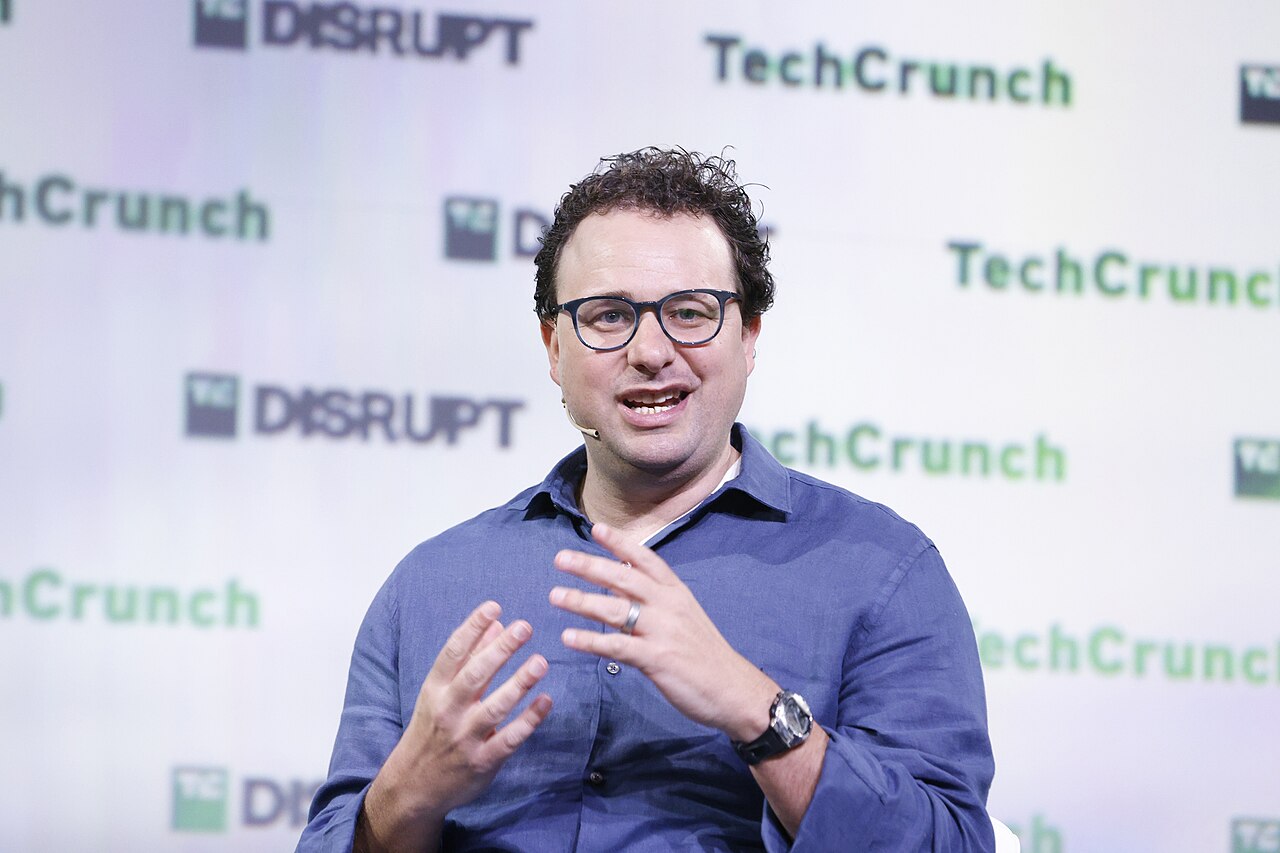
- Dario Amodei at TechCrunch Disrupt 2023, by TechCrunch, licensed CC BY 2.0, via Wikimedia Commons (hero) and Wikimedia Commons (in-body).