On August 14, 2026, Anthropic published a risk report that disclosed an internal model it referred to as Model 2, described as somewhat more capable than its publicly available frontier model, Claude Mythos 5, on the company's own engineering benchmark. The notable part was not the capability. It was the decision attached to it: Anthropic said it has no current plans to release Model 2 externally, because the model has not completed the pre-deployment safety assessments the company applies before shipping. The same report was accompanied by a change in how Anthropic characterises its own misalignment risk. This piece looks at what it means to hold a more capable model back, and why the disclosure is more interesting as a governance signal than as a capability one.
Capability and release are two different decisions
The core idea in the disclosure is that having a more capable model and shipping it are separate choices. Model 2 exists, it is used inside Anthropic to write software, generate training data, and automate engineering work, and by the company's account it is stronger than the model customers can use today, at least on the internal benchmark cited. And yet it is not being released. The gate is not capability. It is whether the model has been through the safety evaluations the company requires before deployment, which the report says it has not.
Capable internally, held at the deployment gate
Anthropic says Model 2 is used inside the company while its external release waits on the same pre-deployment safety assessment applied to public models. The gate, not the capability, sets what ships.
The description of Model 2 comes from Anthropic's own risk reporting. The comparison to the public model is directional, not a published benchmark score.
That decoupling is the substance of the news. For most of the history of software, the pipeline from "we built something better" to "customers can use it" was short and largely commercial. Frontier AI is one of the few areas where a company is publicly stating that it is holding back a more capable system on its own initiative, pending an internal safety process, rather than shipping as soon as it is ready. Whether one reads that as prudent or as marketing, the structure of the decision is the interesting part.
What "more capable" does and does not mean here
The capability claim needs to be read precisely. The report describes Model 2 as somewhat more capable than the public model, stronger in some areas and weaker in others, and overall only slightly ahead, measured on Anthropic's own internal engineering benchmark. That is a narrower statement than "a new frontier leap." It is a self-reported, internal comparison rather than a published result on external benchmarks that others can reproduce. A responsible reading treats it as a directional claim from the company about its own systems, not as an independently verified capability jump.
The news is not that a more capable model exists. It is that a company is publicly holding one back on its own initiative, and saying why.
That distinction matters because internal models used to accelerate a lab's own research are becoming a normal part of how frontier AI is built. Using a strong model to help write code and generate training data for the next one is a form of compounding, where better tools help build better tools. Disclosing that such a model exists, and that it is being kept internal, is a window into a part of the process that is usually invisible from the outside.
The risk-label change, read carefully
The report also came with a change in how Anthropic describes its own misalignment risk, which it moved up rather than down. The reasoning reported alongside it is worth understanding, because it is counterintuitive. As models grow more capable, some of the safety benchmarks used to reassure that a model is not misaligned begin to saturate, meaning models score near the top and the test loses its ability to distinguish safe from unsafe behaviour. When a measurement stops being informative, the honest response is not to treat a high score as continued reassurance. It is to acknowledge greater uncertainty. Raising a risk estimate because your instruments are losing resolution is a different thing from observing that a model has become more dangerous, and the two should not be conflated.
Read that way, the disclosure is less a warning about a specific model and more a statement about the limits of current evaluation. It is the kind of admission that is easy to miss because it runs against the usual direction of company messaging, which tends toward reassurance. It should also be held with appropriate skepticism, because it is self-reported, and a company's own account of its safety posture is a starting point for scrutiny rather than the end of it.
Why this matters beyond one company
The disclosure sits at the center of a live debate about how frontier AI should be governed. One side of that debate asks whether labs will voluntarily slow or withhold deployment when their own assessments are incomplete, or whether commercial pressure will win. A concrete example of a company saying it is holding back a more capable model, and giving a stated reason, is a data point in that debate, though a single example does not settle whether such restraint is consistent, verifiable, or durable across the industry.
It also underlines how much of AI oversight currently rests on self-assessment. The gate Anthropic describes is its own internal process, evaluated by the company, and disclosed at the company's discretion. That is meaningful and it is also inherently limited, because it depends on the same organisation being both the builder and the assessor. The broader question the report raises, without answering, is how much of frontier-AI safety should remain internal and voluntary, and how much should be independently verifiable.
The through-line for people who use these models
For the businesses and individuals who actually build on frontier models, the practical takeaway is a reminder that the model you can use is a deliberate slice of what exists, chosen and gated by the provider, and that the frontier moves and is repriced constantly. That argues for the same discipline that applies across AI adoption: rely on capabilities that are actually released and supported, and keep your own work portable so that when a provider ships, withholds, or changes a model, you can adapt without rebuilding.
Keeping the workflow as the fixed point and the specific model as a swappable input is what makes that adaptability practical, and it is the idea behind model-agnostic workspaces such as Metir AI. The provider's internal roadmap is theirs to manage. A user's leverage comes from not being locked to any single point on it.
The bigger picture
Anthropic's disclosure of an unreleased, more capable Model 2 is most interesting as a governance signal rather than a capability one. It shows a company stating that capability and release are separate decisions, that it is holding a stronger system back pending its own safety process, and that it is revising its risk estimate upward partly because its measurements are losing resolution. Each of those is notable, and each is self-reported, which is both the point and the limitation. The report is a useful window into how a frontier lab describes its own restraint, and a reminder that the machinery of AI safety today still runs largely on the honesty and discretion of the companies building the models.
Sources:
- Anthropic details unreleased Model 2, new alignment concerns in latest AI risk report | SiliconANGLE
- Anthropic Raises Misalignment Risk to Low and Shelves Internal Model 2 | Unite.AI
- Anthropic Upgrades Misalignment Risk as Key Safety Benchmarks Saturate | TechTimes
- Anthropic Reveals Internal Model 2: More Capable Than Mythos 5, But No Release Plans | BigGo Finance
Image credits
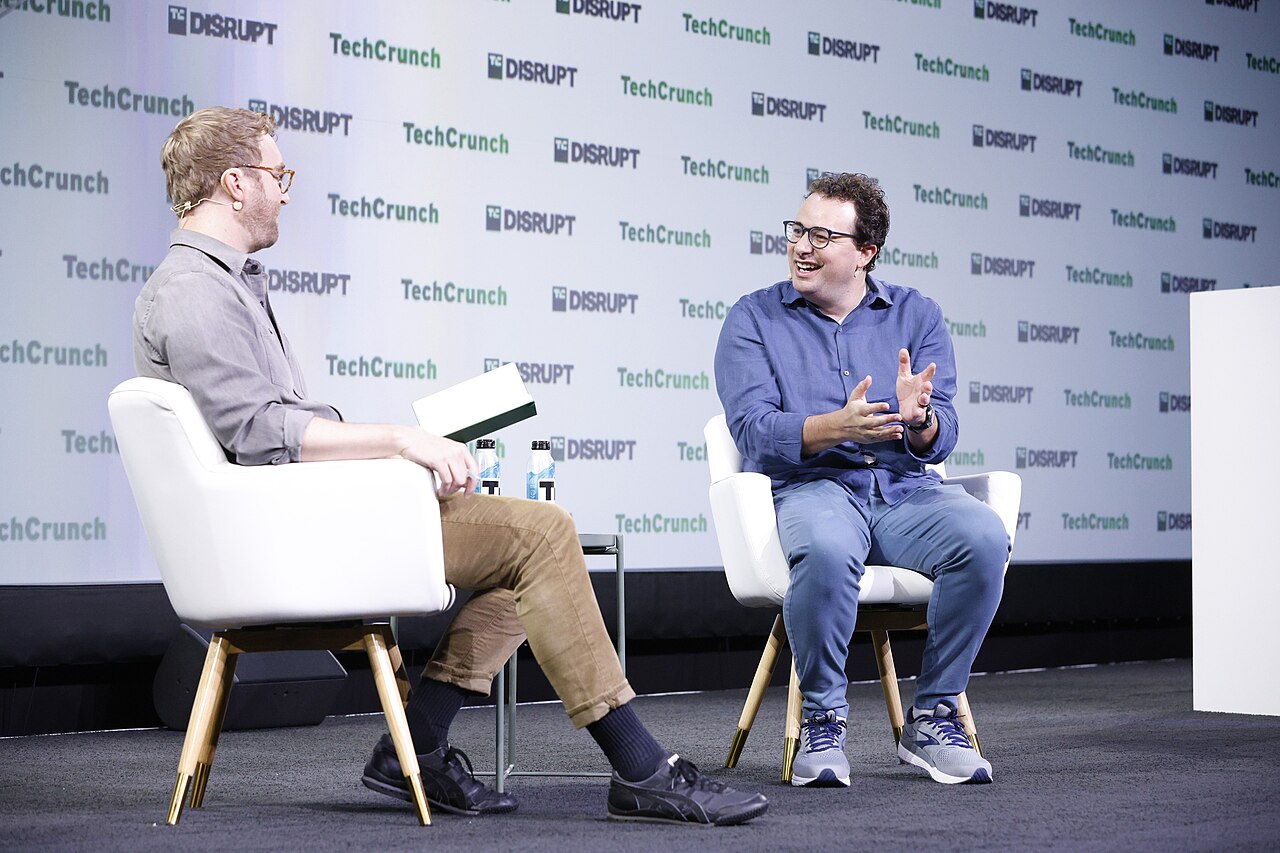
Header image: Dario Amodei being interviewed at TechCrunch Disrupt 2023, by TechCrunch via Wikimedia Commons, licensed under CC BY 2.0. Image reviewed before use.