On September 23, 2026, Anthropic announced that a swarm of Claude agents had surfaced a previously uncharacterized enzyme system hiding in the DNA of bacteriophages, the viruses that infect bacteria. The company named it array-associated reverse transcriptases, or ART, and published the result as a preprint rather than a peer-reviewed paper. That distinction matters more than the headline, and it is the thread worth pulling on before deciding what this announcement actually shows.
 AnthropicClaude
What the swarm actually did
Anthropic gave Claude a single research brief: search a large database of reverse transcriptase sequences for interesting, uncharacterized examples. From there, agents worked with minimal human direction. According to Anthropic's own account, roughly 950 Claude agents ran for about 21 hours and consumed around 210 million tokens. They gathered more than 200,000 reverse transcriptases, scored them down to 3,500 candidate systems, and narrowed those to the 20 most compelling candidates, each written up as a human-readable report. Anthropic says that kind of triage can take an expert scientist weeks to months of manual literature and sequence work.
From 200,000 sequences to one named, unproven system
Each stage is a funnel, not a discovery in itself. Only the last two steps involve a human being, and only a wet lab can turn a computational hypothesis into a validated finding.
Figures from Anthropic's own September 23, 2026 announcement and preprint. The swarm produced a triaged hypothesis; it did not, by itself, produce a validated discovery.
From that shortlist, Anthropic's own scientists picked one pattern that stood out: a reverse transcriptase sitting next to a partner gene and a long, evenly spaced array of DNA repeats. That repeat-array layout is the part that catches a trained eye, because it echoes the structure of a CRISPR array, the bank of stored sequences that makes CRISPR-Cas systems programmable. Human researchers then ran the physical follow-up work themselves, in a lab operating at the lowest biosafety levels and handling no human pathogens. Claude agents do not touch lab equipment; Anthropic CEO Dario Amodei has said that autonomous, agent-run experiments are a future possibility, not something happening today.
Why a new phage enzyme is worth attention at all
The reason this particular kind of finding gets scientists' attention has nothing to do with AI and everything to do with recent biotech history. CRISPR itself was first noticed as an odd, unexplained repeat sequence in bacterial DNA years before anyone understood it was an adaptive immune system, and turning that observation into a gene-editing tool took a long chain of separate discoveries. Retrons and other reverse-transcriptase-linked bacterial defense systems have followed a similar arc: an unusual sequence pattern noticed first, a function worked out later, and in some cases a practical tool built years after that. Bacteriophages are a particularly rich source of this kind of raw material, because the arms race between phages and the bacteria they infect has produced an enormous, largely uncatalogued variety of enzymes for manipulating DNA and RNA.
That context is exactly why "yet another odd repeat sequence next to a reverse transcriptase" is a plausible lead rather than noise. It is also why it is, on its own, nowhere near a gene-editing tool. CRISPR took roughly two decades to go from curious repeat to engineered technology, with dozens of labs doing the intervening work. ART is at the very start of that kind of process, if it turns out to be a real, distinct system at all.
The run: 950 agents, 210 million tokens, one 21-hour pass
Anthropic's reported scale for the search that surfaced ART, ending in 20 candidate reports for a scientist to read. Axis is log-scaled so a count, a token volume and a duration can share one chart; bars are labeled with their real values.
Figures as reported by Anthropic. The 20 reports are the swarm's output; only one candidate went on to wet-lab work and a preprint.
The distinction that matters: surfaced, not discovered
Anthropic's own language is careful on this point, and it is worth repeating rather than smoothing over. The preprint states plainly that the team has not yet shown the enzyme is catalytically active or that it acts on the RNAs it appears to be associated with. Amodei has said the system's precise function, biotechnological utility if any, and level of significance are not yet clear. What the agents produced is a triaged, ranked hypothesis: a sequence pattern flagged as unusual and worth investigating, backed by early evidence that the array is transcribed into distinct short RNAs in the cell. That is a real result. It is not a validated discovery of a new biological function, and it will not become one until independent labs can reproduce the finding and determine what, if anything, ART actually does.
What Claude produced was a ranked hypothesis, backed by early lab evidence. Whether it is a genuine new biological system is a question for the research community, not for the agent that flagged it.
On reading the announcement
The outside reaction reflects that split. Feng Zhang, the MIT and Broad Institute researcher who helped turn CRISPR into a genome-editing tool, called the identification of RNA-repeat arrays next to reverse transcriptases "genuinely intriguing" and said it merits further investigation. Stanley Qi, a bioengineering professor at Stanford, pointed to the speed of the pattern recognition rather than the biology itself, noting that the system found something unusual that had been difficult to detect before. More skeptical voices pushed back on the framing rather than the raw observation: Kevin Blake, a microbiologist at Washington University School of Medicine, noted that CRISPR-like repeat sequences are already known to be common and under-catalogued across the millions of bacterial species science has barely sampled, and said there is nothing yet to indicate ART rivals CRISPR as a technology or has any therapeutic use. Amodei himself has acknowledged that academic researchers, including a group at Stanford, had previously described a system with some similarities, which tempers any claim that this is entirely unprecedented territory.
What it signals about AI-for-science workflows
Strip away the specific biology and the more durable story is methodological. What a 950-agent swarm did in 21 hours was not "understand biology." It was parallel hypothesis generation and triage over a search space large enough that no single scientist, or even a modest team, would work through it by hand in any reasonable timeframe: pull a broad candidate pool, score it against a pattern of interest, narrow it in stages, and hand a short, well-organized shortlist to a human expert for the judgment calls that still require one. That is a genuinely useful division of labor, and it is a shape of work that agentic AI is well suited to regardless of the field it gets pointed at.
It is also a pattern that is quickly becoming a mainstream way to work with AI at all, not something unique to a single lab's research arm. Long-horizon, multi-agent workflows, where many agents run in parallel against a large search space and a human reviews the output, are showing up across research, coding and analysis alike. Platforms like Metir that let people orchestrate agent swarms across different models, rather than being locked into one provider's tooling, are part of why that pattern is becoming accessible well beyond the labs that build the underlying models.
Anthropic has explicitly invited outside scientists to propose research questions the same approach could be pointed at, which is a reasonable next step if the method itself, independent of this specific result, turns out to generalize. Whether it does is an empirical question that will be answered by how many follow-up results hold up, not by how the first one was announced.
The honest summary
A swarm of Claude agents searched an enormous space of enzyme sequences faster than any human team plausibly could, and surfaced a pattern that a leading CRISPR researcher finds genuinely interesting. That is worth taking seriously as a demonstration of what agentic search can do inside a well-scoped scientific search space. It is not, yet, a new gene-editing tool, a validated biological discovery, or proof that the underlying function is real. The preprint says as much. The gap between those two readings is exactly the gap between a computer flagging something odd and a research community confirming what it is, and closing that gap is still going to take the slow, human, wet-lab work it has always taken.
Sources:
- Claude discovers a novel enzyme system | Anthropic
- Anthropic says its biology lab has already found something big | TechCrunch
- Anthropic Says Claude Discovered a New Enzyme System Resembling CRISPR | Unite.AI
- AI model Claude discovers CRISPR-like enzyme system, Anthropic says | Al Jazeera
- Anthropic Says Claude Found Something Big in DNA. It Just Doesn't Know What | Decrypt
- Yoon et al., Array-Associated Reverse Transcriptases (preprint), Anthropic, 2026
Image credits
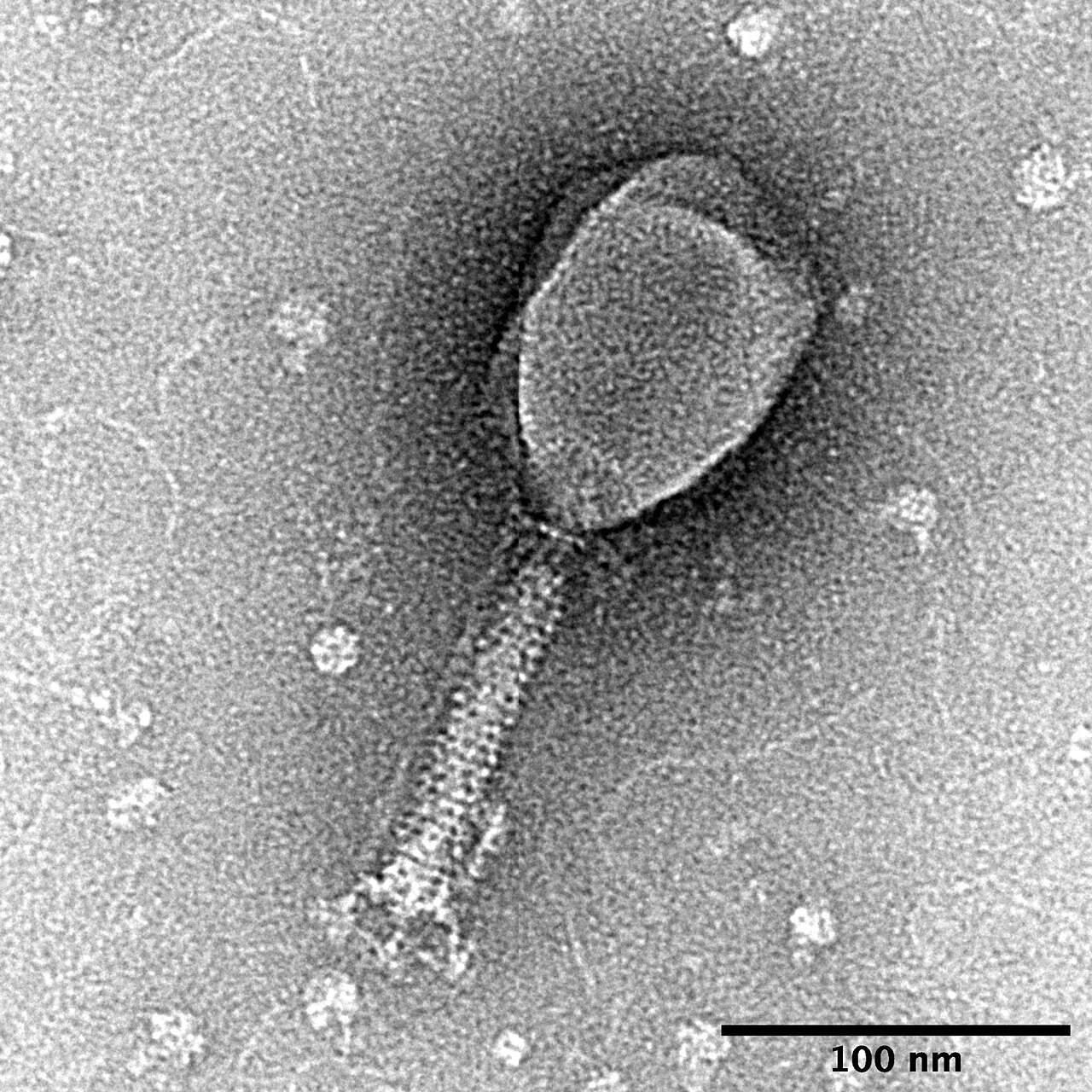
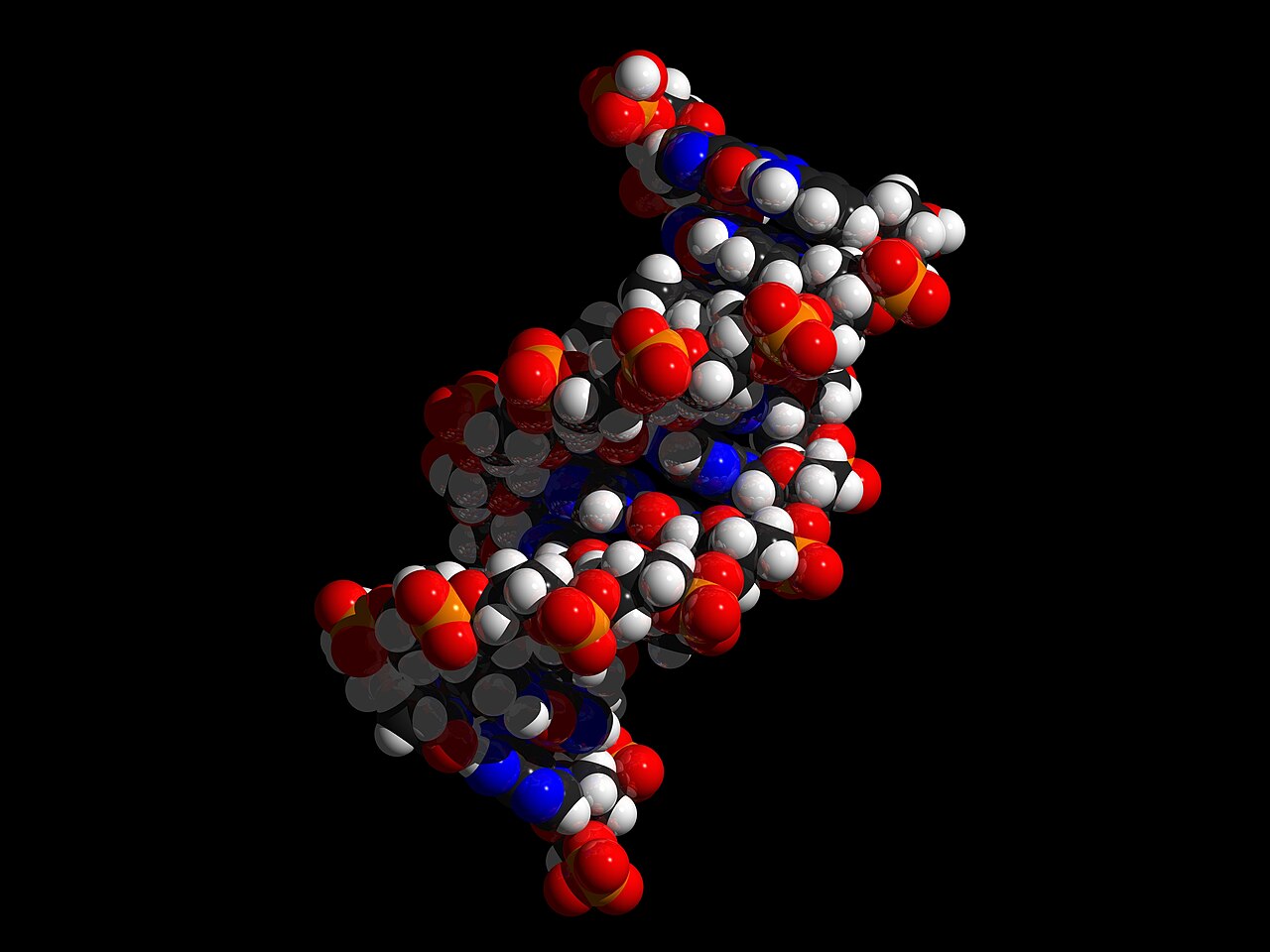
Hero image: a transmission electron micrograph of an Enterobacteria phage T2 particle, showing the icosahedral head and contractile tail typical of many bacteriophages, by SnaxMikn, via Wikimedia Commons, licensed under CC BY-SA 4.0. It is a generic illustration of bacteriophage structure, not a phage from Anthropic's own study. In-body image: a space-filling (CPK) rendered model of a DNA double helix segment by Ude, via Wikimedia Commons, released into the public domain. It illustrates DNA structure generally; no structure of the ART system has been published.