On September 16, 2026, the Queensland government announced that Anthropic will anchor its first Australian data center, taking capacity at a A$31.9 billion campus being built near Dalby, about 250 kilometres west of Brisbane. The facility will run Claude's day-to-day inference, the work of answering user queries, rather than training new models, and it will make Australia a serving location for one of the world's largest AI systems for the first time. The announcement is small in the context of Anthropic's global compute spending and large in the context of Australian infrastructure, and both of those things are worth understanding.
This piece lays out the specifics of the deal, explains why the inference-not-training detail matters, and places it inside the pattern of how frontier labs are now buying capacity.
The specifics
The site is Zerra DC's Western Downs Digital Park, near Kogan, roughly 37 kilometres north-west of Dalby in regional Queensland. Zerra DC is the data-centre arm of the Singapore-based investor AGP Sustainable Real Assets, and the full campus is designed as four single-storey data halls of 360 megawatts each, for a total IT capacity of 1.44 gigawatts and a total facility power demand of 2.16 GVA at full build. The state government compares that draw to roughly 1.5 million average households, which would make it the largest data centre in the country.
Anthropic is not buying the whole thing. It has committed to the first of the four halls, 360 megawatts, with the right to expand across the campus as demand grows, and it is targeting operational use in 2027. The rest of the site is staged across roughly four years of construction. The arrangement is a lease of capacity in a facility someone else owns and builds, not a data centre Anthropic is constructing itself.
 Anthropic
One of four halls, with room to grow
The Western Downs Digital Park is designed as four 360 MW data halls. Anthropic has committed to the first and holds the right to expand across the campus.
Anthropic's initial commitment is 360 MW, one quarter of the planned capacity. Construction is staged across roughly four years.
Two approvals still stand between the announcement and operation. The development application was lodged with the Western Downs Regional Council on August 17, 2026, and is subject to impact assessment with public notification, and the lease itself requires clearance from Australia's Foreign Investment Review Board. Premier David Crisafulli framed the project as "a major win" that positions Queensland "at the forefront of locking in data sovereignty," language that signals how governments now think about hosting AI compute.
Why "inference, not training" is the important phrase
The single most informative detail in the announcement is that the hall is for inference. That word choice determines almost everything about why the compute is going to Australia at all.
Why an inference site is different from a training site
Anthropic says the Queensland hall will run inference, not training. The distinction shapes where the compute makes sense to put.
- •A one-off, compute-heavy job that produces a finished model
- •Can sit anywhere with enough cheap power; users never touch it directly
- •Tends to concentrate in a few very large clusters
- •Runs continuously, every time a user sends a prompt
- •Benefits from being near the users it serves, for latency and data residency
- •Scales with usage, so it spreads out to more regions over time
Placing inference in-region is a signal of where a lab expects sustained demand, and of regulators wanting the compute that serves their citizens on home soil.
Training a model is a one-off, enormously compute-heavy job that produces a finished set of weights. It can happen almost anywhere with enough cheap power and cooling, because no end user ever interacts with it directly, and it tends to concentrate in a handful of very large clusters. Inference is the opposite: it runs every time someone sends Claude a prompt, it never stops, and it benefits from being physically close to the people it serves, both for lower latency and, increasingly, because governments and enterprises want the compute handling their citizens' or customers' data to sit inside their own borders.
Placing inference in-region is a signal of where a lab expects sustained demand, and of regulators wanting the compute that serves their citizens on home soil.
Metir AI analysis
So an inference build in Queensland is really a statement about demand and about policy. It says Anthropic expects enough sustained Claude usage in the Asia-Pacific region to justify dedicated local capacity, and it aligns with a growing preference among governments for data sovereignty, keeping the serving infrastructure, and the data that flows through it, onshore. A training facility would have carried neither signal.
Part of a much larger buildout
The Australian hall is one node in an unusually fast run of Anthropic compute commitments. Across mid-2026 the company disclosed a series of large capacity deals with neocloud and infrastructure partners, including multi-billion-dollar arrangements for sites in the United States and Europe, and formed an infrastructure joint venture with Macquarie Asset Management and GIC to develop AI data centers. The common thread is that Anthropic is overwhelmingly leasing capacity from specialist operators rather than building and owning facilities itself.
The logic behind leasing is consistent across all of these deals. Permitting, grid interconnection and construction for a gigawatt-scale campus take years regardless of who holds the deed, and a frontier lab is not in the business of developing real estate or negotiating utility agreements. Leasing converts a capital-intensive, multi-year construction project into a purchased service, while the developer, here Zerra DC and its parent AGP, absorbs the site-development risk. The trade-off is dependence on a counterparty's construction schedule and on regulatory approvals the lab does not control, which is precisely why the FIRB clearance and the council assessment are not footnotes.
For Australia, the project raises the same questions every large AI data centre now raises about power. A facility drawing the equivalent of 1.5 million households needs firm generation and transmission to match, and the timing of that supply against a four-year construction schedule is the practical constraint that will determine whether the 2027 target holds. Regional Queensland gains construction activity and a marquee tenant; the grid gains a very large new load.
The takeaway
What is verifiable is straightforward: Anthropic has committed to the first 360-megawatt hall of a four-hall, 1.44-gigawatt, A$31.9 billion campus near Dalby, to run Claude inference from 2027, subject to foreign-investment and planning approvals. It makes Australia a serving region for Claude and gives Queensland a data-sovereignty talking point, and it fits a 2026 pattern in which Anthropic leases capacity from specialist developers around the world rather than building its own.
The broader lesson for anyone relying on these systems is that where a model runs is becoming a first-class consideration, not an invisible backend detail. Latency, data residency and regional availability increasingly shape which model is actually usable for a given team in a given country. Keeping the model layer flexible, the model-agnostic approach platforms like Metir AI take by running Claude, GPT, Gemini and Grok side by side, is one way to treat that shifting infrastructure map as a routing decision rather than a lock-in. The compute is moving closer to users; the sensible response is to stay able to use whichever provider has moved closest.
Sources:
- AI giant Anthropic signs agreement for $32b Queensland data centre | ABC News
- Anthropic Joins $32 Billion Western Downs Digital Park West of Brisbane | Brisbane Development
- Anthropic signs deal for Australia data centre, govt says | Dawn
- Anthropic to invest in Australia's $22B data center project | TNGlobal
- Anthropic to lease multi-billion dollar data centre hub in Queensland | Time News
- Australia MOU | Anthropic
Image credits
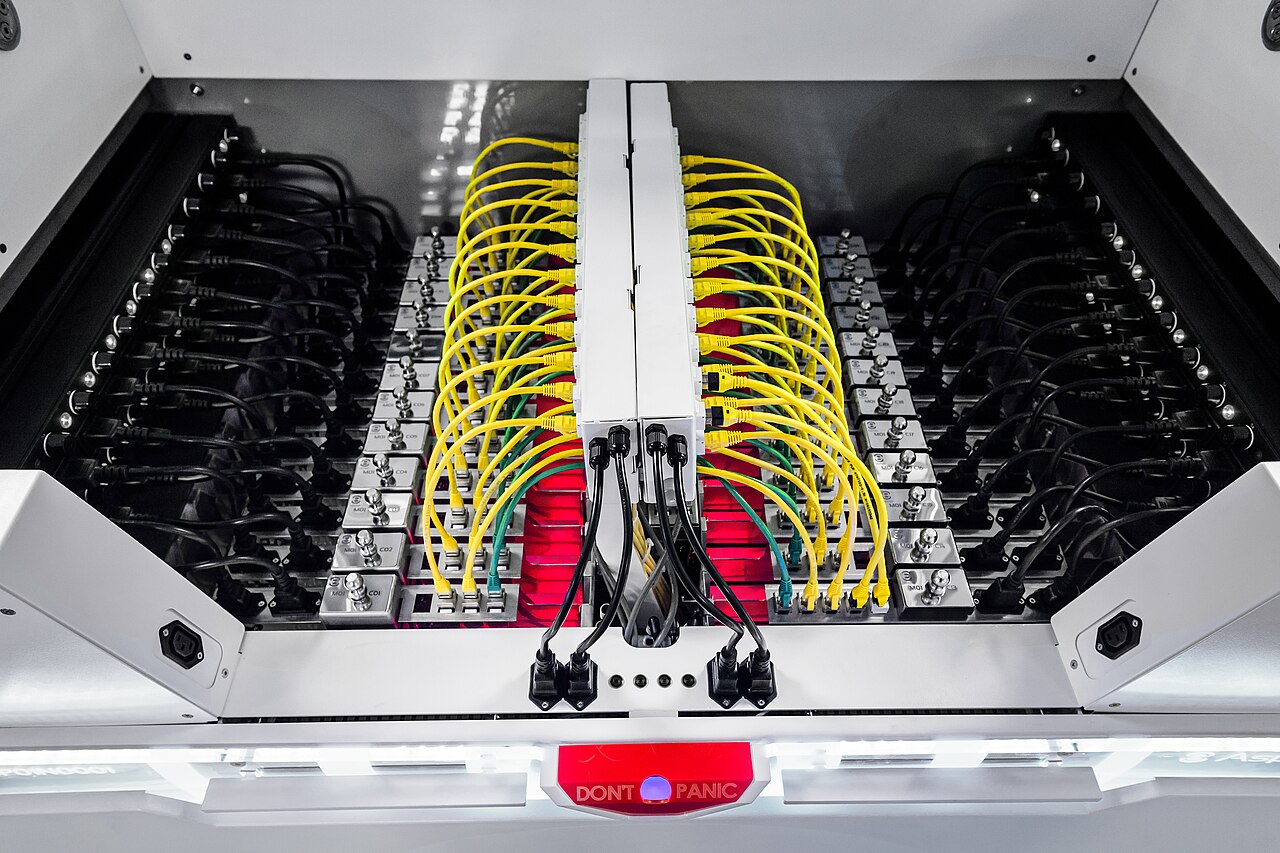
Header image: an immersion-cooling system in a data centre (Asperitas AIC24), via Wikimedia Commons, licensed under CC BY-SA 4.0. It illustrates the kind of dense compute-and-cooling hardware AI data centres use and is not the Queensland site, which is not yet built. In-body photograph of the Brisbane skyline at night from Kangaroo Point, via Wikimedia Commons, released under CC0. Brisbane is the nearest capital to the Western Downs site and is shown for regional context, not as the data centre location.