AMD's Advancing AI 2026 conference opened on July 22 at Moscone Center in San Francisco, and by the time the show floor closed for the day, AMD had already landed a new AI lab as a customer, before its CEO had even given the keynote. Dr. Lisa Su's headline address is scheduled for the morning of July 23, but day one alone brought the commercial debut of AMD's Zen 6 "Venice" EPYC server CPUs and a fresh strategic partnership with Anthropic. This piece separates what AMD has actually confirmed at Advancing AI 2026 from what is still expected at Thursday's keynote, and works through the memory, software and supply constraints that will determine whether the Instinct MI450 series and the Helios rack genuinely dent Nvidia's lead in AI accelerators.
 AMD
AMD NVIDIA
 OpenAI
 Meta
Meta Microsoft
 Anthropic
What's confirmed on day one, and what's still to come
Two things are true at once about this event. First, AMD used July 22 to commercially debut 6th Gen EPYC "Venice" processors, the first high-performance x86 server CPU built on TSMC's 2nm (N2P) process node, according to Tom's Hardware and TechPowerUp's coverage of the launch. Venice ships with up to 256 cores, roughly 1.7 times the performance of the prior Turin generation, and 1.6 TB/s of per-socket memory bandwidth, more than double Turin's 614 GB/s. Second, AMD and Anthropic announced a strategic partnership the same day: Anthropic will deploy up to 2 gigawatts of AMD Instinct MI450-series GPUs on Helios racks, with the first 1 gigawatt beginning in the first half of 2027, and AMD committing to a strategic equity investment of up to $5 billion in Anthropic, per the companies' joint announcement.
What has not happened yet, as of this writing, is Lisa Su's keynote, scheduled for July 23 at 9:30 a.m. Pacific. That address is where AMD is expected to go deeper on Helios deployment timelines, ROCm software roadmap detail, and a first public look at the MI500-series roadmap for 2027. Readers should treat any of that as forward-looking until it is actually said on stage; everything else in this piece is drawn from AMD's own press releases and product pages, or from named customers' joint announcements.
Inside the Instinct MI400 family and CDNA 5
The Instinct MI400 series is AMD's first generation built on the CDNA 5 architecture, and it comes in three variants aimed at different jobs. The MI455X is the top-end part: 40 PFLOPS of FP4 compute and 20 PFLOPS of FP8, built from twelve compute and I/O chiplets on a mix of 2nm and 3nm process nodes, with 432 GB of HBM4 memory per GPU at up to 19.6 TB/s of bandwidth, according to AMD's product materials and TensorWave's accelerator specifications. The MI450X is positioned as the volume part for large-scale training and inference deployments, sharing the same 432 GB HBM4 capacity at a lower power envelope. The MI430X targets HPC and sovereign AI workloads specifically, adding hardware FP64 support and hybrid CPU-plus-GPU configurations for customers who need general-purpose supercomputing alongside AI, per Tom's Hardware's coverage of the lineup from CES 2026.
AMD's memory capacity claim over Rubin
HBM memory capacity per GPU. AMD's new Instinct MI455X reports 432 GB of HBM4, a 50% jump over its own outgoing MI350X and more than Nvidia's competing Rubin GPU at 288 GB. Nvidia reports higher per-GPU bandwidth (up to 22 TB/s versus AMD's 19.6 TB/s), so capacity and bandwidth lead in different directions.
Figures as announced/reported as of July 2026. Vendor-reported specifications, not independently benchmarked.
The capacity jump matters because it is where AMD can make a genuine, on-paper case against Nvidia's competing Rubin GPU. Rubin is reported at up to 288 GB of HBM4 per GPU, meaning AMD's 432 GB gives it a real memory-capacity lead per chip, useful for holding larger models or longer context in memory without spilling across GPUs. Nvidia, in turn, reports higher raw bandwidth per GPU on Rubin (up to 22 TB/s versus AMD's 19.6 TB/s). Both sets of numbers are vendor-published specifications rather than independently benchmarked results, and the more it takes to say "who has the better chip" for a specific workload usually comes down to how a whole rack, not a single die, performs together.
Zen 6 Venice and the Helios rack
That whole-rack framing is exactly what AMD's Helios system is built around. A Helios rack packs 72 liquid-cooled MI455X GPUs alongside Venice EPYC CPUs as head nodes and AMD's Pensando "Vulcano" DPUs for networking, which support up to 800 Gbps per GPU, connected over UALink and Ultra Ethernet Consortium-aligned fabric rather than routing GPU-to-GPU traffic through the CPU, according to Oracle's own description of its planned deployment. Seventy-two GPUs at 432 GB of HBM4 each works out to roughly 31 TB of pooled memory in a single rack, a figure AMD and press coverage of the event's opening day both cite.
On the software side, AMD's ROCm stack has continued shipping updates on its own schedule independent of the event: ROCm 7.14, released earlier in July 2026, debuted "TheRock," AMD's new automated open-source build and release system, alongside expanded framework and inference-library support, per AMD's ROCm blog. That is the piece of this story that is hardest to reduce to a spec sheet, and the one most likely to determine how much of AMD's hardware advantage actually reaches customers as usable performance.
A fast-forming customer list
The more concrete evidence of momentum is the list of named commitments AMD has stacked up in the ten months since October 2025, each disclosed in a joint press release rather than an AMD-only claim:
- OpenAI (October 6, 2025): a multi-year deal to deploy 6 gigawatts of AMD GPUs across multiple Instinct generations, starting with a first 1-gigawatt MI450 deployment in the second half of 2026. AMD granted OpenAI warrants for up to 160 million AMD shares tied to deployment milestones, in a deal AMD has said carries potential cumulative revenue near $90 billion.
- Oracle (October 14, 2025): Oracle Cloud Infrastructure will deploy 50,000 Instinct MI450 GPUs on Helios racks starting in Q3 2026, becoming, per Oracle's announcement, the first hyperscaler to offer a publicly available MI450-based AI supercluster.
- Meta (February 24, 2026): an expanded, multi-year partnership to deploy up to 6 gigawatts of a custom MI450-based AMD GPU alongside Venice EPYC CPUs, in a deal AMD describes as worth more than $100 billion, again with performance-based share warrants for Meta.
- Microsoft (July 20, 2026): Azure will deploy AMD Helios racks for AI inference workloads and add two new Venice-powered VM series (Azure HDv2 and HXv2), with shipments beginning in the second half of 2026.
- Anthropic (July 22, 2026): up to 2 gigawatts of MI450-series GPUs on Helios, plus a joint engineering effort using Claude to help optimize ROCm and AMD's own chip workflows, alongside AMD's equity investment in Anthropic.
By partnering with AMD across the stack, we are securing the capacity we need and optimizing it for training and serving Claude.
Tom Brown, Anthropic Co-founder and Chief Compute Officer, July 22, 2026
Adding OpenAI, Meta and Anthropic's disclosed gigawatt figures alone comes to 14 gigawatts of committed future AMD GPU capacity, before Oracle's and Microsoft's deployments are even converted into power terms. That is a real, if front-loaded, order book. It is also, by design, mostly still ahead of AMD rather than behind it: the first OpenAI and Meta gigawatts begin shipping only in the second half of 2026, and Anthropic's first gigawatt not until 2027.
The competitive math against Nvidia
Context matters here. Nvidia's Data Center segment alone reported $75.2 billion in revenue for its fiscal quarter ended April 26, 2026, up 92% year-over-year, according to Nvidia's own earnings release. AMD's entire Data Center segment, which includes EPYC server CPUs as well as Instinct GPUs, was $5.8 billion in the same period, up 57% year-over-year.
AMD's Data Center segment, quarter by quarter
AMD's Data Center segment revenue (EPYC CPUs plus Instinct GPUs combined) in billions of dollars. The segment reaccelerated through the back half of 2025 as MI350 shipments ramped, ahead of the MI450 series and Helios racks this piece covers.
Data Center segment includes EPYC server CPUs and Instinct GPUs combined; AMD does not disclose Instinct-only revenue every quarter.
Analyst estimates of Nvidia's share of the AI accelerator market for 2026 generally cluster in the mid-70s to low-80s percent range, down from a peak near 87% in 2024, with AMD's Instinct line estimated at a low-single-digit to roughly 10 percent share depending on the source and methodology; AMD does not break out Instinct-only revenue, so any such figure is an external estimate rather than a disclosed number. Morgan Stanley has separately estimated Nvidia will consume roughly 595,000 CoWoS advanced-packaging wafers from TSMC in 2026 alone, a reminder that packaging capacity, not just design wins, still gates how fast either company can actually ship.
AMD's own longer-range framing, laid out at its November 2025 Financial Analyst Day, is that the AI data center total addressable market could exceed $1 trillion by 2030 (doubling AMD's own prior $500 billion estimate) and that its AI data center revenue could reach "tens of billions" of dollars by 2027, growing at roughly 80% a year, according to CNBC's coverage of that event. Nvidia's own CEO Jensen Huang has told investors the company already has close to $1 trillion of AI infrastructure demand it can see through 2027, at GTC 2026. Both figures are guidance from the seller, not independently audited backlogs, and should be read as confidence signals rather than guaranteed numbers.
What AMD still has to prove
The specs and the customer list are real, but three things stand between them and a genuinely different competitive balance. The first is software maturity: ROCm has closed real ground on CUDA's tooling and library ecosystem over the past two years, but Nvidia's decade-plus head start in developer familiarity and third-party framework support is not erased by one release cycle, which is why AMD's own emphasis on ROCm updates, and its new engineering tie-up with Anthropic specifically to speed that work using Claude, matters as much as the chip specs. The second is execution on rack-scale systems: Helios is AMD's first attempt at shipping a fully integrated GPU-CPU-networking rack to compete with Nvidia's NVL72-class systems, and Nvidia has multiple hyperscaler-validated generations of that playbook behind it already. The third is supply: HBM4 output and advanced packaging capacity are shared, finite resources across the whole industry, and Nvidia's larger existing TSMC CoWoS allocation is a structural head start that AMD's memory-capacity advantage on paper does not by itself overcome.
Power is the constraint that sits underneath all of it. Every one of the gigawatt-scale deals above is, in the end, a bet that enough electricity, land and grid capacity will exist on the timeline each customer needs, a limit that applies identically regardless of whose logo is on the rack.
Why the chip fight is good news beyond either vendor
None of this changes what actually matters to the teams building on top of this hardware, which is that a genuine second source for frontier-scale AI compute is a good thing for the market regardless of who ends up ahead. A rack full of Instinct MI450 GPUs, like a rack full of Nvidia GPUs, is agnostic about which model runs on it; the value shows up one layer up the stack, in the tools people actually use. That is the same principle Metir AI applies at the application layer: it gives teams model-agnostic and hardware-agnostic access to leading AI systems in one workspace, so the benefits of AMD and Nvidia genuinely competing on price, memory and performance show up as better, cheaper AI tools rather than as lock-in to any one chipmaker's roadmap.
The takeaway
AMD's Advancing AI 2026 event delivered concrete, dated commitments before its own keynote even started: a production 2nm server CPU, a customer list spanning OpenAI, Meta, Oracle, Microsoft and now Anthropic, and a memory-capacity spec on the Instinct MI455X that genuinely outpaces Nvidia's competing Rubin GPU on paper. What remains unproven is whether Helios racks execute at hyperscaler scale as smoothly as Nvidia's NVL-class systems already do, whether ROCm closes the remaining software gap with CUDA fast enough to matter, and whether AMD can secure the HBM4 and advanced-packaging supply to fill 14-plus gigawatts of announced demand on the timelines its customers expect. The honest read heading into Thursday's keynote is that AMD has built a credible second option in AI compute, not yet a replacement for Nvidia's position at the top of the market.
Sources:
- AMD Advancing AI 2026 | San Francisco, July 22-23
- What to Expect at AMD Advancing AI 2026 | AMD
- AMD Advancing AI 2026 Opens With Zen 6 Venice, Helios, and Open AI Rack Bet | Tech Times
- AMD EPYC Venice boasts 256 cores and bandwidth galore | Tom's Hardware
- AMD Confirms EPYC "Venice" Zen 6 CPUs Launch on July 22-23 at Advancing AI Event | TechPowerUp
- AMD and Anthropic Announce Strategic Partnership to Deploy Up to 2 Gigawatts of AMD Instinct MI450 Series GPUs | GlobeNewswire
- AMD Instinct MI455X | TensorWave
- AMD touts Instinct MI430X, MI440X, and MI455X AI accelerators and Helios rack-scale AI architecture at CES | Tom's Hardware
- NVIDIA Vera Rubin NVL72: Full Specs & Platform Breakdown | Hashrate Index
- Oracle and AMD Expand Partnership to Help Customers Achieve Next-Generation AI Scale | Oracle
- AMD and Oracle partner to deploy 50,000 MI450 Instinct GPUs in new AI superclusters | Tom's Hardware
- ROCm 7.14: TheRock Goes Production and Expands AMD's AI Software Platform | AMD ROCm Blogs
- AMD and OpenAI Announce Strategic Partnership to Deploy 6 Gigawatts of AMD GPUs | OpenAI
- AMD and OpenAI Announce Strategic Partnership to Deploy 6 Gigawatts of AMD GPUs | AMD
- AMD and Meta Announce Expanded Strategic Partnership to Deploy 6 Gigawatts of AMD GPUs | AMD
- Meta strikes AI chip deal with AMD days after committing to deploy millions of Nvidia GPUs | CNBC
- Microsoft to Deploy Next-Gen AMD Instinct and AMD EPYC Processors as the Companies Expand Their Long-Term Strategic Partnership | AMD
- AMD Reports First Quarter 2026 Financial Results | AMD
- AMD Reports Third Quarter 2025 Financial Results | AMD
- AMD Reports Fourth Quarter and Full Year 2025 Financial Results | AMD
- NVIDIA Announces Financial Results for First Quarter Fiscal 2027 | NVIDIA Newsroom
- Jensen Huang expects Nvidia to sell $1 trillion of AI hardware through 2027 | Tom's Hardware
- AMD's Lisa Su sees 35% annual sales growth driven by 'insatiable' AI demand | CNBC
- AMD CEO dismisses AI spending concerns, projects $1 trillion data center market by 2030 | American Bazaar
- NVIDIA AI GPU Market Share 2026: ~80% of AI Accelerators | Silicon Analysts
Image credits
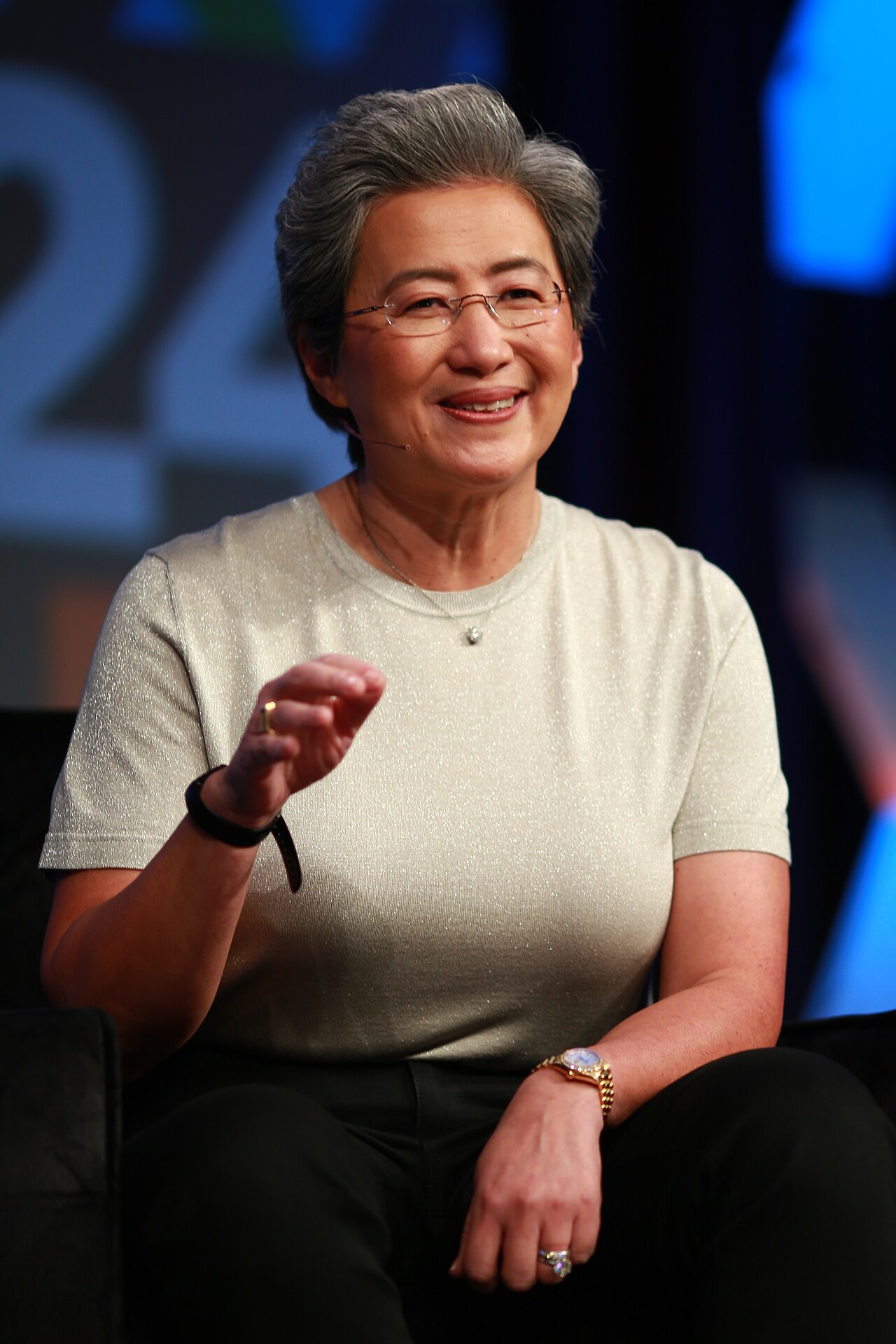
Header image: Dr. Lisa Su, Chair and CEO of AMD, speaking on stage at South by Southwest (SXSW), Austin, Texas, March 11, 2024, via Wikimedia Commons, photographed by Fuzheado (Andrew Lih) as part of WikiPortraits at SXSW 2024, licensed under CC BY 4.0. In-body photograph: AMD's former corporate headquarters building at 2485 Augustine Drive, Santa Clara, California, photographed June 21, 2020 by Coolcaesar via Wikimedia Commons, licensed under CC BY-SA 4.0. No public photograph of the Instinct MI450 series, Helios rack, or the July 2026 Advancing AI keynote exists yet at time of publication, so both images depict the company and its leadership rather than the unreleased hardware.