Internal Amazon documents made public in a Canadian court case describe an in-house AI forecasting tool called Atlas that appears to estimate how likely warehouse staff are to unionise or take other collective action, openDemocracy reported on October 16, 2026. Amazon disputes the characterisation and says Atlas is not currently used in the UK. This article sets out what the reporting says, where the claims are unverified, and what the episode shows about workplace AI governance.
What the documents reportedly describe
According to openDemocracy (reporter Evie Breese), the documents suggest Atlas predicts how likely workers in the US, Canada and the UK are to unionise, stage a sit-in or carry out other "disruptive labour events." They say Atlas draws on "hundreds of data points," including Reddit posts, responses to internal feedback surveys, general site information and past industrial action.
Each warehouse receives a risk score from 100 to 900. A lower score means higher perceived union risk, and the documents say higher scores are "better" for leadership. Warehouses appear to fall into five tiers, from Tier 5 (no immediate perceived risk) to Tier 1 (activity imminent). The documents suggest the tiers could guide staffing, resource planning and actions to mitigate risks to Amazon's labour structure.
How the documents describe Atlas working
As reported from leaked training material for Canadian managers. Amazon says Atlas works at building level only and is not currently used in the UK.
Sixteen warehouses across the US, Canada and the UK are listed as Tier 1. Two are in the UK: EMA4, a £500 million robotic-fulfilment centre in Sutton Coldfield, and BHX4, near Coventry.
The material appears to be training resources for Amazon managers in Canada. It was disclosed in a legal challenge by the Canadian union Unifor and shared with the US outlet Truthout.
What Amazon says
Per openDemocracy, Amazon states that:
- Atlas operates at site or building level only, and it does not track individual employees' opinions, affiliations, union membership or personal data.
- Atlas helps identify where staff need support and is not used to monitor dissent.
- Atlas is not currently used in the UK. Amazon did not respond on whether a similar system exists under another name.
- Employees can choose whether to join a union, and it calls the GMB union's characterisation "wrong."
Reactions and legal questions
Rachel Fagan, a GMB organiser, said the documents show the sites are monitored for union activity and that this is more personal than general surveillance. Michael Newman of law firm Leigh Day said the documents contradict Amazon's earlier statements and that the firm plans to ask what data is used and how scores are reached. Rosa Curling of Foxglove called the surveillance highly intrusive and said Foxglove is reviewing whether to add the documents to an existing legal claim. A UK government spokesperson said monitoring technologies should be transparent, fair and accountable, and that it expects employers to respect lawful union activity.
Amazon says Atlas works at building level and does not track individuals; its critics say site-level scoring built on staff posts and survey answers is still personal. The documents do not settle which reading is right.
Analysis: where the dispute actually sits
The disagreement is less about whether a score exists than about three narrower questions that the reporting leaves open.
- Aggregation versus individuals. Amazon's position is that outputs are site-level. Critics point to inputs such as Reddit posts and survey responses. Aggregated scores can still be built from individual-level data, so the factual question is what the inputs are and how they are processed, which the documents only partly answer.
- Purpose. The documents "suggest" tiers could guide staffing and mitigation of risks to labour structure. Amazon says the purpose is identifying where staff need support. Both can describe the same score; the difference is what managers do with it.
- Jurisdiction. The source material is Canadian training content. The article itself notes it does not independently verify how Atlas works or whether it is used in the UK. Different regimes apply: for context, France's data regulator CNIL fined Amazon €32 million in 2022 under GDPR for excessive worker tracking, and the British Columbia Labour Board has ruled that Amazon violated several local labour laws.
The UK background is part of the context. Coventry workers staged the first formal UK strike against Amazon in January 2023, and in July 2024 GMB lost a recognition ballot there by 28 votes. GMB and Foxglove allege "dirty tricks," including mass hiring and QR codes that let workers cancel union membership, and Foxglove and Leigh Day are challenging the QR codes in court. These are allegations in ongoing proceedings, not findings.
Why it matters for AI governance
Atlas is a useful case study for any employer deploying predictive models on workforce data. Three design questions recur: what data is allowed as input, whether scores are explainable to those scored, and whether outputs can be used in decisions about people. The reporting shows the issue arriving through a court disclosure rather than a regulator's rulebook, which is why the documents' accuracy and context matter.
For organisations choosing AI tools, a practical safeguard is keeping workforce analytics separate from general-purpose assistants and keeping the ability to switch providers, which model-agnostic platforms such as Metir AI are built around.
Sources:
- Amazon's AI monitor of union activity in UK warehouses (openDemocracy, Oct 16, 2026)
- AI News for October 18, 2026 (AI Weekly)
Image credits
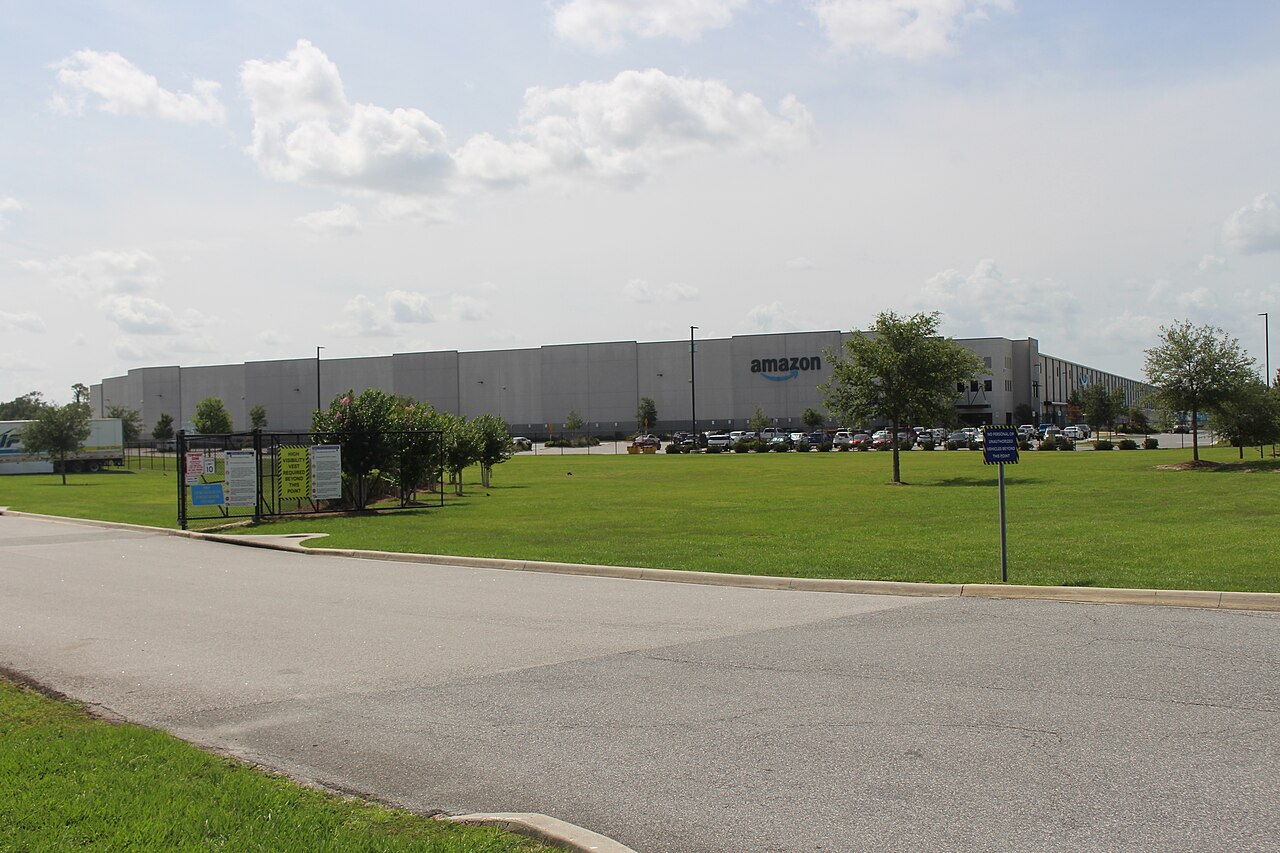
- Hero and figure: Amazon Fulfillment Center, Ocala, Florida. Generic illustration, not a site named in the reporting. Wikimedia Commons, CC0.