At its annual Apsara Conference in Hangzhou on September 22, 2026, Alibaba chief executive Eddie Wu unveiled the Zhenwu V900, a new AI accelerator designed by the company's in-house chip unit T-Head, alongside a plan to expand Alibaba Cloud's global data center capacity to more than 20 gigawatts by 2032 and a Qwen model roadmap targeting 5 to 10 trillion parameters. Alibaba's Hong Kong-listed shares closed roughly 2% higher on the day, having traded up as much as 5% intraday, and its US-listed shares gained more than 3% in premarket trading. Taken together, the announcements are one company's attempt to answer the single question hanging over Chinese AI: whether the country can keep scaling models without reliable access to Nvidia's most advanced chips.
 Alibaba
 NVIDIA
 Qwen
Qwen AMD
AMDWhat the chip actually is
The Zhenwu V900 is a training and inference accelerator, and Alibaba's headline claim is that it delivers three times the performance of the Zhenwu M890, the predecessor it launched only in May 2026. Alibaba described the V900 as carrying 216 gigabytes of memory and 1,200 gigabytes per second of inter-chip bandwidth, and said it offers more on-package memory than Nvidia's H200. Memory capacity and interconnect bandwidth are the specifications that matter most for large-model training, because the bottleneck in training a frontier model is usually moving data between chips rather than raw arithmetic throughput. The company said the chip is built to support clusters of up to 500,000 accelerators working together, and that mass production and commercial release are scheduled for the first quarter of 2027.
A few caveats belong next to those numbers. They are vendor-stated figures from a launch presentation, not independent benchmarks, and a comparison to the H200 is a comparison to a chip Nvidia has itself succeeded with newer parts. Peak specifications also translate into real training performance only through software, and Nvidia's CUDA ecosystem remains the deepest moat in the industry. What the V900 represents is less a claim to have caught Nvidia than a claim to have built something good enough, and domestic enough, to keep training at scale when the alternative may be no advanced imported silicon at all.
Why this is happening now
The context is US export policy. Successive rounds of American export controls have restricted Nvidia's ability to sell its most capable accelerators into China, and the rules have moved repeatedly, leaving Chinese firms unable to plan multi-year buildouts around imported chips. That uncertainty is itself the problem: a data center is a decade-long capital commitment, and you cannot make it on a supply line that a foreign government can restrict at will. Building domestic silicon, even if it trails the frontier, converts an unpredictable dependency into a controllable one.
The V900 represents less a claim to have caught Nvidia than a claim to have built something domestic enough to keep training at scale.
On Alibaba's chip strategy under US export controls
Alibaba is not alone in this. Huawei, Baidu, Cambricon and others have all pushed domestic accelerators, and the Chinese state has openly encouraged buyers to favor local chips. What makes Alibaba's move notable is that it pairs the silicon with both the cloud capacity to deploy it at scale and the models to run on it, a vertically integrated stack from wafer to Qwen. Few companies anywhere can attempt all three layers at once.
The 10-trillion-parameter roadmap
Alongside the chip, Alibaba laid out where its models are heading. Its current flagship, Qwen 3.8-Max, has roughly 2.4 trillion parameters. The company said its next-generation Qwen models, with Qwen 4 already in training and Qwen 4.5 and Qwen 5 in the pipeline, are targeted at a scale of 5 to 10 trillion parameters. That is a two-to-fourfold increase over today's flagship.
A two-to-fourfold jump in model scale
Parameter counts for Alibaba's current flagship Qwen model and its stated target for the next generation, in trillions of parameters.
The lighter bar shows the top of the stated 5T to 10T target range. Parameter count is one input to capability, not a direct measure of it.
It is worth being careful about what a parameter count does and does not tell you. More parameters generally increase a model's capacity to store and combine patterns, but the relationship to real-world capability is neither linear nor guaranteed. The last two years of frontier research have been at least as much about data quality, training techniques, reasoning methods and inference-time compute as about raw size, and several labs have shown that smaller, better-trained models can match much larger ones. A 10-trillion-parameter model is a statement of ambition and of available compute, and it is also expensive to train and to serve. The roadmap is best read as a signal that Alibaba intends to keep spending at the frontier, backed by chips it controls, rather than as a promise of a specific capability jump.
The capacity number is the real commitment
The specification that may matter most is not on the chip at all. Alibaba's target of more than 20 gigawatts of data center capacity by 2032 is an enormous physical and financial commitment. For scale, 20 gigawatts is roughly the output of twenty large power plants, and it is the kind of figure that until recently only the largest US hyperscalers discussed. Delivering it requires land, power, cooling, construction and, crucially, a steady supply of accelerators to fill the racks, which is exactly why the in-house chip and the capacity plan are two halves of one strategy. Chips Alibaba designs itself are chips it can be reasonably confident of obtaining in the volumes a 20-gigawatt buildout demands.
What to watch next
Three things will show whether the announcement translates into reality. First, independent performance data: vendor benchmarks at a launch are a starting point, not a verdict, and the V900's real standing will only be clear once customers train models on it. Second, manufacturing: a Q1 2027 mass-production target depends on foundry capacity and yields for advanced domestic process nodes, an area where China still faces constraints. Third, software: an accelerator is only as useful as the framework support around it, and closing the gap with CUDA is a years-long effort. The stock market's positive reaction reflects the strategic logic of the plan more than proof that it will be delivered on schedule.
The takeaway
Alibaba's Apsara announcements are a coherent bet that the way through export controls is vertical integration: design the chip, build the capacity, and scale the models on top. Whether the Zhenwu V900 closes the gap with Nvidia in practice is unproven, and the 10-trillion-parameter roadmap is an ambition rather than a shipped result. What is clear is that a serious, well-capitalized attempt to build a full domestic AI stack is now underway, and that a more multipolar hardware landscape is emerging beneath the model layer. For everyone building on top, that reinforces a practical point: the specific chip and the specific model powering an application are increasingly interchangeable and geopolitically contingent, which is why the ability to run workloads across whichever models and infrastructure are available, rather than being tied to one provider's supply chain, is becoming a feature rather than a nicety. That model-agnostic posture is the principle Metir AI is built around at the application layer.
Sources:
- Alibaba shares jump as new AI chip, data center buildout plans unveiled | CNBC
- Alibaba unveils Zhenwu V900 AI chip, plans 10 trillion parameter model | Quartz
- Alibaba Unveils Zhenwu V900 and Plans Qwen Models With Up to 10 Trillion Parameters | TechRepublic
- Alibaba unveils Zhenwu V900 AI accelerator, claims it's 'the most powerful AI chip in China' | Tom's Hardware
- Alibaba announced a new AI chip and a large-scale expansion of data centers | dev.ua
- How Alibaba Shares Jumped Following AI Chip Announcement | Data Centre Magazine
Image credits
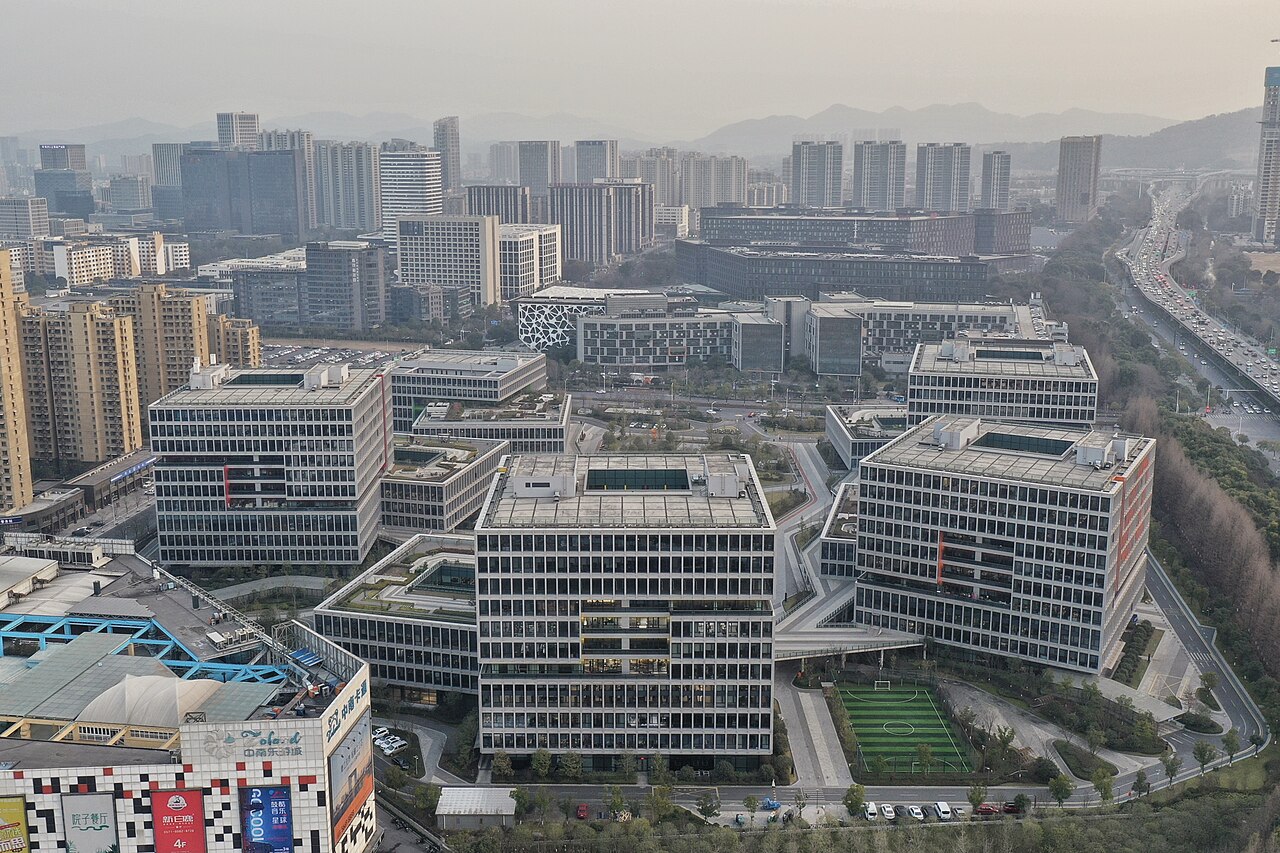
- Hero and in-body figure: "Alibaba Center in Binjiang Hangzhou 2021" by Wikimedia Commons contributor, licensed under CC BY-SA 4.0. Source: Wikimedia Commons. Reviewed before publication; aerial photograph of Alibaba's Hangzhou campus, the city where the Apsara Conference was held. Used to depict the company rather than the chip, as noted in the caption.